AI System 'Apple Intelligence' Unveiled
Similar to Competitors' Features... Late Application Timing
MS, Google, Samsung Electronics Expected to Strengthen Leadership
‘Artificial Intelligence (AI) Latecomer’ Apple made a belated move by unveiling its new AI system, ‘Apple Intelligence.’ As an icon of innovation, it attracted public expectations, but the prevailing assessment is that it "lacked a breakthrough." Analysts believe it will be difficult to overturn the market since the features have already been introduced by competitors such as Microsoft (MS), Google, and Samsung Electronics.
On the 10th (local time), Apple held its annual Worldwide Developers Conference (WWDC) 2024 at its headquarters in Cupertino, California, USA, introducing new AI features including Apple Intelligence.
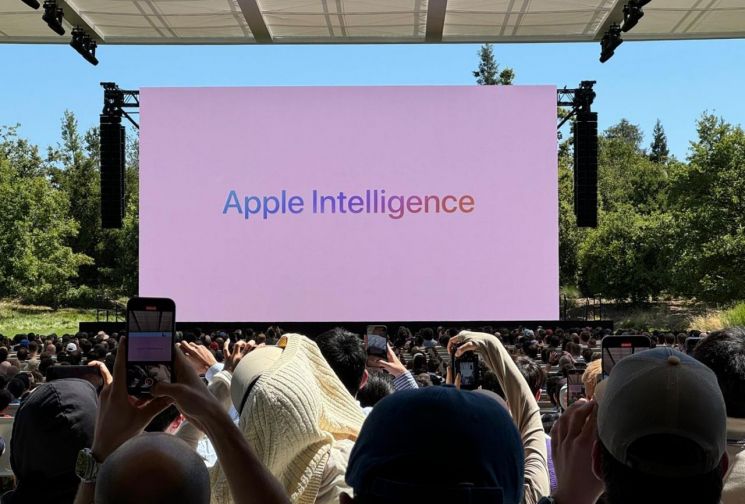
Apple Intelligence is an in-house AI system implemented across Apple devices such as the iPhone, iPad, and Mac. Users can delegate tasks like schedule management, email sorting and composition, text analysis, and data processing to the AI. The AI can view some photos and generate original images or create illustrations and animations on its own.
Although the event drew attention, most evaluations say it failed to demonstrate innovation. Even considering that most features were leaked to the media the day before the event, there were no unprecedented new functions. The generative AI assisting work on PCs was already introduced early on by MS and Google through ‘Copilot’ and ‘Gemini,’ respectively. The AI applied to smartphones is not significantly different from Samsung Electronics’ or Google’s technology.
Despite partnering with OpenAI, the assessment is that Apple’s technological capability is inferior. Analysts suggest that Apple concluded it would be difficult to catch up in speed with its own model. At this WWDC, Apple announced a partnership with OpenAI. Starting in the second half of this year, OpenAI’s latest model, ‘GPT-4o,’ will be integrated into Apple’s voice assistant, Siri. iPhone users will be able to use ChatGPT features for free from the end of the year, with some functions available next year.
Apple stated it will introduce other AI models in the future, drawing a line by saying OpenAI is just one of several partners. Nevertheless, OpenAI CEO Sam Altman showed his presence by sitting in the front row at the WWDC venue and watching the announcement broadcast. The fact that the closed Apple partnered with OpenAI itself is seen as evidence of limitations in its independent technology.
The timing of technology application is also later than competitors. Apple announced it will release a beta version of Apple Intelligence in English in the U.S. this fall. Support for other countries and languages will begin next year. This is about a year later than MS or Google. Considering OpenAI’s rapid technological pace, unveiling video generation model ‘Sora’ and new AI model ‘GPT-4o’ at intervals of a few months, the gap is significant.
Conscious of these limitations, Apple emphasized personalized services and security as its strengths. It claims to provide customized services based on personal information while minimizing concerns about data leakage. For example, if you ask Siri, "Tell me my younger sibling’s flight arrival time," it will provide the exact time based on flight information in emails. If you instruct it to add a schedule to pick up at the airport, it will add it to your personal calendar. The explanation is that AI can only be useful if it understands the user’s ‘Personal Context.’
To alleviate security concerns arising from the use of personal information, Apple introduced ‘private cloud computing.’ It plans to build data centers equipped with Apple’s AI semiconductors and process customer data only there. Apple CEO Tim Cook emphasized, "We access this information in a completely private and secure manner to help users focus on what matters most," calling it "AI only Apple can provide."
This has led to criticism that Apple still remains within a closed ecosystem strategy. Apple first secures personal information through devices connected from iPhone to iPad to Mac. Providing personalized AI as a killer service based on this can strongly ‘lock in’ users to the devices. Offering AI services based on 2.2 billion active Apple devices worldwide can generate more revenue. Rather than taking the lead as a ‘first mover’ in technology, Apple has chosen to solidify the existing ecosystem as a ‘fast follower.’
Reflecting market disappointment, Apple’s stock price on the New York Stock Exchange closed down 1.91% compared to the day before WWDC. Meanwhile, MS rose 0.95%, and Google (Alphabet) increased 0.43%. An IT industry insider said, "Most of the announcements were predictable and felt typically Apple-like in integrating AI features," adding, "It was out of step with the recent trend of daily updates."
© The Asia Business Daily(www.asiae.co.kr). All rights reserved.

















