Regulations on Number of Parking Spaces per Household Revised in 1996
Approximately 80,000 Parking-Related Complaints Received in the Last 4 Years
A truck driver who parked in the alley within an apartment complex expressed a sharp reaction, complaining about the criticism directed at him and claiming it was unfair. On the 7th, a post titled "The Worst Parking Incident in an Apartment Complex" was uploaded on an online community called 'BobaeDream.' The author, Mr. A, pointed out that a blue truck is always parked in front of the daycare center door within an apartment complex located in Uijeongbu, Gyeonggi Province. Mr. A noted that the truck owner, Mr. B, parks his vehicle in front of the daycare center inside the complex, and when apartment residents raised concerns, Mr. B wrote a lengthy warning note on the truck’s windshield.
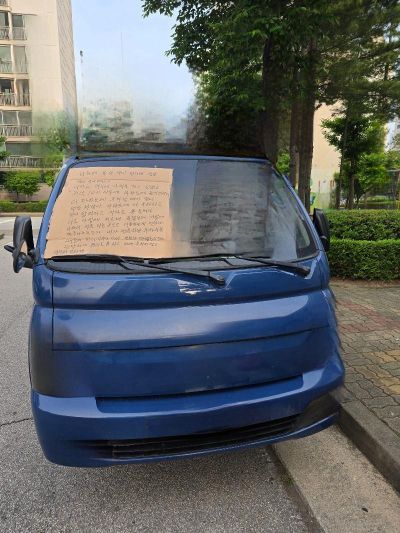 A story has been shared about a truck driver who parked in the middle of an apartment complex and reacted sharply, expressing frustration over the criticism directed at him. On the 7th, a post titled "The Worst Parking Incident in an Apartment Complex" was uploaded on an online community called 'BobaeDream'.
 [Photo source=Online community 'BobaeDream']
In the photo, a long message is written on the edge of a cardboard box placed on the right front windshield of the blue truck. Mr. B wrote, "If I catch anyone cursing at me, I will really tear them apart," and "Do you think I want to park here? Come into the apartment after 10 p.m. and see if there’s ever a time to park here." He continued, "All visitor vehicles are parked in the apartment, so the truck can’t enter the underground parking. Do you know how much I argued with the management office because of visitor parking?" and "I’m exhausted in the morning, but do you know how annoying it is to come out and move my truck somewhere else?" Lastly, he wrote, "Don’t curse at me boldly with a letter stuck on the car; call me instead," leaving his phone number.
Mr. A criticized, "He parks strangely every day, and when the security guards enforce regulations, he threatens to tear people apart," adding, "He parks oddly every day in front of the daycare center door; just park properly and talk." He also warned, "Don’t park there. It’s dangerous because children go to school there every day." In response to Mr. A’s story, some netizens expressed understanding toward Mr. B. While some said Mr. B was wrong, others sympathized with his feelings.
Netizens commented, "If external vehicles enter an apartment with insufficient parking spaces, that’s what should be blamed. We also need to understand how frustrated and unfair the truck owner felt to write such a message," "Fighting over parking is a daily occurrence. Self-employed people or those who get off work late can’t live like this," and "Looking at the photo, the truck is parallel parked on the sidewalk with the side mirrors folded, so he doesn’t seem to be inconsiderate."
Ministry of Land, Infrastructure and Transport Considering Changing Apartment Parking Standards for the First Time in 28 Years
While many netizens sympathize with truck owner Mr. B’s message, an assault incident occurred among residents in an apartment in Gangnam-gu, Seoul, in June last year. They raised their voices over parking issues in the underground parking lot and even exchanged punches. The incident happened after a complaint was filed about the inconvenience of parking in a narrow space only 2.3 meters wide.
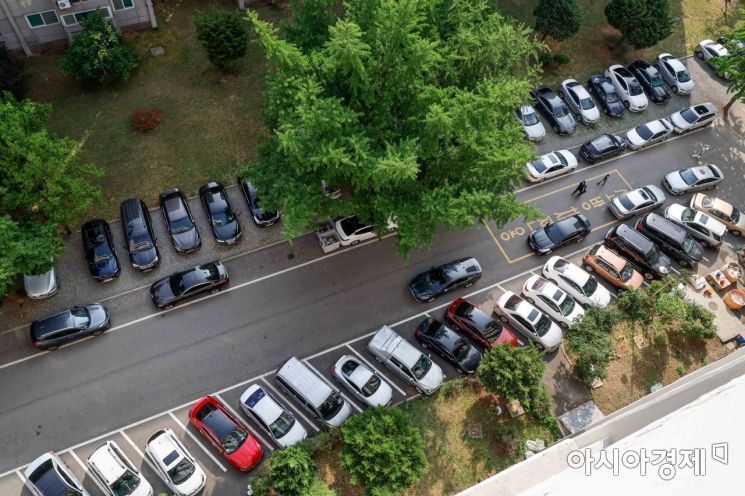 The current regulations regarding the number of parking spaces per household in apartments and other residential buildings were revised in 1996. According to the current law, if there is a residential complex, the number of parking spaces must be calculated as a ratio based on the total exclusive residential area, and parking lots exceeding that number must be installed. The number of parking spaces per household must be at least one, and for households with an exclusive residential area of 60㎡ or less, meeting 0.7 spaces also satisfies the legal standard.
 [Photo by Jinhyung Kang aymsdream@]
The current regulations on the number of parking spaces per household in apartments and other housing were revised in 1996. According to the current law, if there is a housing complex, the number of parking spaces must be calculated based on the total exclusive residential area, and parking lots exceeding that ratio must be installed. The number of parking spaces per household must be at least one, and for households with an exclusive residential area of 60㎡ or less, 0.7 spaces still meet the legal standard. However, since the standards were established 28 years ago, there have been continuous criticisms that they do not reflect reality. Especially with the popularization of passenger cars and the increase of dual-income couples, there have been many calls to revise the outdated law of "one household, one vehicle" to reflect the common "one household, two vehicles" situation.
For these reasons, conflicts over apartment parking have become a social issue. According to the Anti-Corruption and Civil Rights Commission, over the past four years, more than 76,000 complaints related to parking conflicts on private property such as apartments have been filed through the national complaint portal. A report from the apartment living support platform 'Apartmenti' also showed that parking issues were the most frequently raised complaints by residents over the past year. Among residents who filed complaints, 29.1% raised concerns about double parking, parking in passageways, and other parking dissatisfaction. In a new town apartment in Gyeonggi Province, conflicts arose among residents when a parking fee of 200,000 KRW was imposed on households with more than two registered vehicles. Additionally, non-residents sometimes park there, making it impossible for residents to find parking. In response, the government is considering changing the parking space standards for the first time in 28 years to solve the chronic apartment parking shortage.
However, there are concerns that increasing the parking space standards could lead to higher sale prices. Recently, new apartment complexes have no above-ground parking lots and only underground parking, so raising the parking space standards could increase construction costs accordingly. The Ministry of Land, Infrastructure and Transport plans to study related issues such as forecasting future parking demand and analyzing the increase or decrease in construction costs if parking standards are improved.
© The Asia Business Daily(www.asiae.co.kr). All rights reserved.


















