Bank of Korea Announces 'April Balance of Payments (Preliminary)'
Current Account Turns Deficit After One Year Due to Increased Dividend Payments in April
Exports Remain Strong, Led by Semiconductors
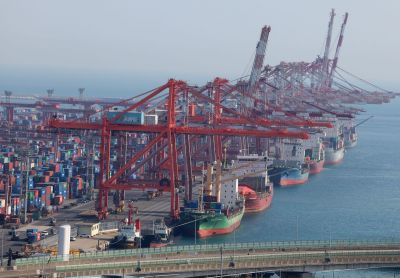
The current account balance turned to a deficit in April for the first time in a year due to large-scale dividend payments to foreigners.
According to the "April Balance of Payments (provisional)" released by the Bank of Korea on the 11th, the current account balance in April recorded a deficit of $290 million. The current account had posted a surplus for 11 consecutive months since May last year but shifted to a deficit after one year. However, the deficit was smaller compared to the $1.37 billion deficit recorded in April last year.
The April current account deficit was due to a significant increase in dividend payments to foreigners by companies following the government's value-up policy, which also expanded the deficit in the dividend income account. The dividend income account recorded a deficit of $3.58 billion in April, larger than the $1.2 billion deficit in the same period last year.
Exports continued to show strong performance. April exports increased for the seventh consecutive month to $58.17 billion, driven by growth in IT items such as semiconductors and non-IT items such as petroleum products. Based on customs clearance, semiconductors rose 54.5% year-on-year, petroleum products 18.7%, information and communication devices 16.7%, passenger cars 11.4%, machinery and precision instruments (7.9%), and chemical products (1.9%) also increased. In contrast, steel products decreased by 4.9%.
By region, exports increased year-on-year to Southeast Asia (26.1%), the United States (24.3%), Japan (18.4%), and China (9.9%), but decreased to the European Union (EU) by 7.1%.
Imports amounted to $53.06 billion, up 9% year-on-year. Imports increased for the first time in 14 months as raw materials, capital goods, and consumer goods all rose. Based on customs clearance, raw materials such as petroleum and gas increased by 5.5% year-on-year, capital goods such as semiconductors and information and communication devices rose 3.7%, and consumer goods including home appliances and direct consumer goods increased by 8.4%.
The goods balance, which represents the difference between exports and imports, recorded a surplus of $5.11 billion, continuing the surplus since April last year, although the surplus margin narrowed. The goods balance posted surpluses of $4.24 billion in January, $6.67 billion in February, and $8.09 billion in March this year.
The services balance recorded a deficit of $1.66 billion, mainly due to travel and processing services. Construction maintained a surplus of $310 million, but travel (-$820 million) and processing services (-$590 million) continued to run deficits.
The primary income account showed a deficit of $3.37 billion, centered on dividend income. Salaries and wages decreased by $210 million, and investment income dropped significantly by $3.16 billion.
The financial account, which indicates capital inflows and outflows, saw a net asset decrease of $6.6 billion in April, marking a decline for the first time in a year since April last year. Direct investment increased by $1.57 billion. Domestic investors' overseas investments rose by $3.93 billion, and foreign investors' domestic investments increased by $2.36 billion.
Securities investment in April decreased by $2.12 billion. Domestic investors' overseas investments increased by $3.51 billion, mainly in stocks, while foreign investors' domestic investments rose by $5.62 billion, mainly in bonds. Reserve assets decreased by $5.55 billion.
© The Asia Business Daily(www.asiae.co.kr). All rights reserved.

![A Woman with 50 Million Won Debt Clutches a Stolen Dior Bag and Jumps... A Monster Is Born [Slate]](https://cwcontent.asiae.co.kr/asiaresize/183/2026021902243444107_1771435474.jpg)















