The German government, which suffered a crushing defeat by far-right parties in the European Parliament elections, confirmed that it has no plans for an early general election like France. In this election, the pro-European Union (EU) 'grand coalition' maintained a majority, while the rise of far-right forces was confirmed, centered on countries such as France and Germany.
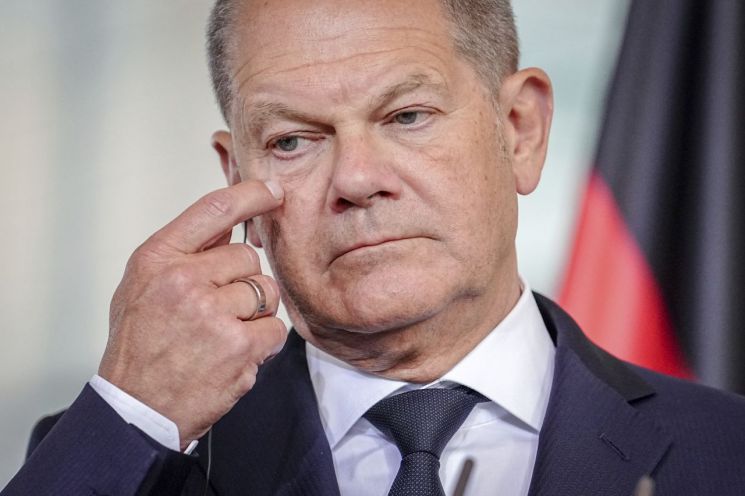
According to German public broadcaster Deutsche Welle (DW) and others, Steffen Hebestreit, spokesperson for the German government, on the 10th (local time) dismissed opposition demands that the coalition government take responsibility for the election defeat and hold early general elections, stating, "The election date is planned for next fall." He emphasized, "We will watch this until the end," and "At this point, there is no idea to bring the election forward."
In the European Parliament elections held until the previous day, Chancellor Olaf Scholz's party was embarrassed by being overtaken by the far-right party Alternative for Germany (AfD). AfD achieved a vote share of 15.9%, ranking second after the conservative Christian Democratic Union (CDU) and Christian Social Union (CSU) alliance. Although it did not reach the first-quarter poll results that suggested it could exceed 20%, the rise of far-right forces was confirmed despite fierce controversies such as Nazi-sympathizing remarks and bribery scandals ahead of the recent election.
On the other hand, the center-left Social Democratic Party (SPD), to which Chancellor Scholz belongs, recorded its worst result in about 130 years with 13.9%. The Green Party, a coalition partner, fell sharply from 20.5% in 2019 to 11.9% this year. Similarly, the Free Democratic Party (FDP), also part of the coalition, garnered only 5.2% of the vote.
In response, the CDU/CSU alliance and AfD urged the German government to hold early general elections like France. Markus S?der, leader of the CSU and also Minister-President of Bavaria, appeared on n-tv that morning and said, "This government is basically over. Now it should be like France," adding, "There have been demands for a new election, and French President Emmanuel Macron has decided to hold a new (early) election." Alice Weidel, co-leader of AfD, also called for early elections, saying, "The people are now tired."
In France, following exit polls the previous night showing the ruling party's crushing defeat by the far-right National Rally (RN), President Macron immediately played a surprise card by dissolving the parliament and calling for early general elections. Accordingly, plans are in place to hold early elections on the 30th of this month and the 7th of next month.
However, locally, it is assessed that holding early general elections in Germany is structurally more difficult than in France. To hold early elections, the Chancellor must first face a vote of no confidence in the Bundestag before requesting the dissolution of parliament.
On this day, Chancellor Scholz evaluated the European Parliament election results, saying, "It was not good for all three ruling parties: SPD, the Greens, and FDP." After a meeting with the Chilean president, he told reporters that he was cautious about the rise of far-right forces confirmed in this election, stating, "We must not get used to it. The task is to push them back again." Voter turnout among German voters in this election was counted at 64.8%.
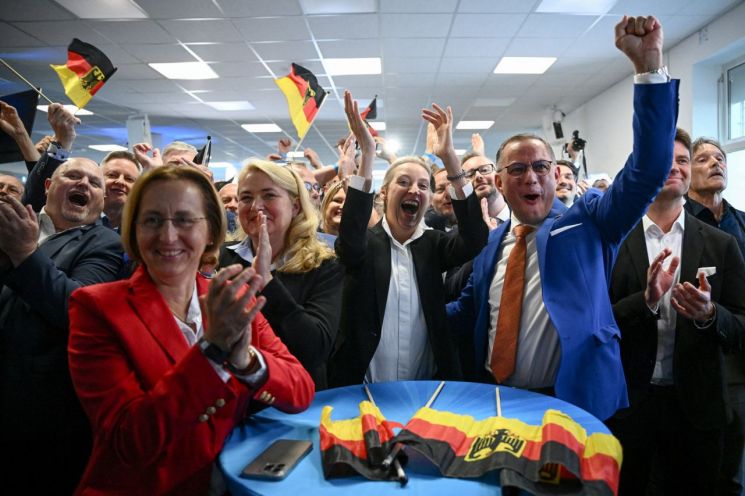 Co-leader Tino Chrupalla and other members of the far-right party Alternative for Germany (AfD) are celebrating as they watch the exit poll results after the European Parliament elections ended on the 9th (local time).
 [Image source=Reuters Yonhap News]
Meanwhile, despite the rise of far-right forces in this European Parliament election, the pro-EU 'grand coalition' maintained a majority. According to the analysis of the expected number of seats in the European Parliament updated as of 4:20 p.m. that day, the center-right European People's Party (EPP), currently the largest party, is expected to maintain its position as the largest party in the European Parliament by securing 186 seats (25.8%) out of a total of 720 seats.
Following that, the center-left Progressive Alliance of Socialists and Democrats (S&D) and the centrist Renew Europe (RE) are expected to hold the second (135 seats) and third (79 seats) party positions respectively, albeit with fewer seats than before. As expected, far-right forces made gains. The hard-right European Conservatives and Reformists (ECR) and the far-right Identity and Democracy (ID) political groups are projected to increase their seats from 69 and 49 to 73 and 58 respectively.
This figure is a provisional total combining the results from countries where counting is complete, such as Germany and France, and those still in progress among the 27 member states, so changes may occur in the final tally. Voter turnout was provisionally counted at about 51%, the highest level in 30 years since 1994 (56.7%).
© The Asia Business Daily(www.asiae.co.kr). All rights reserved.


















