Financial Services Commission Announces Guidelines on Whether NFTs Are Virtual Assets
Need to Determine Securities and Virtual Asset Characteristics
Virtual Asset Operators Required to Report to FIU
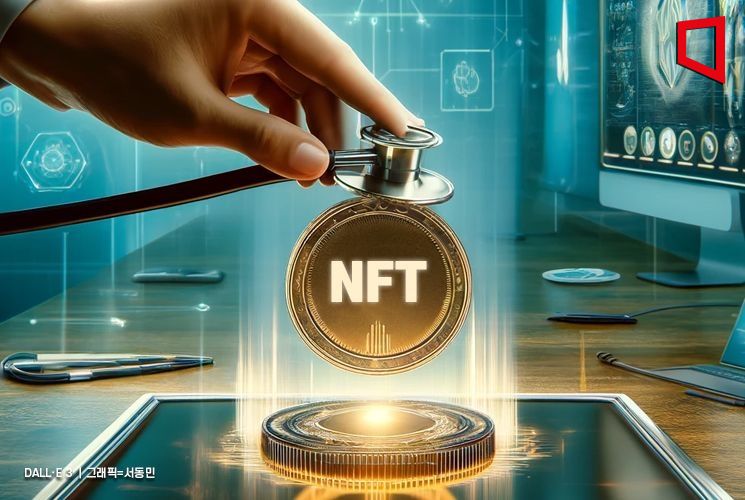
The financial authorities have disclosed the criteria for determining whether non-fungible tokens (NFTs) qualify as virtual assets ahead of the enforcement of the "Virtual Asset User Protection Act (Virtual Asset Act)" on the 19th of next month. Since the Virtual Asset Act is set to be enforced soon and the "Act on Reporting and Using Specified Financial Transaction Information (Specified Financial Information Act)"?a virtual asset regulatory law?is already in effect, NFT operators must conduct self-assessments to avoid future disadvantages.
On the 10th, the Financial Services Commission announced that it has prepared guidelines to determine whether NFTs qualify as virtual assets. As NFTs are defined for the first time under the Virtual Asset User Protection Act, the guidelines aim to address institutional shortcomings.
The most important characteristic of NFTs is uniqueness. The definition of NFTs is also "tokens that generally possess unique information and are non-fungible." They are often traded for the purpose of collecting content such as videos or images. The number of holders is limited, and secondary transactions are few, so unlike virtual assets, the likelihood of harm to a large number of users is relatively low. When the Financial Services Commission announced the legislative notice for the Virtual Asset Act in December last year, NFTs were excluded from regulation. However, concerns were raised about legal predictability due to ambiguity in classification between NFTs and virtual assets.
NFT operators should assess securities characteristics (whether profit distribution is involved) and virtual asset characteristics (whether there is an economic function) according to the Financial Services Commission’s guidelines released on this day, and if self-assessment is difficult, they can inquire with the financial authorities.
First, the criteria for determining securities characteristics involve whether the NFT corresponds to one of five standardized securities (debt securities, equity securities, beneficiary certificates, derivative-linked securities, depositary receipts, collective investment securities) or investment contract securities. For investment contract securities, the "Token Securities Guidelines" announced in February last year can be referenced. Investment contract securities typically have features such as ▲joint ventures ▲investment of money or other assets ▲primarily performed by others ▲contractual rights to share profits or losses based on the results of the joint venture.
The criteria for virtual assets are uniqueness and non-fungibility. These include cases where ▲tokens are issued in large quantities or large series ▲tokens are divisible, significantly weakening uniqueness ▲tokens can be used as direct or indirect means of payment for specific goods or services ▲tokens can be exchanged as virtual assets among unspecified persons or linked with other virtual assets to pay for goods or services.
Conversely, cases where ▲tokens are used solely for identity or qualification verification, proof of assets or transaction history (receipts) ▲tokens are issued in limited quantities such as concert tickets and used only for exhibition or viewing purposes ▲secondary transactions are impossible are likely to be judged as not virtual assets. However, judgments on individual cases are expected to be made through advisory committees in the future.
There is no separate grace period for industry guidance, and the guidelines are immediately applicable under current law. NFTs that qualify as virtual assets and whose business involves trading are included as virtual asset operators under the Specified Financial Information Act. Virtual asset operators who fail to report to the Financial Intelligence Unit (FIU) are subject to criminal penalties.
Jeon Yoseop, Head of the Financial Innovation Planning Division at the Financial Services Commission, stated, "Even if it is an NFT, if it possesses the characteristics of a virtual asset and is judged as such, it must comply with two laws: the Virtual Asset Act (scheduled) and the Specified Financial Information Act. Since the Specified Financial Information Act is already in effect, if the NFTs currently being traded qualify as virtual assets, they must be reported to the FIU."
© The Asia Business Daily(www.asiae.co.kr). All rights reserved.
!["The Woman Who Threw Herself into the Water Clutching a Stolen Dior Bag"...A Grotesque Success Story That Shakes the Korean Psyche [Slate]](https://cwcontent.asiae.co.kr/asiaresize/183/2026021902243444107_1771435474.jpg)
















