Park Dae-chul "Broadcasting 3 Laws, If MBC Biden and Nalli Are Removed, Broadcasting System Will Be Institutionalized"
Media Groups Also Attend... "Ruling and Opposition Must Discuss to Prevent It from Becoming a Frenzied Playground"
Hwang Woo-yeo on Controversy Over Party Convention Rule Revision: "No Relation to Yongsan or Specific Candidates"
On the 10th, the People Power Party launched an all-out effort to block the revision of the Broadcasting Three Acts (Broadcasting Act, Broadcasting Culture Promotion Act, Korea Educational Broadcasting System Act) being re-pushed by the seven opposition parties including the Democratic Party of Korea.
Park Dae-chul, chairman of the People Power Party's Special Committee on Fair Media, held a "Joint Meeting to Block the Democratic Party-Korean Confederation of Trade Unions' Broadcasting Takeover Three Acts" at the National Assembly at 10 a.m. that day, criticizing the opposition by saying, "No political power or any authority should take control of the media."
The Broadcasting Three Acts pushed by the opposition include provisions to increase the number of directors of public broadcasters such as KBS, MBC, and EBS to 21 and to expand the authority to recommend directors to professional organizations and academia. During the 21st National Assembly, the revision was blocked and discarded due to President Yoon's veto power, but the opposition plans to push it through with the 192 seats they have secured this time.
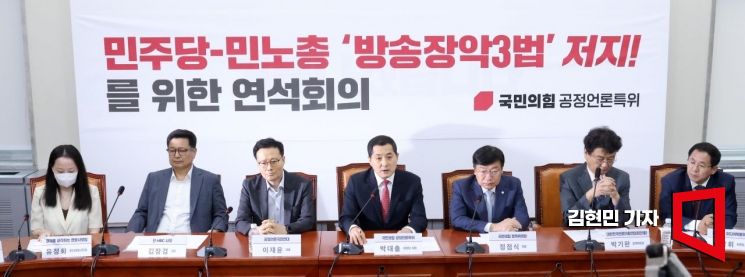 Park Dae-chul, Chairman of the Fair Media Special Committee of the People Power Party, is speaking at the joint meeting held on the 10th at the National Assembly to block the Democratic Party-Minnochoong's 'Broadcasting Control 3 Acts'. Photo by Kim Hyun-min kimhyun81@
The joint meeting that day was attended by many ruling party lawmakers including Policy Committee Chairman Jeong Jeom-sik, Representative Park, former MBC president and lawmaker Kim Jang-gyeom, Media Special Committee Chairman Lee Sang-hwi, as well as civic group figures. Lee Jae-yoon, representative of the Fair Media National Solidarity, argued that the civic groups that take the director recommendation rights share the same political color as the Democratic Party, emphasizing, "If you think the law should be amended regarding public media, the opinions of the people must be asked, and the ruling and opposition parties should come together to start discussions to prevent the media field from becoming a playground of illegality and agitation."
Meanwhile, ahead of the party convention scheduled for the 25th of next month, the People Power Party drew a line against claims that the rule revision push targets Han Dong-hoon, the leading candidate for party leadership and former emergency committee member.
Hwang Woo-yeo, emergency committee chairman of the People Power Party, said in a phone interview with Asia Economy on the same day regarding the party leadership system reform, "There is absolutely no intention to watch the presidential office or favor any party leader candidate," adding, "It has nothing to do with Yongsan (the presidential office) or any specific candidate."
Chairman Hwang said, "The party convention rule issue is under review by the special committee, and once the special committee reaches a conclusion, it will be discussed by the emergency committee and then passed to the Standing National Committee. We are in the preparation stage, and the decision-making authority lies there (at the Standing National Committee)." The special committee is expected to decide on the reflection ratio of public opinion polls as early as that day.
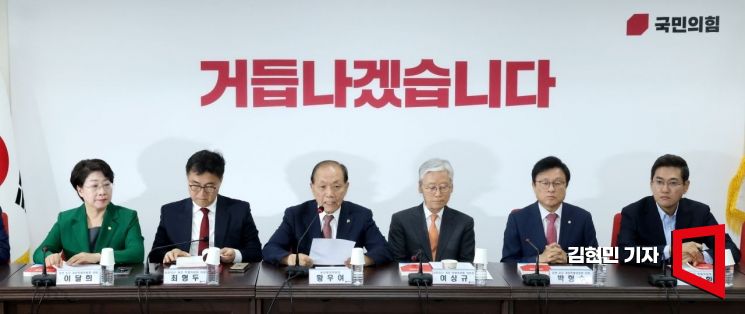 Hwang Woo-yeo, Emergency Response Committee Chairman of the People Power Party, is speaking at the appointment ceremony and first meeting of the Party Constitution and Rules Revision Special Committee held at the party headquarters in Yeouido, Seoul on the 4th. Photo by Kim Hyun-min kimhyun81@
© The Asia Business Daily(www.asiae.co.kr). All rights reserved.


















