Government Launches Full-Scale North Korea Broadcast Targeting Hwanghae Province
Communication Channel Between South and North Disappears... Concerns Over 'Military Conflict'
Yang Wook: "North Korea Likely to Escalate Crisis Until Disadvantageous"
Broadcasting to North Korea will be fully resumed. Initially, the military only operated some loudspeakers mainly along the western front, but as North Korea has launched additional provocations, it is expected to raise the level of response. Concerns have also been raised that the escalating 'strong against strong' confrontation between South and North Korea could lead to accidental clashes. North Korea declared a 'quasi-war state' nine years ago in response to loudspeaker broadcasts directed at the North.
On the 10th, a government official stated, "Although some frontline divisions such as the 1st, 5th, 25th, and 28th divisions resumed broadcasting to North Korea the day before, North Korea disregarded this and released additional trash balloons," adding, "Full-scale broadcasts to North Korea are planned from frontline divisions, mainly in the Hwanghae Province area, which is presumed to be the source."
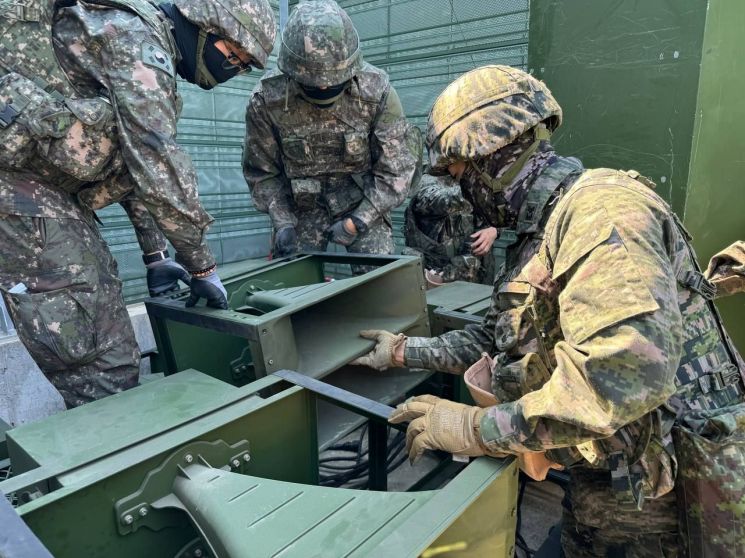 The Joint Chiefs of Staff announced on the 9th that they recently conducted a live exercise in the front-line area in preparation for the immediate implementation of broadcasts to North Korea.
 [Photo by Joint Chiefs of Staff]
The frontline divisions consist of 11 divisions. Each division is equipped with 2 to 3 fixed loudspeakers, totaling 24 units. There are also 16 mobile (maneuverable) loudspeakers mounted on 2.5-ton military trucks. The military broadcast the psychological warfare program 'Voice of Freedom' to North Korea from some frontline divisions for two hours starting at 5 p.m. the previous day. High-power loudspeakers with a listening range of 10 to 30 km were operated. The government considers the release of trash balloons and GPS jamming attacks as serious provocations because they can directly affect the daily lives of citizens. This is the reason for deciding to resume broadcasts to North Korea.
However, the military added a caveat regarding further broadcasts, stating that it "depends on North Korea's response." This means that if North Korea carries out additional provocations, loudspeakers will be operated accordingly. During the Cheonan sinking incident in March 2010, the military installed fixed loudspeakers but did not broadcast. In August 2015, when the DMZ landmine provocation occurred, broadcasts to North Korea were resumed, and North Korea responded with artillery fire targeting the loudspeakers before resuming dialogue.
Based on these precedents, there was a prospect that South and North Korea might refrain from reciprocal responses, but North Korea provoked again. The Joint Chiefs of Staff announced to the Ministry of National Defense press corps around 9:40 p.m. the previous day that "North Korea is once again releasing objects presumed to be trash balloons aimed at South Korea." Despite operating broadcasts to North Korea after the trash balloons were released on the 8th, North Korea released more trash balloons.
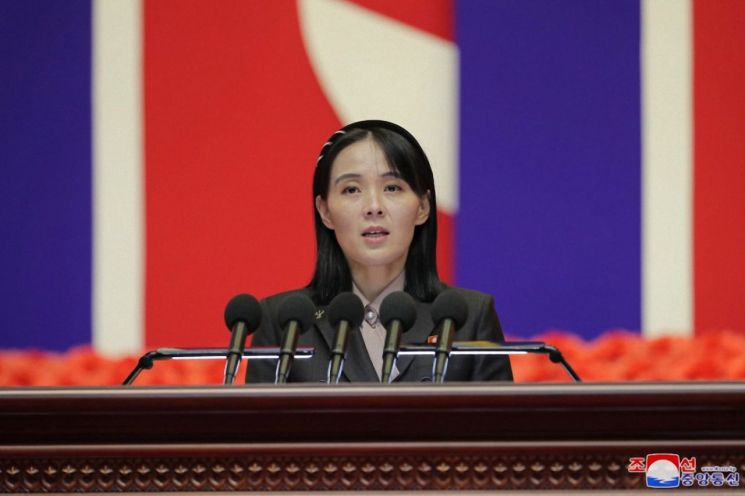
For now, the possibility of escalating conflict seems high. Kim Yo-jong, Deputy Director of the North Korean Workers' Party, issued a statement late the previous night, warning, "If South Korea continues leaflet distribution and loudspeaker broadcast provocations beyond the border, without a doubt, you will witness 'our new response.'"
Jung Sung-jang, head of the Korea Strategy Center at the Sejong Institute, assessed, "Even if conflicts arise, the channels to manage the crisis have disappeared," adding, "There is a significant possibility that minor clashes could escalate greatly or that North Korea could cause accidental clashes at the frontline or the Northern Limit Line (NLL)."
The possibility of a 'military clash' being reenacted is also being discussed. Yang Wook, a research fellow at the Asan Institute for Policy Studies' Center for Foreign Affairs and Security, predicted, "North Korea is highly likely to escalate the current conflict into military provocations," and "They will likely try to intensify the crisis until they judge the situation to be unfavorable to themselves."
© The Asia Business Daily(www.asiae.co.kr). All rights reserved.


















