Aging Accelerates in Korea, Growing Discussions on Abolishing Retirement Age
Hyundai Motor Union and Others Bring 'Retirement Age Extension' to Negotiation Table
87% Support Retirement Age Extension in Survey
In Japan, Where 30% of Population Are Elderly, More Companies Abolish Retirement Age
Discussions on extending the retirement age are reigniting in South Korea and Japan. As the working-age population decreases due to rapid population aging and low birth rates, there is growing advocacy for extending the retirement age to draw the elderly population into the labor market.
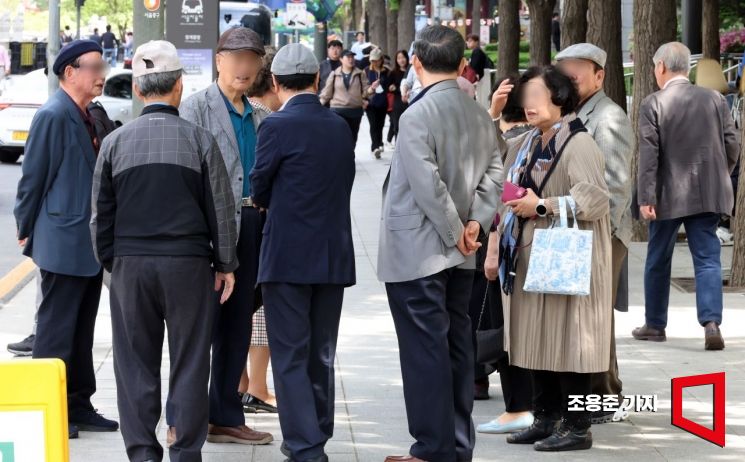 Elderly people are gathered near Cheonggyecheon in Seoul, having a conversation. Photo by Jo Yongjun jun21@
On the 7th, Andong Hospital, a medical foundation, announced the introduction of a 'post-retirement continued employment system' allowing work until the age of 70. Employees who wish to continue working after the legal retirement age of 60 can undergo a qualification review by the hospital's HR department and initially sign a 3-year contract, with renewals every year thereafter. Kang Shin-hong, director of Andong Hospital, said, "When I traveled to the U.S. last October to establish a local corporation, I was moved to see people in their 80s happily working alongside their colleagues at a local supermarket," adding, "From that perspective, we proactively responded to alleviate employment insecurity among our staff and ensure the continuity of economic activity."
Currently, South Korea is experiencing rapid aging. According to Statistics Korea, the population aged 65 and over reached 9.73 million last year, accounting for 19.0% of the total population. This ratio has been increasing annually from 13.2% in 2015, 16.4% in 2020, and 18.0% in 2022, and is expected to reach 20% next year, entering a super-aged society.
Accordingly, demands for extending the retirement age have become a key issue in this year's wage collective bargaining agreements (wage negotiations). The labor unions of Hyundai Motor Company and KG Mobility proposed raising the retirement age from 60 to 64 and 63, respectively, in this year's negotiations. The labor unions of the three HD Hyundai shipbuilding companies?HD Hyundai Heavy Industries, HD Hyundai Samho, and HD Hyundai Mipo?also plan to demand retirement age extension and abolition of the wage peak system in this year's negotiations. Some companies, such as Dongkuk Steel Group, have already agreed to extend the retirement age in recent negotiations.
Public opinion supporting the extension of the retirement age is also strong. A survey conducted by Embrain Public, K-Stat Research, Korea Research, and Hankook Research from the 27th to 29th of last month, targeting 1,004 people aged 18 and over nationwide, asked, "What do you think about the proposal to gradually extend the legal retirement age of workers currently at 60 to 65?" The result showed 86% in favor, while 11% opposed. Compared to the same question asked a year ago, support increased by 2 percentage points, and opposition decreased by 2 percentage points.
In Japan, where the population aged 65 and over has reached a record high of about 30%, companies are also extending or abolishing retirement ages. According to the Nihon Keizai Shimbun on the 30th of last month, Toyota plans to rehire all senior employees aged 65 and over starting this August. The existing personnel system, which allowed reemployment up to age 65 after retirement at 60, will be changed to extend the reemployment age to 70.
Japanese zipper manufacturer YKK abolished the retirement age system at its domestic operations in 2021. Automobile manufacturer Mazda also raised its retirement age from 60 to 65 starting in 2022.
The Japanese government has been enforcing the revised Elderly Employment Stabilization Act since 2021. This law stipulates that providing employment opportunities up to age 70 is a corporate 'duty of effort.' As a result, employment rates among the elderly population have increased. According to Japan's Ministry of Internal Affairs and Communications, the employment rate for those aged 65 to 69 was 52.0% last year, up 1.2 percentage points from the previous year and 13.3 percentage points higher than ten years ago.
© The Asia Business Daily(www.asiae.co.kr). All rights reserved.
![Clutching a Stolen Dior Bag, Saying "I Hate Being Poor but Real"... The Grotesque Con of a "Human Knockoff" [Slate]](https://cwcontent.asiae.co.kr/asiaresize/183/2026021902243444107_1771435474.jpg)
















