Shows traces of self-repair with tape in various places
Presumed to be Daewoo 'Espero' released in 1990
A photo of a vehicle on the verge of falling apart running on the road has gone viral on an online community, sparking public interest. On the 7th, a post titled "Occasionally Seen Horror Car" was uploaded to a community. The author, Mr. A, wrote, "I can't even imagine who would drive this car," adding, "I think the phone number might start with 016 or 017." The car in the photo shared by Mr. A is presumed to be the 'Espero,' released by Daewoo Motors in 1990. The Espero was a model produced by Daewoo Motors from 1990 to 1997 and was highly regarded at the time for its quality and economic efficiency.
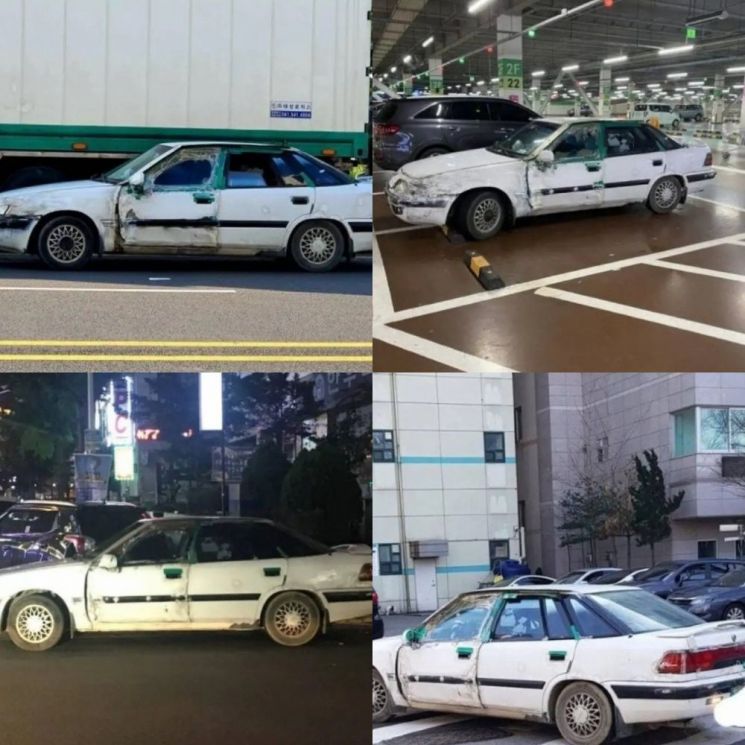
The vehicle in the photo shows clear signs of damage all over, to the extent that it would not be surprising if it were scrapped. The windows and headlights are broken, and the handles and window frames are tightly wrapped with blue tape. The body is covered with repeated scratches and dents, but it appears to rely solely on tape without any professional repairs. Concerns about the engine and other internal components are mounting, and as eyewitness reports of seeing the car on the road continue, people are calling it a "horror car" and expressing their worries.
A Classic Car Market with a Distinct Enthusiast Base
While the vehicle in the previous case is called a "horror car" due to its poor condition, the market for old cars or classic cars like this has a clear enthusiast base. Above all, these vehicles are often seen on the streets but are more frequently featured in advertisements and music videos. They serve as excellent props to convey a sense of speed or to create spatial effects on screen.
Among these, recently, the culture of driving old cars has been spreading like a trend among the MZ generation (Millennials + Generation Z). In the past, old cars were a collecting culture shared among "old men" as a form of nostalgia. However, the younger generation perceives old cars as "Newtro," a reinterpretation of past cultures they have never experienced before.
 The Hyundai Galloper, 1st generation Grandeur (commonly known as Kak Grandeur), and Pony 2 pickup are highly sought-after models among domestic old car enthusiasts.
 [Photo by Hyundai Motor Company]
In particular, the Hyundai Galloper, the first-generation Grandeur (commonly called "Gak Grandeur"), and the Pony 2 pickup are highly sought-after models among domestic old car enthusiasts. The Galloper is popular among campers due to its spacious interior. Although it was originally a 6-seater when released, its interior was so roomy that a 7-seater license was even considered. Another popular feature is its frame body, which is rarely seen in modern SUVs. A frame body is a design where the body is mounted on a ladder-shaped frame. Since the body and frame are separate, restoration work is much easier.
The Galloper also holds historical significance as Hyundai's first SUV. It was the first project undertaken by Honorary Chairman Chung Mong-koo when he took charge of the automotive division at Hyundai. During the Hyundai Precision Industry (now Hyundai Mobis) era, Chairman Chung launched a four-wheel-drive SUV development project with the full support of the founding chairman Chung Ju-yung. This coincided with the Seoul Olympics and a surge in leisure activities among the public, leading to explosive growth in the four-wheel-drive SUV market. In its first year of release in 1991, the Galloper caused a stir in the market. The following year, it captured 52% of the domestic four-wheel-drive SUV market share.
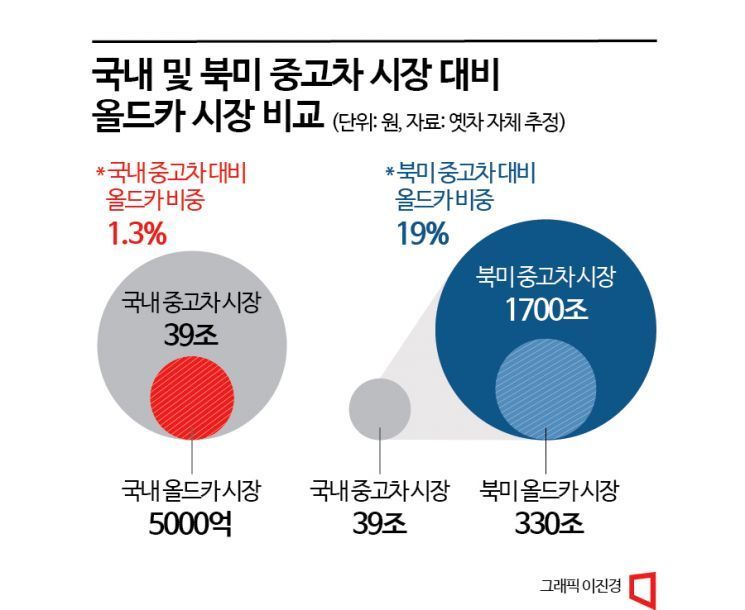 The size of the domestic old car market in 2023, estimated by the classic car platform startup Yetchaga, is about 500 billion KRW. This accounts for approximately 1.3% of the domestic used car market (39 trillion KRW), which is still a modest scale.
 [Photo by Lee Jin-kyung, Asia Economy]
The first-generation Grandeur, known as "Gak Grandeur," is also a bestseller in the domestic old car market. Released in 1986, the first-generation Grandeur was the most expensive domestic luxury car. The launch price of the 3.0-liter first-generation Grandeur was 28.9 million KRW. At that time in 1987, the sale price of an 18-pyeong apartment in Banpo Jugong was around 34 million KRW. The price of one car was roughly equivalent to that of a decent apartment in Seoul. The first-generation Grandeur is popular in the old car market due to its image as a luxury sedan aimed at the wealthy and a symbol of success. Even now, well-maintained "Gak Grandeur" models are listed on the old car market for around 10 million KRW. Its clean, straight-lined, and dignified design is highly appreciated. The seventh-generation new Grandeur, released at the end of last year, also inherits the design of the "Gak Grandeur," as many consumers feel nostalgic about the first-generation design.
According to estimates by the classic car platform startup Yetcha in 2023, the domestic old car market size is about 500 billion KRW. This accounts for approximately 1.3% of the domestic used car market (39 trillion KRW), which is still a modest scale. However, in advanced automobile manufacturing countries such as the United States, Japan, and Germany, the old car market is already separated and the auction market is active. Environmental regulations have also been addressed early on.
© The Asia Business Daily(www.asiae.co.kr). All rights reserved.
![Clutching a Stolen Dior Bag, Saying "I Hate Being Poor but Real"... The Grotesque Con of a "Human Knockoff" [Slate]](https://cwcontent.asiae.co.kr/asiaresize/183/2026021902243444107_1771435474.jpg)


















