Total Fertility Rate 1.2 Last Year... 8 Consecutive Years of Decline
'Children and Childcare Support Act Amendment' Passed in Plenary Session
Japan's total fertility rate last year dropped to 1.2, marking an all-time low. The Japanese government has introduced measures to support low birth rates, including a significant increase in child allowances.
According to Japanese media on the 5th, the "Child and Childcare Support Act Amendment" passed the House of Councillors (upper house) plenary session. This bill includes the expansion of child allowances and childcare support measures announced by Prime Minister Fumio Kishida (岸田文雄) last year as part of a "next-level low birth rate countermeasure."
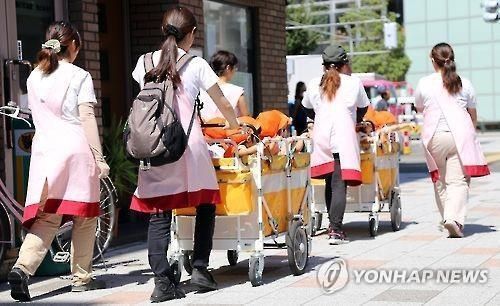
The main point of this amendment is the expansion of child allowances. The eligibility for child allowance payments has been extended from the previous age limit of 15 to 18 years old, and income restrictions have been removed, shifting from "selective payments" to "universal payments."
Once the amendment is implemented, anyone can receive an allowance of 10,000 yen (approximately 87,000 KRW) per child. For the third child and beyond, the allowance will increase to 30,000 yen, and pregnant women will receive support worth 100,000 yen.
The salary received during parental leave will also increase from 80% to 100% of the previous salary. Additionally, a "Universal Childcare Attendance System," allowing children to use daycare centers regardless of their parents' employment status, is scheduled to be introduced from 2026.
The Kishida administration has decided to raise health insurance premiums to secure funding. They plan to collect taxes tied to health insurance premiums under the name of "support funds." To this end, they plan to gradually collect 600 billion yen in 2026 and 1 trillion yen in 2028.
According to the Asahi Shimbun, company employees are expected to pay an additional 800 yen per month per person, self-employed individuals 400 yen per month, and elderly people aged 75 and over 350 yen. Some critics argue that this effectively amounts to a tax increase.
The media reported, "There is also a goal to double the childcare budget by the early 2030s, making it inevitable that the burden will increase."
Each local government in Japan maintains separate childcare allowances and support measures. For example, Tokyo Metropolitan Government already provides up to 60,000 yen annually per child aged 0 to 18 and supports free hospital use.
According to the Nihon Keizai (Nikkei) Shimbun, the Japanese government's budget for low birth rate countermeasures has exceeded 66 trillion yen since 2004. Despite the budget spent so far, the media pointed out that "there is no prospect of reversing the fertility rate trend" and emphasized the need to review low birth rate policies.
According to the 2023 "Population Dynamics Summary" announced by the Ministry of Health, Labour and Welfare on this day, the total fertility rate, which indicates the number of children a woman is expected to have in her lifetime, was 1.20?the lowest since statistics began in 1947. It has been declining for eight consecutive years since 2016.
By region, Tokyo Metropolis (東京都) had the lowest fertility rate nationwide at 0.99, and the three major metropolitan prefectures of Saitama (埼玉), Chiba (千葉), and Kanagawa (神奈川) also showed low fertility rates around 1.1, indicating a trend of lower birth rates in urban areas.
The number of births decreased by 5.6% from the previous year to 727,277, which was fewer than the number of deaths (1,575,936), resulting in a natural population decline of 850,000.
Foreign media reported that despite Japan recording its worst fertility rate, its situation is better compared to South Korea, the country with the lowest birth rate in the world. South Korea's total fertility rate last year was 0.72, and this year it is projected to be even lower at 0.68.
© The Asia Business Daily(www.asiae.co.kr). All rights reserved.

















