1Q Real GNI Growth Rate 2.4%, Highest in 8 Years
Significant Improvement in Terms of Trade Due to Increased Semiconductor Exports
1Q Real GDP Grew by 1.3%
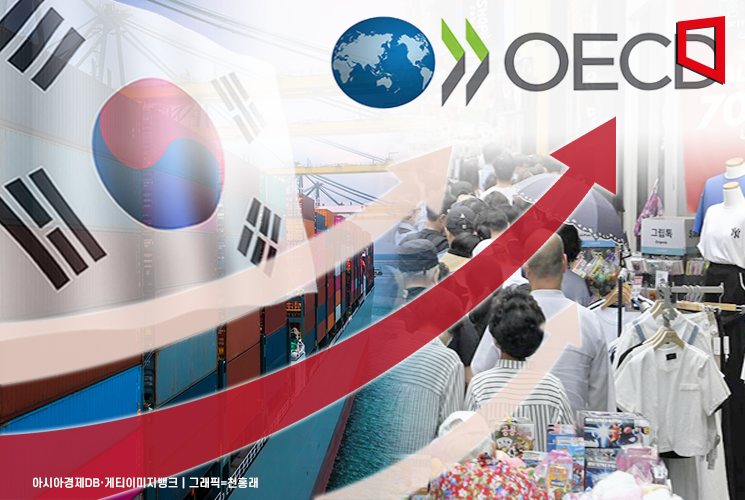
The Gross National Income (GNI) growth rate in the first quarter reached its highest level in eight years. It is also projected that the era of per capita national income reaching $40,000 could be achieved within a few years.
According to the 'First Quarter National Income Statistics' released by the Bank of Korea on the 5th, the real domestic GNI in the first quarter rose by 2.4% compared to the previous quarter. This is the largest increase in eight years since a 2.8% rise in the first quarter of 2016.
GNI is calculated by adding the income earned by nationals abroad to GDP and subtracting the income earned domestically by foreigners. It is an indicator developed to more accurately measure national income.
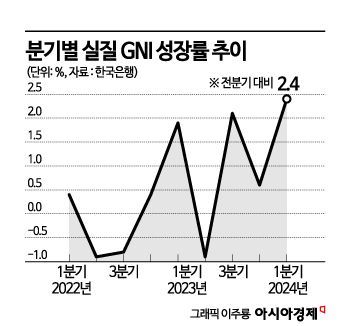
The Bank of Korea explained that GNI improved in the first quarter as exports increased significantly while imports decreased. Choi Jeong-tae, head of the National Accounts Department at the Bank of Korea's Economic Statistics Bureau, said, "In the first quarter of this year, prices of IT export products such as semiconductors rose compared to the previous quarter, while prices of imported goods like crude oil fell, which led to a higher GNI growth rate."
The reason why this year's GNI growth rate is higher than in other years is due to a significant improvement in semiconductor exports. Choi said, "The terms of trade for Korea's exports are heavily influenced by semiconductors, accounting for about 70%. This reflects the strong improvement in the semiconductor industry at the beginning of the year."
The GDP deflator, an index representing the overall domestic price level, rose by 3.9% in the first quarter compared to the same period last year. This is the highest in nine quarters since it recorded 4.4% in the fourth quarter of 2021. The export deflator rose due to increases in semiconductor prices, while the import deflator fell due to lower prices of crude oil and natural gas.
The Bank of Korea announced that Korea's per capita GNI last year was $36,194. Among countries with populations over 50 million worldwide, Korea ranked sixth after the United States, Germany, the United Kingdom, France, and Italy.
It is expected that achieving a per capita GNI of $40,000 is possible within a few years. Choi projected, "If the current trend continues and assuming exchange rates remain stable, reaching a per capita national income of $40,000 within a few years is feasible."
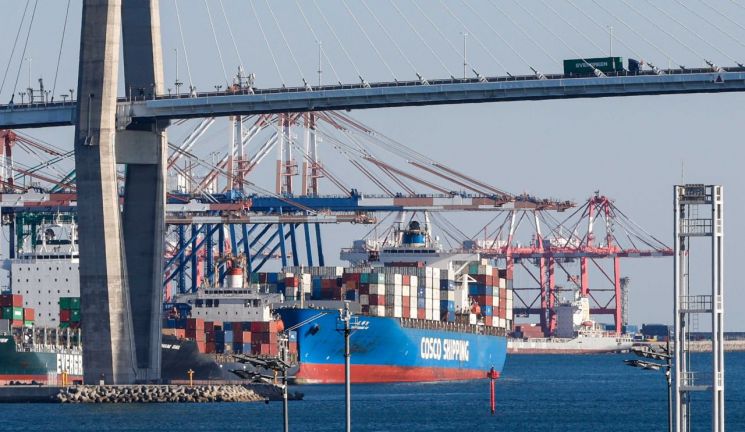
First Quarter Real GDP Growth Rate 1.3%, Same as Preliminary Estimate
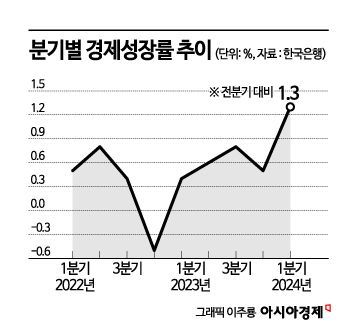
The Bank of Korea reported that Korea's real Gross Domestic Product (GDP, provisional) growth rate in the first quarter was 1.3% compared to the previous quarter. This matches the preliminary estimate announced on April 25.
Korea has recorded positive growth rates for five consecutive quarters, with 0.4% in the first quarter of last year, 0.6% in the second quarter, 0.8% in the third quarter, 0.5% in the fourth quarter, and 1.3% in the first quarter of this year.
The economic growth rate in the first quarter of this year significantly exceeded market expectations (0.6%). It is also the highest in nine quarters since the 1.6% recorded in the fourth quarter of 2021.
Not only did the export improvement trend continue, but domestic demand such as construction investment and private consumption also improved. Looking at the growth rates by expenditure items in the first quarter, exports increased by 1.8% compared to the previous quarter, mainly driven by IT products like semiconductors and mobile phones, as well as petroleum products.
Construction investment rose by 3.3% as both building construction and civil engineering improved. Private consumption increased by 0.7%, with growth in both goods (such as clothing) and services (such as food and accommodation), while government consumption rose by 0.8% due to increased spending on goods.
On the other hand, facility investment decreased by 2.0%, mainly due to a decline in transportation equipment, and imports fell by 0.4%, affected by reductions in natural gas and electrical equipment.
Compared to the preliminary estimate, private consumption (-0.1 percentage points) and facility investment (-1.2 percentage points) were revised downward, while construction investment (+0.7 percentage points) and exports (+0.9 percentage points) were revised upward.
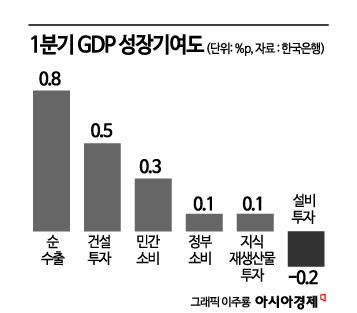
Regarding the contribution to GDP growth by expenditure items in the first quarter, net exports contributed 0.8 percentage points, construction investment 0.5 percentage points, private consumption 0.3 percentage points, and government consumption 0.1 percentage points. By sector, the private sector contributed 1.2 percentage points and the government 0.1 percentage points, indicating that most of the growth came from the private sector.
In particular, the contribution of construction investment rose significantly from -0.6% in the fourth quarter of last year to 0.5% in the first quarter. The Bank of Korea explained that this improvement was due to increased finishing work at some construction sites following favorable weather conditions in the first quarter.
Looking at growth rates by economic activity, manufacturing increased by 0.9% compared to the previous quarter, driven by transportation equipment. Construction rose by 5.5% as both building and civil engineering construction increased. The service sector improved by 0.9% compared to the previous quarter, supported by growth in wholesale and retail, accommodation and food services, and cultural and other services.
© The Asia Business Daily(www.asiae.co.kr). All rights reserved.
![Clutching a Stolen Dior Bag, Saying "I Hate Being Poor but Real"... The Grotesque Con of a "Human Knockoff" [Slate]](https://cwcontent.asiae.co.kr/asiaresize/183/2026021902243444107_1771435474.jpg)


















