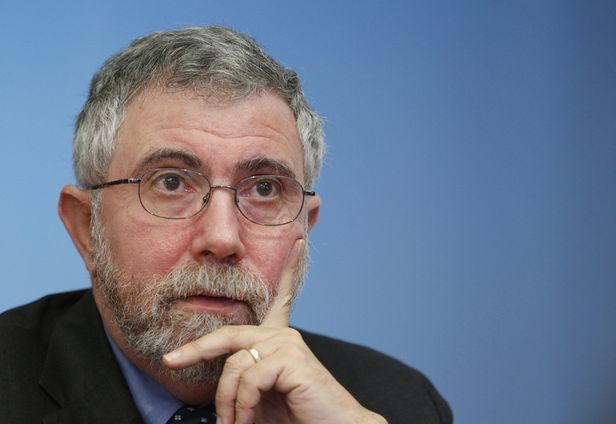
Paul Krugman, Nobel laureate in economics and professor at the City University of New York, has now diagnosed that it is time to worry more about a recession than inflation. He argues that the U.S. Federal Reserve (Fed) should soon begin cutting interest rates.
In a column titled "Goodbye Inflation, Hello Recession?" published on the afternoon of the 4th (local time) in the New York Times (NYT), Professor Krugman stated, "It is time to stop obsessing over inflation, which seems like yesterday's problem, and start worrying about the possibility of a recession."
Starting his column with a reference to American economic historian Charles Kindleberger, who pointed out that "when looking at complex economic phenomena, stories are more important than single numbers," Krugman evaluated that "the same applies to the current problem of inflation."
He said, "There are various ways to measure inflation, so to borrow another of Kindleberger's sayings, depending on one's temperament, one can always find a way to justify either optimism or pessimism," adding, "The answer I want to argue is that inflation is gradually decreasing to an acceptable level without a recession."
As the basis for this claim, he focused on various measurement methods of the core Personal Consumption Expenditures (PCE) price index, the Fed's preferred key inflation indicator. Professor Krugman presented the PCE price index growth rate trends over the past year on both a monthly and annual basis, explaining, "The inflation rate measured monthly is very unstable, and it is always difficult to know whether the fluctuations are real changes or statistical noise. On the other hand, the annual inflation rate has been continuously declining."
He also noted that housing costs are a lagging indicator reflecting rents from at least a year ago, so it is reasonable to exclude them when confirming recent disinflation trends, stating, "Not because housing costs are not a problem for households, but because measurements excluding housing costs better predict future inflation." According to this criterion, Professor Krugman's analysis is that current U.S. inflation is already close to the Fed's price stability target of 2%, both monthly and annually.
Furthermore, Krugman found the inflation reports from companies on the ground useful. The Beige Book, a report on economic conditions regularly published by the Fed, contains survey results from businesses. He emphasized, "The most recent Beige Book states that 'inflation rose at a modest pace,' which is almost identical to the content of the January 2020 Beige Book, just before the COVID-19 pandemic, when everyone thought inflation was well controlled."
He also pointed out, "Overall, core inflation is between 2 and 3%. The hot figures from earlier this year seem to have been false alarms. In fact, inflation is not something to be primarily focused on at this point." He added, "No one is calling for a recession right now," but expressed concern, saying, "I have started to worry a little about economic slowdown." As a representative advocate of economic stimulus, he has been someone who recently evaluated the U.S. economy as better than ever.
Professor Krugman said, "Consumption expenditures adjusted for inflation slightly declined in April, and manufacturing-related indicators suggest a deepening weakness," adding, "It is not yet time to raise alarms, but the balance of risks has definitely shifted." The recently released May U.S. Institute for Supply Management (ISM) Manufacturing Purchasing Managers' Index (PMI) fell below the baseline of 50 for the second consecutive month, indicating contraction. Real personal consumption in April decreased by 0.1%, and job openings in the same month hit the lowest level since February 2021.
He emphasized, "We need to stop obsessing over inflation. As the economy's strength finally begins to be eroded by high interest rate pressures, it is time to start worrying about the possibility of a recession," and added, "Therefore, I think the Fed should soon start cutting interest rates." Amid ongoing uncertainty about the timing of rate cuts, the Fed will hold the Federal Open Market Committee (FOMC) meeting on the 11th and 12th of this month. The FOMC's dot plot, which contains the committee members' interest rate projections, is also scheduled to be released at this meeting. Prior to that, the Labor Department's employment report and the May Consumer Price Index (CPI) will be released on the 7th and 12th, respectively.
© The Asia Business Daily(www.asiae.co.kr). All rights reserved.

















