Battery Industry Association-Gwangjang, Seminar Held
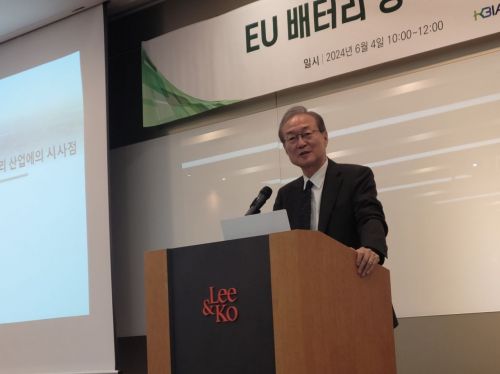 Park Tae-ho, Director of the International Trade Research Institute at Law Firm Kwangjang, is delivering the keynote speech at the 'EU Battery Policy Corporate Utilization Seminar' held on the 4th. Photo by Kang Hee-jong
The European Union (EU) battery regulations, which came into effect last August, have been gradually implemented since February. Starting this August, all batteries must bear the CE (European Community Certification) mark and undergo conformity assessment procedures. Next year, a carbon footprint reporting system for electric vehicle batteries will be enforced. These EU battery regulations aim to internalize the battery industry and are generally seen as measures to curb the growing influence of Chinese companies. Although these regulations apply equally to domestic companies, it is pointed out that since Korean companies have a competitive edge over Chinese firms in terms of ESG (Environmental, Social, and Governance), they should seize this opportunity to expand their presence in the European market.
On the 4th, the Korea Battery Industry Association and the law firm Kwangjang jointly held the 'EU Battery Policy Corporate Utilization Seminar' at the Hanjin Building in Sogong-dong, Seoul. According to Park Jeong-hyun, a lawyer from Kwangjang who presented at the seminar, the EU will mandate the attachment of the CE mark on all batteries starting August 18. Additionally, all battery models must undergo conformity assessment procedures. Restrictions on hazardous substances, starting with a ban on lead content exceeding 0.001%, will be implemented in stages.
The scope and stringency of the EU battery regulations will continue to increase. From February next year, electric vehicle batteries must report their carbon footprint. From August, batteries will be subject to due diligence inspections (excluding companies with sales under 40 million euros). Simultaneously in August, labeling for separate collection, extended producer responsibility, producer registration, and mandatory collection of waste batteries will also commence.
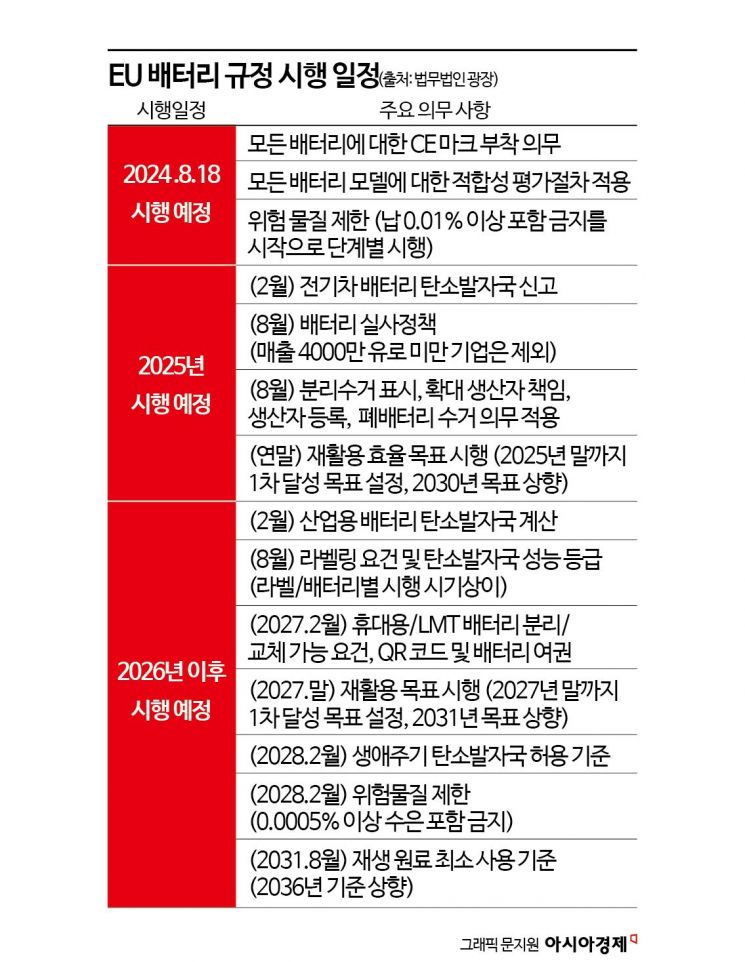
By the end of next year, recycling efficiency targets will be enforced. The goal is to increase the proportion of recycled materials by 2031 to 16% cobalt, 85% lead, 6% lithium, and 6% nickel.
Additionally, under the Critical Raw Materials Act (CRMA) effective from this year, the EU aims to expand its mining capacity of strategic raw materials to 10% of annual EU consumption, domestic processing capacity to 40%, and recycling capacity to at least 25% by 2030. Furthermore, at every processing stage, the import dependency on any single country for specific strategic raw materials must not exceed 65% of the EU's annual consumption.
In April, the EU Parliament also passed the Forced Labor Regulation (FLR), which applies to products imported and distributed within the EU that involve forced labor during manufacturing. If forced labor is clearly proven through in-depth investigations, the competent authorities may prohibit the import and export of such products outside the EU.
The EU Supply Chain Due Diligence Directive (CSDDD), approved by the EU Parliament in April, is also expected to impact domestic battery companies. The CSDDD imposes various obligations on companies inside and outside the EU to prevent human rights and environmental violations such as forced labor and deforestation throughout their supply chains. This directive received official approval from the Council on May 24 and will be published 20 days after being gazetted. EU member states must enact domestic laws within two years from the effective date.
At the seminar, Park Tae-ho, head of the International Trade Research Institute at Kwangjang and former director of the Trade Negotiations Headquarters at the Ministry of Trade, Industry and Energy, stated, "Techno-political risks are emerging as a new concern for national economic security. The EU is advancing trade policies in the areas of environment, human rights, security, and digital sectors. We must establish new foreign economic strategies for due diligence, research and development, and production processes to comply with EU regulatory requirements and develop into a global hub country for advanced technology products, materials, and components."
Park Tae-sung, vice chairman of the Korea Battery Industry Association, said, "Our companies have an advantage over Chinese firms in terms of ESG, so if they respond well, this can be a stepping stone for a new leap forward," but also emphasized, "Government support is necessary to strengthen the capacity to respond to various battery regulations such as carbon footprint and supply chain due diligence."
© The Asia Business Daily(www.asiae.co.kr). All rights reserved.
![Clutching a Stolen Dior Bag, Saying "I Hate Being Poor but Real"... The Grotesque Con of a "Human Knockoff" [Slate]](https://cwcontent.asiae.co.kr/asiaresize/183/2026021902243444107_1771435474.jpg)












