POSTECH Research Team Predicts Death Toll from Ultrafine Dust
A study has found that if the concentration of fine particulate matter (PM2.5) remains at the current level, premature deaths caused by PM2.5 will triple by 2050 compared to today. On the 4th, Professor Lee Hyung-joo of the Department of Environmental Engineering at Pohang University of Science and Technology (POSTECH) and researcher Kim Narae, who is pursuing a master's degree, announced that their research team predicted the number of deaths in 2050 considering PM2.5 levels and the rate of aging.
Fine particulate matter refers to dust particles with a diameter of 10㎛ (micrometers, 1㎛ = one-thousandth of a millimeter) or less, and PM2.5 refers to particles 2.5㎛ or smaller. In particular, PM2.5 is known to penetrate the alveoli (air sacs) of the lungs and enter the bloodstream, potentially causing cardiovascular diseases. Additionally, the elderly are known to be more vulnerable to PM2.5, which is expected to pose a greater burden on South Korea, where aging is progressing rapidly.
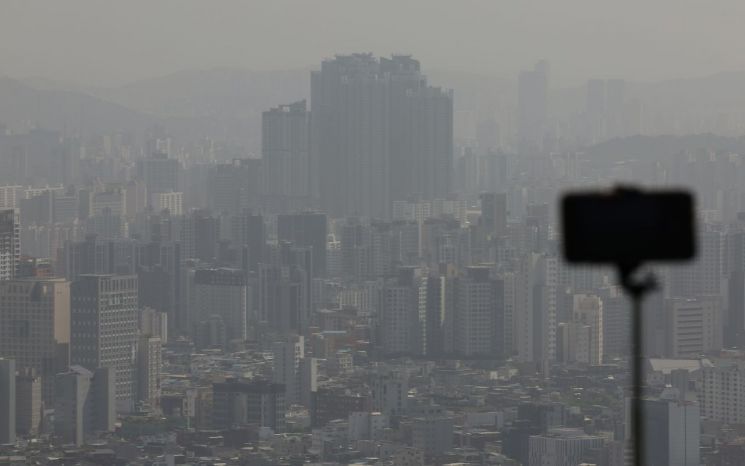 The sky over Seoul on May 12th showed a 'Bad' level of fine dust concentration. [Image source=Yonhap News]
The research team found that the average domestic PM2.5 concentration from 2019 to 2021 was approximately 20㎛/㎥. This exceeds the Ministry of Environment’s annual air quality standard of 15㎛/㎥ and is far above the World Health Organization (WHO) recommended level of 5㎛/㎥. Furthermore, using data from the Population and Housing Census and future population projections, the team concluded that the elderly population, which was 16% in 2020, will increase to 40% by 2050. Based on this, the team designed scenarios to predict the number of deaths.
If the PM2.5 concentration maintains the recent three-year average level of 20㎛/㎥, premature deaths due to PM2.5 in 2050 are predicted to reach about 110,000. This is approximately three times the 34,000 premature deaths recorded in 2020. Even if the PM2.5 concentration is reduced to the Ministry of Environment’s annual air quality standard of 15㎛/㎥, the number of deaths in 2050 is projected to be about 84,000.
The research team found that to keep the number of deaths in 2050 at the 2020 level, PM2.5 concentration must be reduced to 6㎛/㎥. This means that PM2.5 levels need to be reduced much more than current policies to lower deaths and public health burdens. These research findings were recently published in the online edition of the international environmental journal, Environmental Research.
Meanwhile, this spring, the nationwide PM2.5 concentration recorded the lowest level in five years. The Ministry of Environment announced that from December last year to March this year, the average PM2.5 concentration was 21㎍/㎥. This is the lowest level in five years since the seasonal management system was implemented in 2019. The seasonal management system is a policy that enforces strengthened measures to reduce and manage particulate matter emissions from December to March of the following year, when PM2.5 concentrations tend to rise.
© The Asia Business Daily(www.asiae.co.kr). All rights reserved.
![Clutching a Stolen Dior Bag, Saying "I Hate Being Poor but Real"... The Grotesque Con of a "Human Knockoff" [Slate]](https://cwcontent.asiae.co.kr/asiaresize/183/2026021902243444107_1771435474.jpg)











