Intelligent Rapid Sampling Completed... Payload Operating Normally
Return Expected Around the 25th
China's spacecraft 'Chang'e 6' successfully collected samples from the far side of the moon for the first time in the world on the 4th.
The China National Space Administration (CNSA) announced on the 4th, "At 7:38 a.m. local time, Chang'e 6 took off after collecting samples from the far side of the moon," adding, "It has entered the planned lunar orbit."
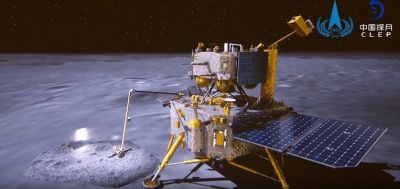
This is the world's first time soil and rock samples have been collected from the far side of the moon. Until now, lunar surface sample collection has been conducted 10 times worldwide, but all were on the near side of the moon.
CNSA explained, "On the 2nd and 3rd, Chang'e 6 successfully completed intelligent rapid sampling in the South Pole-Aitken Basin located on the far side of the moon and stored valuable far side lunar samples in the storage device," adding, "Intelligent sampling is the core mission of Chang'e 6." Chang'e 6 collected lunar samples using two methods: drilling and surface extraction with a mechanical arm. China's state-run Xinhua News Agency reported that Chang'e 6 adopted intelligent rapid sampling technology, reducing the lunar surface sample collection time to less than 20 hours.
Additionally, the cameras, lunar soil structure detector, and lunar mineral spectrum analyzer onboard Chang'e 6 operated normally. It was confirmed that the detection of lunar surface morphology and mineral composition, as well as scientific exploration, proceeded as planned.
Furthermore, the European Space Agency (ESA)'s lunar surface anion analyzer and France's lunar radon detector onboard Chang'e 6 also functioned normally. The Italian laser retroreflector was used for distance measurement on the far side of the moon. Xinhua News Agency stated, "International scientific research is being conducted," and "Chinese and partner scientists will share data and conduct joint research to produce more results."
CNSA stated, "After surface sampling was completed, the five-star red flag onboard Chang'e 6 was successfully unfurled on the far side of the moon," adding, "This is the first time China has raised a flag on the far side of the moon, made with new composite materials and special processes."
Unlike ground launches, Chang'e 6 uses the lander as a temporary tower instead of a fixed launch tower system. Since it takes off from the far side of the moon, it cannot receive direct ground control support and must use the Queqiao 2 relay satellite, making the operation more difficult. CNSA stated, "After ignition, Chang'e 6's ascent vehicle took off and successfully entered lunar orbit through three stages: vertical ascent, attitude adjustment, and orbit insertion." Xinhua News Agency said, "The 'treasure hunt' on the far side of the moon has successfully ended, and Chang'e 6 has started its journey home."
Subsequent operations include docking with the orbiter waiting in lunar orbit and transferring the lunar samples to the reentry module. The reentry module will fly near Earth with the lunar samples and reenter the atmosphere to land at the Shizhuang landing site in Neimenggu, China. The return is expected around the 25th.
Previously, Chang'e 6, launched on the 3rd of last month, successfully landed in the South Pole-Aitken Basin on the morning of the 2nd.
© The Asia Business Daily(www.asiae.co.kr). All rights reserved.
![Clutching a Stolen Dior Bag, Saying "I Hate Being Poor but Real"... The Grotesque Con of a "Human Knockoff" [Slate]](https://cwcontent.asiae.co.kr/asiaresize/183/2026021902243444107_1771435474.jpg)
















