Impact of Reduced Increase in Agricultural, Livestock, and Marine Products
Simultaneous Decline in Chicken and Pork Prices
Fruit Prices Continue to Soar, Pears Up 125%
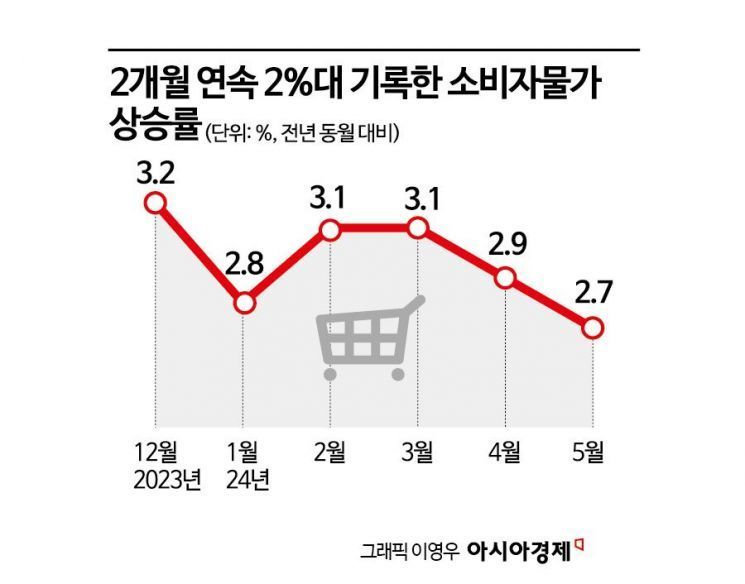
Last month, the consumer price inflation rate recorded 2.7%, maintaining a 2% range increase for two consecutive months. However, the surge in fruit prices continued, with pear prices reaching an all-time high.
According to the 'May Consumer Price Trends' released by Statistics Korea on the 4th, the consumer price index last month rose 2.7% compared to the same month last year. The consumer price inflation rate, which slowed down to 2.8% in January this year, surged above 3% again in February (3.1%) and March (3.1%) due to the sharp rise in fruit and vegetable prices, then dropped to the 2% range for two consecutive months in April (2.9%) and last month.
Gong Mi-sook, Director of Economic Trend Statistics at Statistics Korea, explained, “Due to the impact of rising international oil prices, petroleum products increased and processed food price increases expanded, but the rise in agricultural, livestock, and fishery products narrowed, causing a 0.2 percentage point decrease in inflation compared to the previous month.”
The slight narrowing of price increases in agricultural, livestock, and fishery products influenced the slowdown in inflation. Last month, the price increase rate for agricultural, livestock, and fishery products was 8.7%, down 1.9 percentage points from the previous month (10.6%). In particular, livestock products (-2.6%) turned negative for the first time in four months since January (-0.6%). Prices for chicken (-7.8%), pork (-5.2%), and domestic beef (-2.3%) all fell simultaneously.
Statistics Korea explained that the increase in the number of animals slaughtered and import volumes influenced this trend. Agricultural products rose 19.0%, slightly slowing from April (20.3%). Especially, vegetables increased by 7.4%, showing signs of stabilization compared to April (12.8%). Director Gong said, “The weather improved last month, which greatly enhanced vegetable crop yields.”
However, strong fruit price increases persisted, with apples (80.4%) and pears (126.3%) showing significant rises. Pear prices recorded the largest increase ever since the survey began, as consumption increased as a substitute for apples. Tomatoes (37.8%) also rose sharply. Consequently, the fresh food index surged 17.3% compared to the same month last year, and the increase in fresh fruit prices (39.5%) slightly expanded compared to last month (38.7%).
The inflation rate for petroleum products was 3.1%, showing a stronger upward trend than the previous month (1.3%). This is the highest level in 16 months since recording 4.1% in January last year. Processed foods also rose 2.0%, increasing more than the previous month (1.6%). The service sector rose 2.3%, with public services and personal services increasing by 2.2% and 2.8%, respectively.
Core inflation, which shows the underlying trend of prices, appears to be stabilizing. The index excluding agricultural products and petroleum products, which represents core inflation, rose 2.0% compared to the same month last year, and the OECD standard core inflation index excluding food and energy increased 2.2% compared to the same month last year. Director Gong stated, “Core inflation is continuously being managed,” adding, “Core inflation excluding highly volatile components is becoming quite stable.”
The living cost index rose 3.1% compared to the same month last year. The living cost index is calculated based on 144 items out of a total of 458 items, focusing on those with high purchase frequency and large expenditure shares, which are sensitive to price changes. The living cost index peaked at 4.5% in October last year, then slowed its increase to 3.4% in January this year, and has since fluctuated in the 3% range. Among these, food prices rose 3.9% compared to a year ago, while non-food items increased by 2.5%. The living cost index including rent and lease rose 2.6%.
© The Asia Business Daily(www.asiae.co.kr). All rights reserved.

















