Characteristics and Economic Impact of Domestic Monetary Policy Uncertainty Report
Rising Monetary Policy Uncertainty Raises Concerns Over Contraction in Real Economy and Financial Markets
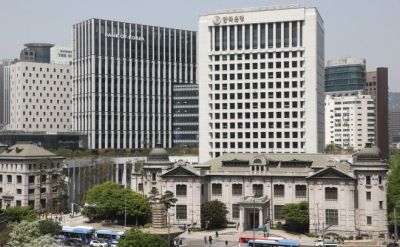
As uncertainty in monetary policy expands, concerns have been raised that it is not only contracting the real economy but also undermining the stability of financial markets. There are calls for continued efforts by central banks to enhance communication in order to reduce monetary policy uncertainty.
On the 4th, Heecheol Jung, a research fellow at the Korea Capital Market Institute, released a report titled "Characteristics and Economic Impact of Domestic Monetary Policy Uncertainty," stating that the current level of monetary policy uncertainty in South Korea is higher than the historical average.
Monetary policy uncertainty can be measured through various methods such as surveys, interest rate futures indices, and news data analysis. Jung measured the monetary policy uncertainty index based on the monthly frequency of articles related to monetary policy uncertainty from 13 major domestic newspapers.
According to Jung, South Korea's monetary policy uncertainty index surged sharply from April 2021 to July 2022, a period marked by a significant rise in domestic inflation following the COVID-19 pandemic. When setting the long-term average of this index from January 2000 to January 2024 at 100, the peak in July 2022 reached 300. This level is comparable to the peak during the global financial crisis in October 2008.
Although the monetary policy uncertainty index declined to around 120 this year after peaking in July 2022, it remains elevated compared to the long-term average. Jung explained, "Unlike the policy interest rate, which changes infrequently, the monetary policy uncertainty index exhibits high monthly volatility and continues to fluctuate in response to changing domestic and external conditions, even during periods when the policy rate is fixed."
Monetary Policy Uncertainty Negatively Impacts Industry, Capital Markets, and Foreign Exchange Markets
Even when the policy interest rate is fixed, an increase in monetary policy uncertainty itself has been found to negatively affect the real economy and capital markets.
The study shows that shocks from increased domestic monetary policy uncertainty reduce the industrial production index by up to 0.32% at maximum response and significantly decrease production for six months. The expansion of uncertainty leads economic agents to adopt a wait-and-see approach, reducing aggregate demand such as corporate investment and durable goods consumption, and decreasing input factors, which negatively impacts aggregate supply as well.
Furthermore, shocks from increased monetary policy uncertainty cause the KOSPI index to drop by up to 2.27%, while the won-dollar exchange rate rises by 1.06% (indicating a depreciation of the Korean won against the dollar).
Domestic factors contributing to increased monetary policy uncertainty include inflation and a deteriorating real economy, while external factors include U.S. interest rate hikes and expanded external uncertainties.
Jung warned, "Shocks from increased domestic monetary policy uncertainty not only contract corporate production and raise financing costs but also lower stock indices, thereby having an overall negative impact on the domestic real economy and capital markets. Domestic monetary policy uncertainty can act as a significant factor worsening economic stability and financial stability."
He emphasized the need for the Bank of Korea to enhance communication to reduce domestic monetary policy uncertainty. He mentioned that communication expansion policies such as the forward guidance introduced by the Monetary Policy Committee members since October 2022?which provides projections on the policy interest rate over the next three months?can help reduce monetary policy uncertainty.
Jung claimed that their own analysis confirmed that the introduction of conditional forward guidance contributed to lowering the level of domestic monetary policy uncertainty when announcing monetary policy directions. He stated, "It is judged that the Bank of Korea's conditional forward guidance has contributed to reducing domestic monetary policy uncertainty. Monetary authorities should not only strive for optimal monetary policy management but also work to reduce the level and volatility of monetary policy uncertainty."
© The Asia Business Daily(www.asiae.co.kr). All rights reserved.

















