'Crisis of Basic Jurisprudence' Academic Conference
Among 788 Professors from 25 Law Schools,
Only 30 Are Basic Major Professors
Concerns have been raised in the legal academia that foundational law subjects such as legal philosophy, legal history, and sociology of law are in a state of 'extinction' at law schools, with both the number of professors teaching these courses and students enrolling in them decreasing.
If foundational law education collapses in law schools, there is a growing worry that 'half-baked legal professionals' may be produced?those who know how to catch fish (practical skills) but not how to make the net (theory).
To explore the crisis and alternatives in legal studies, the Korean Association of Law Professors (President Cho Hong-sik) held an academic conference on May 31 at the mock courtroom of Konkuk University Law School in Gwangjin-gu, Seoul, under the theme 'The Crisis of Foundational Law.'
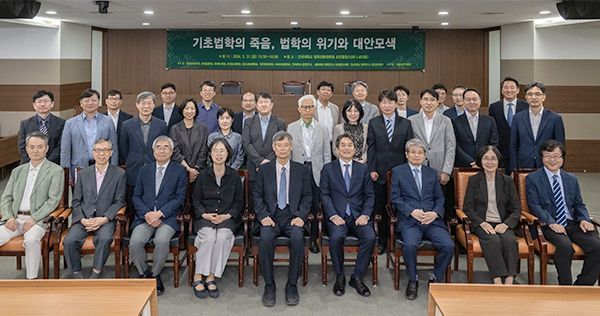
The event was organized by Park Beom-gye, a member of the Democratic Party of Korea, and co-hosted by the Korean Society of Legal Philosophy, Korean Society of Legal History, Korean Society of Sociology of Law, Society for Law and Social Theory, Korean Gender Law Association, Asia Women’s Law Association, Konkuk University Law Research Institute, Seoul National University Law Research Institute’s Legal Theory Research Center, and Chonnam National University Law Research Institute’s Legal Humanities Center.
Attendees agreed that although foundational law subjects are included in the law school curriculum, the number of professors teaching them and students taking these courses has declined to a 'near extinction' state.
Among the total 788 law school professors, only 30 (3.8%) are dedicated to foundational law subjects.
Professor Jang Won-kyung of Ewha Womans University Scranton Division presented on 'The Status of Foundational Law Education and Research in Law Schools Based on Data,' stating, "As of 2023, there are only 30 professors specializing in foundational law: 6 at Seoul National University, 3 at Chonnam National University, 2 each at Korea University, Yonsei University, and Pusan National University." She added, "Five universities?Kyung Hee University, University of Seoul, Wonkwang University, Chungnam National University, and Chungbuk National University?do not have a single professor specializing in foundational law."
She further noted, "Last year, only about 40 students took sociology of law courses across 18 law schools. The situation is similar for other foundational law subjects such as legal methodology, sociology of law, and legal history."
Professor Go Bong-jin of Jeju National University Law School also expressed concern, saying, "Vacant positions of retired foundational law professors are not being filled, and professors from other specializations are gradually taking over these roles. If this trend continues, foundational law will be relegated to a 'minor subject'."
Foundational Law Courses Should Be Designated as Mandatory Subjects
The reason for the crisis in foundational law was pointed out as the law school education being centered on subjects required to pass the bar exam, such as civil law, criminal law, and public law, leaving students with little opportunity to experience foundational law. Accordingly, there are calls to designate foundational law courses as mandatory major subjects required for law school graduation and to include the offering of foundational law courses as a criterion in law school evaluations.
Professor Gong Doo-hyun (43, Judicial Research and Training Institute Class 40) of Seoul National University Law School proposed, "Foundational law subjects such as legal philosophy, legal history, sociology of law, and gender law should be designated as selectively mandatory courses so that anyone aspiring to become a legal professional can take at least one foundational law course in law school. To achieve this, the availability of foundational law courses should be reflected in law school evaluation criteria."
He also criticized, "Academic management focused on short-term bar exam results has ultimately caused a 'tragedy of the commons' in academia, stifling not only foundational law but also the academic development of specialized subjects such as environmental law, tax law, and intellectual property law."
Professor Kim Yeon-mi of Chonnam National University Law School emphasized, "The Enforcement Decree of the Act on Professional Graduate Schools of Law should be amended to clearly define foundational law subjects in the curriculum, which have been institutionally marginalized under the current law school system."
Former Constitutional Court Justice Lee Seok-tae (71, Class 14), who participated in the roundtable discussion, suggested, "The approval conditions or operational requirements for law schools should include an assessment of whether foundational law courses are offered and whether it is realistically possible to conduct such lectures. Another option is to incorporate foundational law subjects as elective subjects in the bar exam."
There was also a forecast that foundational law education would be possible only if all law students meeting minimum standards pass the bar exam. Professor Lim Sang-hyuk of Soongsil University’s Department of Law analyzed, "Currently, the bar exam operates with a quota system similar to the former judicial examination. This situation leads to law students neglecting law lectures and relying on private exam academies, which is being replicated in law schools."
Professor Go Bong-jin of Jeju National University Law School added, "Unlike Korea, where the bar exam is a binding factor, U.S. law schools have the flexibility to approach law from various perspectives. Although bar exam pass rates vary by state, they generally exceed 70-80%."
To strengthen foundational law, there was also an opinion that practical training should be conducted separately at other institutions after law school graduation.
Professor Lee Hwang-hee (47, Class 34) of Sungkyunkwan University Law School said, "Due to the heavy study load required to prepare for exams during the three years of law school, it is even more difficult to focus on foundational law studies. Like in Japan, where successful candidates of the new bar exam undergo practical training at separate institutions such as the Judicial Research and Training Institute or the Korean Bar Association, such a system could be considered."
Professor Lee Jae-seung of Konkuk University Law School explained, "In reality, students rarely take courses unrelated to the bar exam. It is more appropriate for students to receive thorough theoretical education in law school and then acquire necessary practical knowledge through internships after obtaining their bar qualification, which would be a better educational structure balancing theory and practice."
Reported by Lee Soon-gyu and Ahn Hyun, Legal News Journal
※This article is based on content supplied by Law Times.
© The Asia Business Daily(www.asiae.co.kr). All rights reserved.
![Clutching a Stolen Dior Bag, Saying "I Hate Being Poor but Real"... The Grotesque Con of a "Human Knockoff" [Slate]](https://cwcontent.asiae.co.kr/asiaresize/183/2026021902243444107_1771435474.jpg)
















