Last Month's Anode Material Export Price $27,683
Up $55 from Previous Month
Small Increase but
Sign of Raw Material Price Stabilization Starting to Reflect
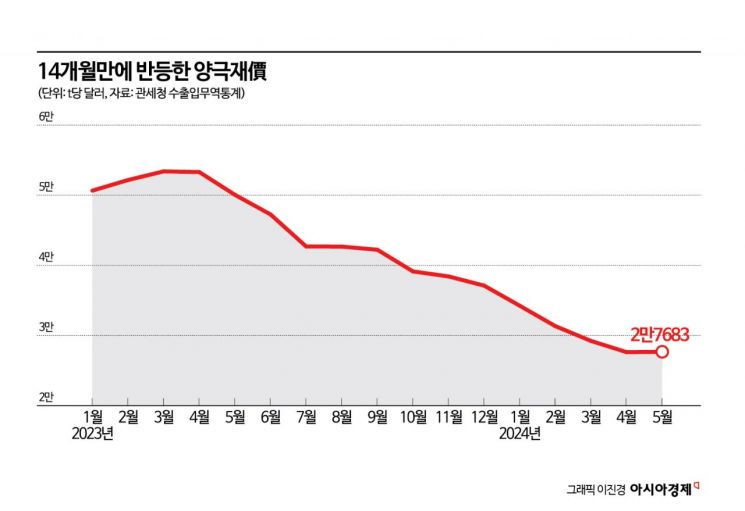
The export price of cathode materials rebounded for the first time in 14 months since March last year. Although slight, this signals that the stabilization phase of raw material prices has begun to be reflected in actual selling prices. This is interpreted as having a positive impact on the profitability of cathode material companies.
According to the Korea Customs Service export-import trade statistics on the 3rd, the average export price of NCM (Nickel-Cobalt-Manganese) and NCA (Nickel-Cobalt-Aluminum) cathode materials in May last month recorded $27,683 per ton (approximately 38.34 million KRW). This is a slight increase of about $55 from $27,628 per ton (approximately 38.26 million KRW) in the previous month. Although the rise is minimal, the halt in the downward trend is seen as a positive sign. The export price of cathode materials fell nearly 50% over about a year after recording $53,394 per ton (approximately 73.95 million KRW) in March last year.
The decline in raw material prices such as lithium and nickel caused cathode material prices to struggle. Cathode material prices are greatly influenced by raw materials like lithium and nickel, whose prices have continuously dropped. Lithium prices fell from 581,000 CNY per ton (approximately 110.79 million KRW) in November 2022 to the 80,000 CNY range by the end of last year. Currently, they have slightly risen to around 100,000 CNY, stabilizing the downward trend. Nickel prices also increased from about $16,000 in January this year to nearly $20,000 now. There is a 3 to 6-month lag between raw material prices and actual selling prices, so the slight rebound in cathode material prices appears to reflect most of the raw material price declines.
If the rising raw material prices this year are reflected in selling prices, profitability could improve significantly. Cathode material companies sign contracts linking mineral prices such as lithium and nickel with selling prices. The selling price is based on the mineral price at the time of selling the final product, the cathode material, not when purchasing the minerals. When mineral prices fall, companies buy high and sell low, but when mineral prices rise, they buy low and sell high. The increase in product prices due to rising prices, which enlarges the margin companies earn when selling actual products, is called the 'Lagging Effect.' Battery companies are hopeful for profitability improvements this year due to the lagging effect.
While prices rebounded, export volume, indicated by export weight, showed a declining trend again. Export weight rose to 26,000 tons last year but dropped to the 10,000-ton range in the fourth quarter and further fell to 13,964 tons. This year, with the release of electric vehicle subsidies and recovery of upstream demand, it reached 21,695 tons last month, recovering to the 20,000-ton range. However, last month it declined again to 19,442 tons. The slow recovery of export weight indicates that electric vehicle demand has still not fully recovered.
© The Asia Business Daily(www.asiae.co.kr). All rights reserved.
![Clutching a Stolen Dior Bag, Saying "I Hate Being Poor but Real"... The Grotesque Con of a "Human Knockoff" [Slate]](https://cwcontent.asiae.co.kr/asiaresize/183/2026021902243444107_1771435474.jpg)
















