Political Circles Divided Over Establishing Jigu-dang
Debate on How Far to Expand Donation Targets
At the Crossroads Between Parliamentary Party and Mass Party Paths
Debate on How Far to Expand Donation Targets
At the Crossroads Between Parliamentary Party and Mass Party Paths
Upon entering the 22nd National Assembly, the issue of 'reviving the Jigu Party' has emerged as a major focus in the political arena. Since the Jigu Party, once considered a hotbed of illegal political funds, was abolished, there has been a call to improve the situation akin to 'kicking away the ladder,' where opportunities were excluded for politicians other than incumbent lawmakers. On one side, proponents argue that reviving the Jigu Party is political reform. However, on the other side, critics raise their voices, claiming it is a regression in political reform. Nonetheless, there is a point that a more fundamental question should be raised regarding this matter.
A prominent figure who has recently actively advocated for the 'revival of the Jigu Party' in the political sphere is Han Dong-hoon, former Emergency Committee Chairman of the People Power Party, who is rumored to be a candidate for the party convention. On the 30th of last month, he expressed on social media (SNS), "I believe that reviving the Jigu Party to break down the walls of vested interests and allow political newcomers and youth to compete fairly on the ground is 'political reform,'" thus raising the argument for reviving the Jigu Party. Kim Young-bae of the Democratic Party and Yoon Sang-hyun of the People Power Party also submitted amendments to the Political Parties Act and Political Funds Act as the first bills of the 22nd National Assembly, initiating legislation for the revival of the Jigu Party. Earlier, Lee Jae-myung, leader of the Democratic Party, also emphasized the necessity of reviving the Jigu Party.
However, opposing voices have also emerged. Oh Se-hoon, Mayor of Seoul and the very person responsible for abolishing the Jigu Party through legislation in 2004 following the illegal presidential election fund scandal in 2002, expressed opposition, stating, "While creating the Jigu Party might help the party leader dominate the party, what benefit would that have for the people?" Opposition is also strong among the ruling party centered in the Yeongnam region. The Innovation Party for Justice and the Reform New Party are also negative about the revival of the Jigu Party.
The core issue in the current discussion about the Jigu Party is the fairness between incumbent and non-incumbent party branch chiefs. For this reason, the key point of the bills related to reviving the Jigu Party is to allow non-incumbent party branch chiefs to operate local offices and raise funds. Under current law, incumbent lawmakers can have local offices, but non-incumbent chiefs cannot. Advocates for reviving the Jigu Party emphasize that it provides opportunities for political newcomers to compete fairly with incumbents. However, opponents worry that the Jigu Party could again become a hotbed of political corruption as in the past. Mayor Hong Joon-pyo criticized it as "re-establishing the institutional framework for political corruption."
To address the 'fairness issue,' it must be dealt with beyond party branch chiefs at the non-incumbent level
However, there is also a view within the political sphere that a more fundamental issue exists beyond this point. Why should fair competition be guaranteed only up to party branch chiefs? Former lawmaker Yoo Seung-min pointed out this issue on SNS the day before. He said, "The debate over the 'revival of the Jigu Party' misses the truly necessary political reform," adding, "The unfairness in our politics is a problem between incumbents and non-incumbents. It is not simply an issue between incumbent lawmakers and non-incumbent party branch chiefs (or regional chiefs)."
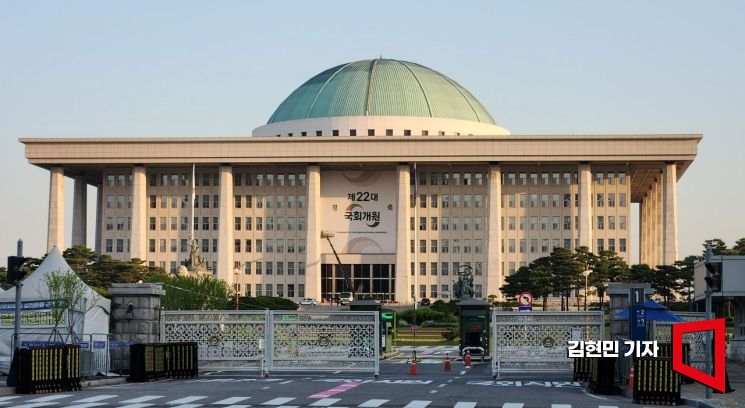 On the 29th, the last day of the 21st National Assembly's term, a banner congratulating the opening of the 22nd National Assembly is hung at the main building of the National Assembly. Photo by Kim Hyun-min kimhyun81@
The current discussion about reviving the Jigu Party ultimately benefits only non-incumbent regional chiefs similarly positioned to incumbents, but does not apply to other politicians or political aspirants. In effect, it is no different from issuing 'politician licenses' to hundreds of non-incumbent chiefs of major parties in addition to the 300 incumbent lawmakers. Former lawmaker Yoo Seung-min criticized, "To create a level playing field where fair and free competition is possible, all entry barriers must be removed. Reviving the Jigu Party for non-incumbent party branch (regional) chiefs and allowing them to receive political donations to maintain offices and staff for political activities raises the question: how can politicians who are not party branch chiefs engage in political activities? That is another entry barrier." Yoo proposed an alternative direction allowing fundraising regardless of incumbency. He also stated, "Political donations should be registered with credible national institutions such as the National Election Commission, with legal limits and spending purposes defined. All expenditures should be transparently disclosed for monitoring, and illegal activities must be strictly punished." He argued that subsidies, which are paid in large amounts according to the number of seats, should also be reformed from the perspective of removing entry barriers.
The path forward for political parties? Member-centered mass parties vs. legislature-centered parliamentary parties
Underlying this issue is a latent difference in perspectives regarding the development direction of political parties. Whether to establish themselves as parliamentary parties like in the United States or to follow the path of mass parties that reflect the will of party members. The revival of the Jigu Party could promote the path of member-centered mass parties instead of the legislature-centered parliamentary parties pursued since the so-called 'Oh Se-hoon Law.'
Within the Democratic Party, there are opinions advocating for member participation and using the Jigu Party as a kind of tool. On the 2nd, the Democratic Party National Innovation Council passed a resolution rejecting "the regressive parliamentary party centered on lawmakers," demanding "institutionalization of full party member voting to decide party positions." They called for "regularizing party member assemblies to gather members' opinions" and "reviving local parties so that all regional committees can operate." They argue that the direction for political parties is not parliamentary parties but member-centered mass parties.
Opponents of reviving the Jigu Party point out that this controversy could strengthen the power of hardline party members within the Democratic Party. Mayor Hong Joon-pyo noted, "There is an intention to strengthen 'Gaeddal politics' (a term referring to fervent female Democratic Party supporters)." He explained that hardline party members are concentrated online, and if the Jigu Party is revived, conditions will be created for them to also be active within the Jigu Party.
Mayor Oh Se-hoon, who opposes the revival of the Jigu Party, mentioned the advantages of the parliamentary party structure. He said, "In the United States, there is no party leader, and outside election periods, there is no constituency activity in the parliamentary party structure," adding, "It is ideal for the party to be led by the parliamentary leader and for politics to revolve around legislative issues, as in the U.S." Comparing with Korea, where party branch committees exist, he said, "Would the U.S. fail to gather public opinion? On the contrary, there are many evaluations that it does better." He also introduced that "In the past, the U.S. had organizations similar to the Jigu Party called 'party machines,' but due to numerous corruption and abuses, they have now disappeared."
© The Asia Business Daily(www.asiae.co.kr). All rights reserved.
![Clutching a Stolen Dior Bag, Saying "I Hate Being Poor but Real"... The Grotesque Con of a "Human Knockoff" [Slate]](https://cwcontent.asiae.co.kr/asiaresize/183/2026021902243444107_1771435474.jpg)
















