New Product Record in One Year
'Blackwell Ultra' Next Year · 'Rubin' in 2026
HBM Required... Benefits for SK Hynix and Samsung Electronics
NVIDIA, leading the competition in artificial intelligence (AI) chips, unveiled its next-generation AI graphics processing unit (GPU) "Rubin" for the first time at Computex 2024, Asia's largest ICT exhibition. NVIDIA plans to release Rubin in 2026.
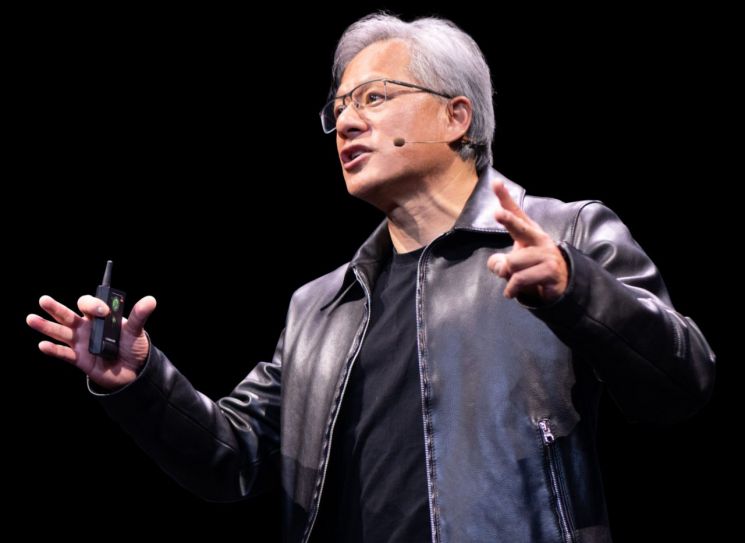
Jensen Huang, CEO of NVIDIA, said in his keynote speech at the National Taiwan University Sports Center in Taipei, Taiwan, on the evening of the 2nd, "Through GPUs equipped with the necessary functions for data centers, we will push new technologies such as packaging, memory, and optics to their limits."
As part of this, NVIDIA will launch "Blackwell Ultra" next year and Rubin in 2026. Blackwell Ultra is a product that significantly enhances the performance of the server GPU NVIDIA introduced last March. Rubin is a product with a completely redesigned internal structure. With the development and release of these products, NVIDIA will release new products on a yearly basis. CEO Huang stated, "GPU development after Rubin will proceed on a yearly cycle."
With the development of Blackwell Ultra and Rubin, Korean companies SK Hynix and Samsung Electronics are also expected to continuously benefit, as high-bandwidth memory (HBM) is crucial for both GPUs. According to Huang's announcement, Rubin will use the 6th generation HBM4. The likely next version, "Rubin Ultra," will be equipped with 12 HBM4 units.
In addition, NVIDIA announced plans to showcase the performance of various products, including AI chips, at this Computex. On the 30th and 31st of last month, an online media pre-briefing was held, led by Gilad Shainer, Senior Vice President of Networking, and Manvir Das, Vice President of Enterprise Computing, to provide an early preview.
NVIDIA plans to introduce its GPU technology "RTX (Ray Tracing Texel eXtreme ? a professional visual computing platform)" and the "RTX AI Toolkit." PCs based on RTX are called RTX AI PCs, examples of which include ASUS's TUF A14/16 models and Zephyrus G16, as well as MSI's Stealth A16. These products are equipped with "GeForce RTX."
By utilizing RTX-based AI PCs, content creators can simplify and automate their workflows, and streamers can use AI-based background removal and noise reduction features, NVIDIA explained.
NVIDIA also added that developers can use the "RTX AI Toolkit," which helps optimize and personalize workflows, to process tasks quickly and with less capacity. Additionally, products for game developers such as digital human technology that helps create realistic avatars and the RTX-based AI assistant "G-Assist" will be introduced.
For enterprise products, the next-generation AI chip "Blackwell" will be showcased again. According to NVIDIA, Blackwell can deliver AI performance 1,000 times greater than the "Pascal platform" released eight years ago. It also supports building and running real-time generative AI on large language models (LLMs) with lower costs and energy compared to previous generations. NVIDIA cited Taiwan's Foxconn as a representative company adopting the Blackwell platform.
In the networking field, NVIDIA will introduce the AI Ethernet networking platform "Spectrum X." This service, designed to build hyperscale AI clouds, helps users improve AI cloud performance and power efficiency while reducing time to market. Other technologies to be introduced include "NVIDIA NIM," which facilitates easy deployment of AI models, and "NVIDIA Isaac," a platform used for developing AI robots such as robotic arms.
© The Asia Business Daily(www.asiae.co.kr). All rights reserved.
![Clutching a Stolen Dior Bag, Saying "I Hate Being Poor but Real"... The Grotesque Con of a "Human Knockoff" [Slate]](https://cwcontent.asiae.co.kr/asiaresize/183/2026021902243444107_1771435474.jpg)
















