US-China Exchange of Blows
Zelensky Criticizes China and Russia for Disrupting Peace Talks
The 21st Asia Security Conference (Shangri-La Dialogue) concluded on the afternoon of the 2nd (local time), once again confirming global security conflicts and crises.
Over three days, intense exchanges took place centered on the United States and China regarding various international issues such as Taiwan and the South China Sea, the wars in Ukraine and the Gaza Strip, and North Korean provocations.
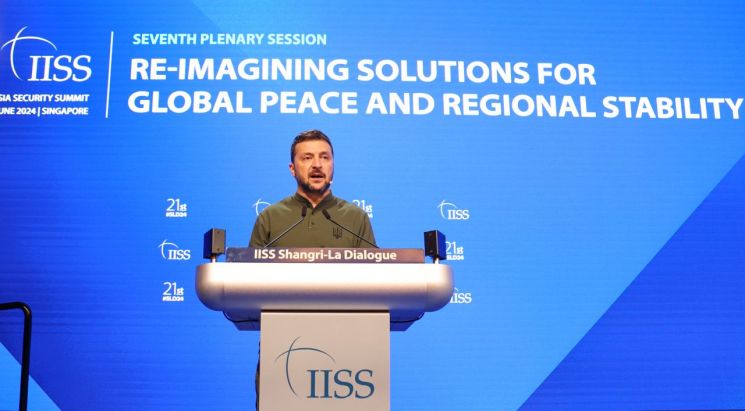
The conference began with an opening speech by Philippine President Ferdinand Marcos and ended with a closing speech by Ukrainian President Volodymyr Zelensky.
The speeches of the two leaders, which drew significant attention, covered multiple topics and reflected the international community's concerns about China and Russia.
On the first day of the event, May 31, President Marcos sharply criticized China, which is involved in territorial disputes in the South China Sea, stating, "The Philippines and other Southeast Asian countries have a vision for peace, stability, and prosperity in the South China Sea, but it is being undermined by other actors."
The following day, U.S. Secretary of Defense Lloyd Austin said, "Peaceful dispute resolution through dialogue is necessary, not coercion, conflict, or so-called 'punishment,'" adding, "Propagandists will continue to reject the rule of law and try to impose their will through coercion and aggression."
This was interpreted as criticism of the Chinese military's "Taiwan encirclement" exercises and the Chinese coast guard's water cannon attack on Philippine vessels following the pro-American and independence-leaning Lai Ching-te government’s inauguration on April 20.
Secretary Austin also expressed concern about Chinese military exercises around Taiwan and emphasized the importance of freedom of navigation in the South China Sea during talks with Chinese Defense Minister Dong Jun on the first day of the event.
The face-to-face meeting between the U.S. and Chinese defense chiefs, held for the first time in 18 months, attracted attention, but the dialogue ended with both sides reiterating their respective positions.
In his speech on the 2nd, Minister Dong counterattacked by condemning U.S. involvement in what China considers its "core interests," such as Taiwan and the South China Sea. He warned, "Anyone who dares to separate Taiwan from China will surely have their body and bones shattered to dust and bring about their own destruction."
However, the two countries agreed to continue communication by resuming phone calls between military commanders and establishing a "crisis communication working group."
As the final speaker of this year’s conference, President Zelensky made a surprise appearance and criticized Russia and China.
In his speech, he called for attendance at the "Ukraine Peace Conference" and later stated at a press conference, "China is pressuring other countries and leaders not to attend the Ukraine Peace Conference," adding, "It is regrettable that an independent power like China is a tool of Putin."
The peace conference, scheduled for June 15-16 at the resort B?rgenstock near Lucerne in central Switzerland, will invite world leaders to discuss ending the war in Ukraine.
Hosted by neutral Switzerland at Ukraine’s request, Russia and China have announced their intention not to participate.
During the event, countries held bilateral and multilateral meetings separately from the main conference.
South Korean Minister of National Defense Shin Won-sik condemned North Korea’s release of contaminated balloons as a violation of the armistice agreement during his meeting with U.S. Secretary Austin.
In talks with Japanese Defense Minister Kihara Minoru, they agreed on measures to prevent the recurrence of the "patrol aircraft conflict" and decided to activate dialogue between their defense authorities.
© The Asia Business Daily(www.asiae.co.kr). All rights reserved.
![Clutching a Stolen Dior Bag, Saying "I Hate Being Poor but Real"... The Grotesque Con of a "Human Knockoff" [Slate]](https://cwcontent.asiae.co.kr/asiaresize/183/2026021902243444107_1771435474.jpg)
















