Increase in Working Elderly Due to Aging Population and Elderly Poverty
It was found that 3 out of 10 recipients of unemployment benefits are aged 60 or older.
According to the employment administration statistics from the Ministry of Employment and Labor on the 2nd, the total number of unemployment benefit recipients in April was 680,325. Among them, the age group of 60 to 69 accounted for the largest number with 192,369 (28.3%). Adding 8,433 recipients aged 70 and above, those aged 60 or older made up 29.5% (208,020) of all recipients in April.
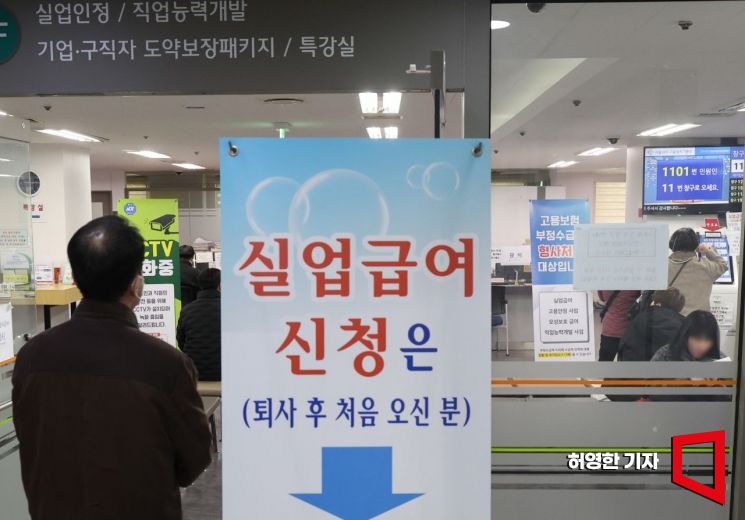 At an employment support center in Seoul, clients are waiting in line at the unemployment recognition application window to receive unemployment benefits. Photo by Huh Younghan younghan@
In the same month 10 years ago, in 2014, recipients aged 60 or older accounted for only 13.4% of the total. With the rapid aging of the domestic population and increased labor market participation of those aged 60 and above, the proportion of unemployment benefit recipients aged 60 or older has also risen rapidly.
Looking at a one-year basis, in 2013, out of 1.21 million total recipients, about 132,000 (10.9%) were aged 60 or older. Last year, out of 1.77 million recipients, about 445,000 (25.1%) were aged 60 or older, meaning about one in four recipients was 60 or older. This represents a 2.3-fold increase over 10 years. Furthermore, this year, the monthly proportion of elderly recipients has consistently remained around 30%, increasing compared to last year.
The increase in unemployment benefit recipients among the elderly is mainly attributed to the rise in the working population over 60 due to aging and elderly poverty. While the number of employment insurance subscribers in their 20s and 40s has been continuously decreasing recently, the number of subscribers aged 60 or older has not declined. As of April, those aged 60 or older accounted for 16.7% of all employment insurance subscribers.
Additionally, many aged 60 or older are employed in relatively unstable jobs such as non-regular positions, which is another reason for the increase in recipients. As of August last year, the proportion of non-regular workers among all wage workers was 37.0%, whereas among workers aged 60 or older, 68.7% were non-regular workers.
The Government Pushes to Cut Unemployment Benefits
The total amount of unemployment benefits paid in April exceeded 1 trillion won for the first time in eight months since August last year, reaching 1.0546 trillion won.
Last month, the Ministry of Employment and Labor announced legislative amendments including partial revisions to the Employment Insurance Act and the Industrial Accident Compensation Insurance Collection Act. The main points are ‘reducing benefits for repeat recipients’ and ‘extending the waiting period.’ The amendments stipulate that recipients who have received unemployment benefits two or more times within five years prior to their separation date (last working day) will have their benefits reduced by up to 50% based on the number of times they have received benefits. The specific reduction range will be determined by enforcement ordinances.
In response, the Korean Confederation of Trade Unions criticized, “The cause and responsibility for the increase in unemployment benefit recipients and repeat claims lie with companies that make employment unstable and the government that encouraged this. They claimed to protect vulnerable workers but are now trying to take away even the minimum safety net.”
© The Asia Business Daily(www.asiae.co.kr). All rights reserved.
![Clutching a Stolen Dior Bag, Saying "I Hate Being Poor but Real"... The Grotesque Con of a "Human Knockoff" [Slate]](https://cwcontent.asiae.co.kr/asiaresize/183/2026021902243444107_1771435474.jpg)
















