Deputy Foreign Ministers of Three Countries Hold Meeting Near Washington DC
Express Concern Over Strengthening Military Ties Between North Korea and Russia
"Reaffirm Importance of Trilateral Cooperation... Essential for Security and Prosperity"
The deputy foreign ministers of South Korea, the United States, and Japan jointly condemned North Korea's security-threatening actions, including its satellite launch, during a meeting held near Washington DC on the 31st (local time). They expressed concern over the strengthening military ties between North Korea and Russia and agreed on strong opposition to unilateral attempts to change the status quo in the Indo-Pacific maritime region.
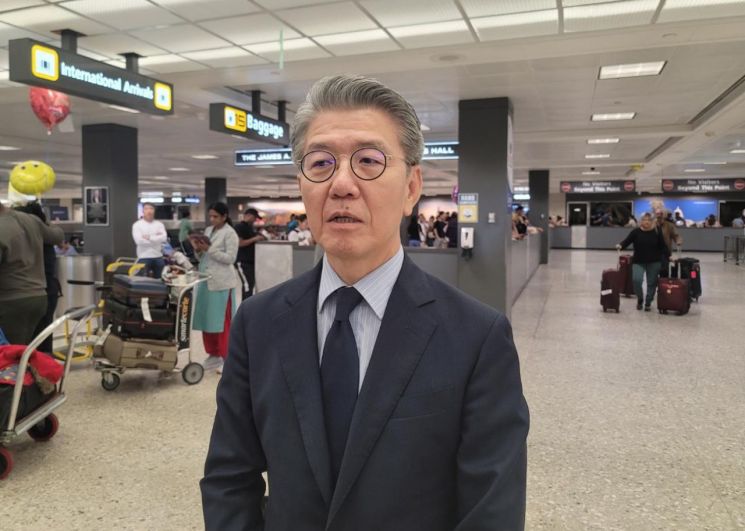 On the 29th of last month (local time), Kim Hong-gyun, the First Vice Minister of Foreign Affairs, arrived through Dulles Airport near Washington D.C., USA, to attend the Korea-U.S.-Japan Deputy Foreign Ministers' Meeting scheduled for the 31st, and responded to reporters' questions.
 [Image source=Yonhap News]
Kim Hong-kyun, First Vice Foreign Minister of South Korea, Kurt Campbell, U.S. Deputy Secretary of State, and Masataka Okano, Administrative Vice Minister of Foreign Affairs of Japan, held consultations at a farm near Washington owned by Deputy Secretary Campbell to discuss regional issues including North Korea's escalating provocations.
Immediately after the meeting, the three countries' deputy ministers issued a joint statement reaffirming that "we recognize the importance of trilateral cooperation in responding to the difficult challenges we face" and emphasized that "our triangular cooperation is essential for the security and prosperity of the Indo-Pacific."
They continued, "We share concerns over the increase in North Korea's security-threatening acts and rhetoric and strongly condemn the recent launch using ballistic missile technology, including North Korea's so-called 'military reconnaissance satellite,'" and "We reaffirm our commitment to the complete denuclearization of the Korean Peninsula and urge North Korea to engage in substantive dialogue without preconditions."
Targeting China, they stated, "We strongly oppose unilateral attempts to change the status quo in the Indo-Pacific maritime region and recognize the importance of opposing illegal maritime sovereignty claims in the South China Sea." They further added, "We reaffirm the importance of maintaining peace and stability in the Taiwan Strait," and "Our fundamental position on the Taiwan issue remains unchanged, and we urge a peaceful resolution of cross-strait issues."
They also pledged, "We will continue to expand trilateral cooperation to strengthen regional security against North Korea's threats," and reaffirmed that "Deputy Secretary Campbell confirmed that the United States' security commitments to South Korea and Japan are ironclad and supported by capabilities across the full spectrum, including nuclear."
Deputy Secretary Campbell is also reported to have confirmed the enhancement of extended deterrence for South Korea and Japan. They agreed to closely cooperate in finding ways to ensure the full implementation of UN Security Council resolutions following the conclusion of the UN Panel of Experts on North Korean sanctions.
Additionally, they shared concerns about the strengthening military cooperation between North Korea and Russia, stating, "We will cooperate more closely to support Ukraine's energy infrastructure and reconstruction and join efforts to hold Russia accountable."
Regarding economic cooperation, they emphasized, "We will strengthen economic cooperation and enhance coordination in supply chain sectors," and stressed that "Investing in each other's prosperity by strengthening economic cooperation as some of the world's most dynamic economic actors is a top priority."
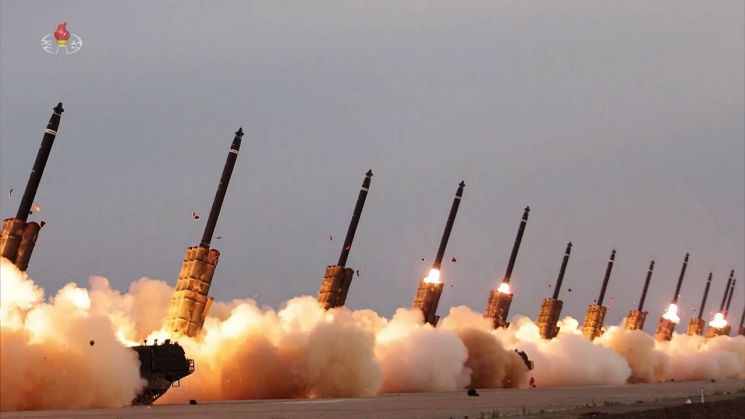 North Korean State Affairs Commission Chairman Kim Jong-un personally supervised the demonstration firing of a 600mm super-large multiple rocket launcher within striking range of South Korea on the 30th of last month, according to Korean Central TV on the 31st. Eighteen super-large rockets were simultaneously fired from 18 Transporter Erector Launchers (TEL) at Pyongyang Sunan Airport. [Korean Central TV footage] [Image source=Yonhap News]
"As evidence of this, through a new quantum program with IBM and universities from South Korea, the U.S., and Japan, we will train more than 40,000 students over the next decade," and "We also welcome the launch of the trilateral technology leadership program at Johns Hopkins University," they added.
The three countries plan to hold their next meeting in the second half of the year in Seoul, South Korea, and also intend to promote a trilateral summit within this year. At a press conference prior to the meeting, Deputy Secretary Campbell stated, "President Joe Biden will be most proud of the positive progress in trilateral relations during his tenure," and "We will establish a consultative body akin to a secretariat to maintain this momentum."
Before the meeting, Vice Minister Kim said at a press conference, "North Korea continues to violate UN Security Council resolutions and threatens the region with its nuclear weapons and missiles," pointing out that "the so-called 'military reconnaissance satellite' launch on the 27th is a recent example of such provocative acts."
© The Asia Business Daily(www.asiae.co.kr). All rights reserved.


















