Japanese F-35 'Jesa' Photo Sparks Attention
Carrying Meaning of Safety Prayers
On the 30th, a photo became a hot topic on X and various online communities. It showed a Japanese Shinto priest performing a ritual in front of the state-of-the-art stealth fighter F-35. Behind the priest dressed in white robes stood members of the Japan Self-Defense Forces and government officials in a row.
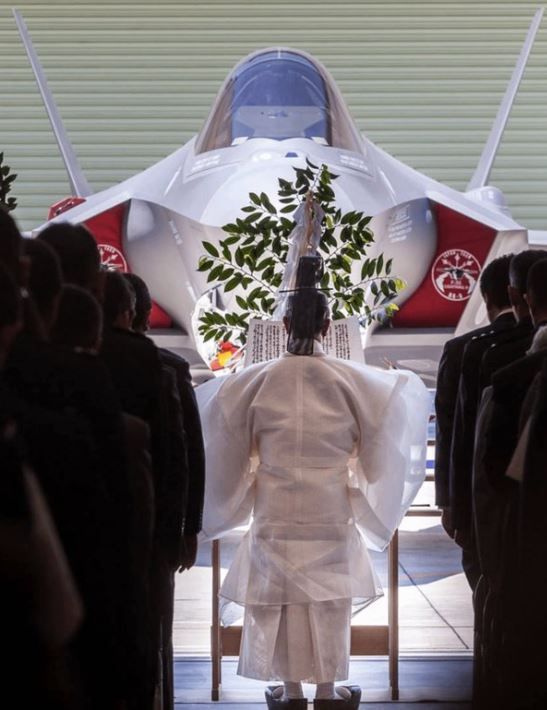 A Japanese Shinto priest blessing a fighter jet. [Image source: captured from X, Lockheed Martin homepage, etc.]
Netizens both domestic and international who saw the photo reacted with fascination, saying things like "This is a scene you would only see in Japan," and "They even perform rituals for machines." So, where does Japan's tradition of 'machine rituals' come from?
Japan Performs Rituals for Fighters, Laptops, and Semiconductors
The photo was taken in 2017 during an event held in front of an F-35 rolled out from Mitsubishi's Nagoya factory, a Japanese heavy industry company. The first F-35 rollout took place with participation from U.S. and Japanese government officials, and the Shinto priest's ritual was part of the ceremony.
Unlike other countries, Japan has a developed folk religion called Shinto. Shrines dedicated to gods are found throughout regions and even prominently in large cities. Shinto priests live in these shrines and conduct various shamanistic rituals.
In Japan, it is common to hold rituals before large construction projects or factory openings. Most are simple ceremonies meant to 'pray' that no casualties occur during future work. The same applies to fighter jets. The ritual prays for the safety of pilots during dangerous training and operations.
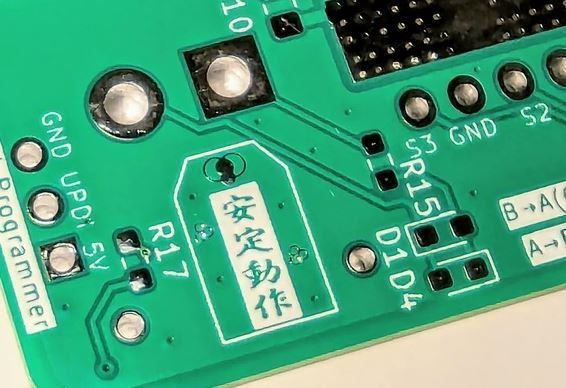 An electronic device circuit board from Japan engraved with the talisman called 'Anjeondongjak' (Safe Operation).
 [Image source=Captured from online community]
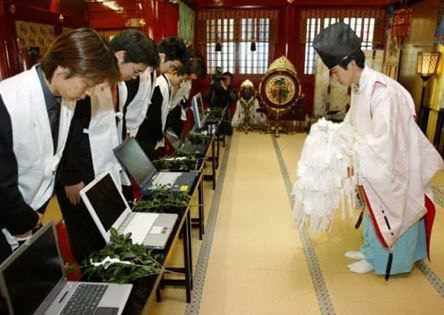
This type of prayer can also be found with everyday electronic devices. In the past, the overseas IT media outlet The Register highlighted a Japanese shrine where IT engineers receive blessings for their mobile phones and laptops one by one. Additionally, some electronic devices manufactured in Japan have 'talisman' images engraved on their circuit boards.
Superstitions Wishing for Good Luck Still Remain Worldwide
Some may dismiss these ceremonies as mere superstitions, but the act of blessing machines that perform dangerous tasks has a long history.
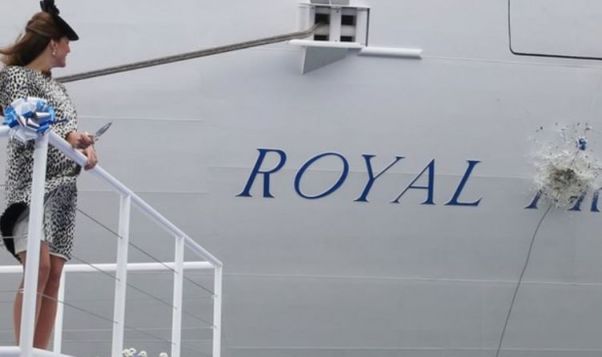 It is common in other countries as well for past superstitions to develop into ancestral rites and ceremonies. A scene from a British ship christening ceremony where a bottle of alcohol is broken on the bow. [Image source=Getty Images]
For example, in European countries such as the United Kingdom, a grand ceremony is held before a warship is officially commissioned. During this event, key figures from the royal family or government break alcoholic beverages like champagne or wine on the ship's bow, a ritual based on ancient superstitions.
In 15th century England, before a ship set sail, the king's representative would drink a glass of wine, pour the next glass onto the deck, and throw the remaining bottle overboard. This custom later evolved into the ritual of breaking a bottle filled with alcohol on the ship's bow. According to superstition, if the bottle breaks and the wine spills, the voyage would be smooth, but if it did not break, the crew would be cursed.
© The Asia Business Daily(www.asiae.co.kr). All rights reserved.



















