The American Society of Clinical Oncology (ASCO), considered one of the world's top three cancer conferences, opened on the 31st of last month (local time) in Chicago, USA. While antibody-drug conjugates (ADCs) continue to lead trends in the cancer treatment market, domestic pharmaceutical and bio companies are also unveiling new drugs at this conference.
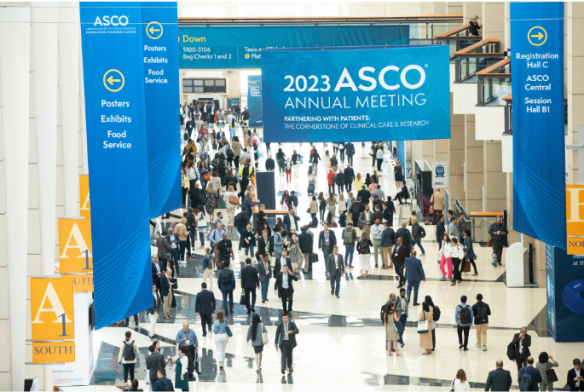 The American Society of Clinical Oncology (ASCO) is being held in Chicago, USA, last year.
 [Photo by American Society of Clinical Oncology]
ASCO, held until the 4th, is regarded as one of the world's top three cancer conferences alongside the American Association for Cancer Research (AACR) and the European Society for Medical Oncology (ESMO). With tens of thousands of attendees each year, many late-stage clinical results and real-world patient treatment outcomes are disclosed, providing clues to the birth of global blockbuster drugs.
The current cancer treatment market is rapidly being reorganized around ADCs, and since global big pharma companies are paying great attention, ADCs are also at the center of the agenda at this year's ASCO.
The reason ADCs are attracting attention is that they precisely target cancer cells like a guided missile. ADCs are based on antibody therapies; while traditional antibody therapies have the ability to locate cancer cells, in terms of actual cancer treatment, they only function like radar that suppresses growth or attracts immune cells to attack cancer cells.
ADCs can be described as guided missiles that attach bombs (cytotoxic drugs) to the radar, adding the function of attacking cancer cells. Two years ago at ASCO, AstraZeneca (AZ) and Daiichi Sankyo announced results showing that their ADC Enhertu was effective even for breast cancer patients who were previously difficult to treat with targeted therapy, sparking a surge in ADC development.
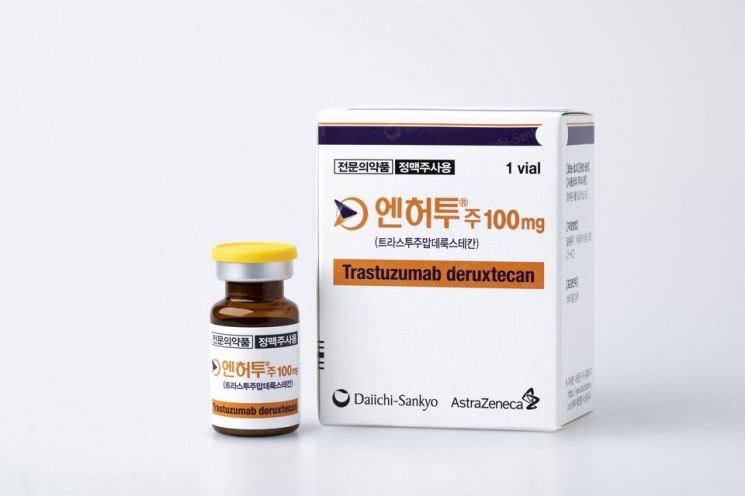 AstraZeneca-Daiichi Sankyo's antibody-drug conjugate (ADC) Enhertu (generic name: trastuzumab deruxtecan)
 [Photo by Daiichi Sankyo Korea]
AZ plans to continue this trend by presenting research related to Enhertu at this year's ASCO. This time, they have expanded the number of treatable breast cancer patients. Enhertu is a drug based on an antibody therapy that detects the human epidermal growth factor receptor 2 (HER2) protein. When only antibody therapy was available, treatment was effective only if HER2 was highly expressed, but Enhertu, as an ADC, proved two years ago that it could treat patients with 'low expression.' At this ASCO, results showing efficacy even in 'ultra-low expression' patients with almost no HER2 are expected to be presented. AZ will also disclose clinical data on another breast and lung cancer ADC, Datopotamab Deruxtecan (Dato-DXD).
Domestic medical AI company Lunit will also present research supporting Enhertu's efficacy. Using its biomarker testing solution Lunit SCOPE, they will announce research results showing that the ultra-low expression group, a new target for Enhertu, can be more clearly identified by accurately assessing HER2 expression status.
Additionally, MSD will release results for the breast cancer-targeting ADC MK-2870, and Pfizer will present phase 3 clinical trial results of Adcetris for lymphoma patients. The ADC CS5001, jointly developed by domestic ADC developers Rigachem Bio (formerly LegoChem Biosciences) and ABL Bio, will release early phase 1 clinical data through their Chinese partner, SisTone Pharmaceuticals. Rigachem also announced interim phase 2 clinical results of FS-1502, a gastric cancer drug under development by another Chinese partner, Fosun Pharma.
Attempts to develop therapies that further enhance ADCs are ongoing, but since commercialization is still premature, the ADC trend is expected to continue for the time being. Johnson & Johnson (J&J) disclosed phase 1 clinical trial results of JNJ-6420, an antibody-radioisotope conjugate (ARC) under development, at this ASCO. ARC can be described as a guided 'nuclear missile' that replaces the cytotoxic drug in conventional ADCs with a radiopharmaceutical to enhance therapeutic efficacy. Among 57 patients analyzed, one experienced complete cancer remission, but 21 suffered severe treatment-related adverse events, and four ultimately died, revealing serious toxicity concerns regarding safety.
 2024 American Society of Clinical Oncology (ASCO) Image [Photo by American Society of Clinical Oncology]
Among many domestic pharmaceutical and bio companies participating, Yuhan Corporation is drawing the most attention. Yuhan is aiming for FDA approval in the U.S. for the lung cancer drug Lekraza, which it licensed out to J&J, through combination therapy with J&J's targeted antibody therapy Rybrevant.
Yuhan plans to present multiple research results at this ASCO, among which the combination therapy results with the subcutaneous injection form of Rybrevant were selected as the most important study, "Best of ASCO," by the organizers. Currently, Rybrevant is only developed as an intravenous injection administered at hospitals, so even if FDA approval is obtained, there are concerns about limited market expansion. However, if a subcutaneous injection form that patients can self-administer at home is developed, these concerns will disappear.
HLB, which previously aimed to be the first domestic anticancer drug approved by the FDA but faced setbacks with its drug Lenvatinib, is seeking a comeback through additional research results. Following the 2022 ESMO presentation where, in combination therapy with Chinese Hansoh Pharmaceutical's antibody therapy Camrelizumab, it showed a median overall survival (mOS) exceeding 20 months for the first time among liver cancer treatments at 22.1 months, this time it presented final study results showing an increased mOS of 23.8 months. Other companies such as GI Innovation and Tium Bio are also expected to reveal various research results.
© The Asia Business Daily(www.asiae.co.kr). All rights reserved.
![Clutching a Stolen Dior Bag, Saying "I Hate Being Poor but Real"... The Grotesque Con of a "Human Knockoff" [Slate]](https://cwcontent.asiae.co.kr/asiaresize/183/2026021902243444107_1771435474.jpg)


















