WSJ Highlights Four Negative Factors
Concerns Over Nvidia Leading AI Rally
Impact on US Stock Market Inevitable
There is an analysis suggesting that Nvidia's stock price, which has been the biggest beneficiary of the AI technology development boom, may undergo a correction. In this case, the US stock market, which has continued its AI-driven rally despite concerns over prolonged high interest rates, is also expected to experience significant volatility.
WSJ: “AI Follower Concerns Are Worrisome”… Highlights Four Negative Factors
The daily Wall Street Journal (WSJ) on the 30th (local time) pointed out that the US stock market rally is excessively skewed towards AI and identified four factors that could threaten Nvidia's stock price. Nvidia's stock price has surged more than 120% this year alone, surpassing the $1,000 per share mark.
First, WSJ noted that AI is overvalued, which could lead to a decrease in demand. Contrary to global leaders including US President Joe Biden emphasizing AI innovation, the training and inference levels of large language models (LLMs), essential for advanced AI, are still considered to fall short of expectations.
AI hallucination is a representative example. WSJ stated, “Google's Gemini recommends adding glue to pizza, and Microsoft's (MS) Copilot, when asked how to cross a river with a goat, emphasizes the risk of cabbage being eaten,” and questioned, “Do you really think AI is ready to enter its prime?”
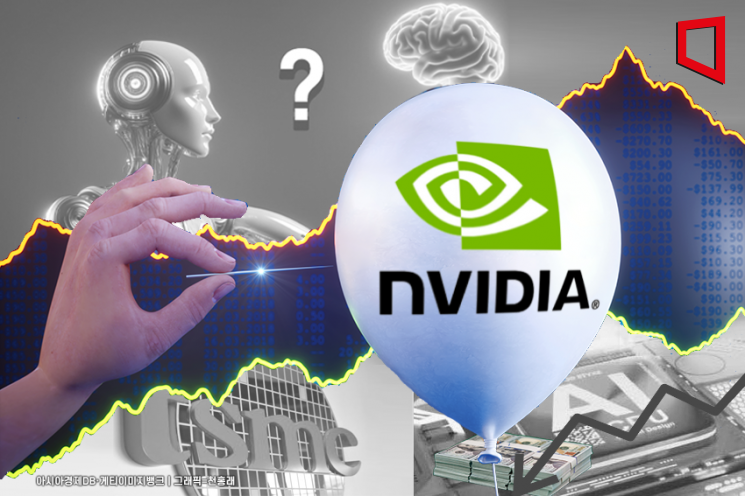
Concerns were also raised that AI semiconductor prices could fall due to overheated competition. Nvidia's operating margin led by AI semiconductors reached 65% in the first quarter. However, with not only Intel and AMD but also startups like xAI entering AI semiconductor development, the market supply is inevitably expected to increase. In this case, Nvidia's products may not be attractive enough to command a premium price, according to the analysis.
Additionally, Nvidia's AI semiconductors are entirely produced by Taiwan's TSMC, the world's number one foundry (semiconductor contract manufacturer). WSJ diagnosed that if TSMC raises the delivery price of AI semiconductors, Nvidia has no alternative but to accept it reluctantly.
Along with this, amid fierce competition among generative AI models centered on OpenAI's ChatGPT, there is a forecast that if all other models are driven out of the market, it would be a major negative factor for Nvidia. WSJ added, “It is concerning that the market is not paying close attention to these risks.”
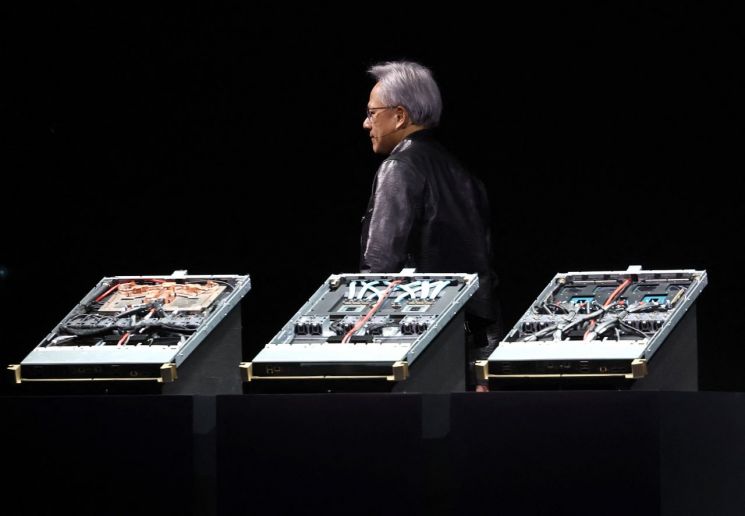 NVIDIA CEO Jensen Huang delivering the keynote speech at the GTC Artificial Intelligence Conference held last March at the SAP Center in San Jose, California.
 [Photo by Getty Images Yonhap News]
Nvidia Stock Falls 3.7%... Further Adjustment in After-Hours Trading
Nvidia's stock, which had been rising for four consecutive trading days, closed down 3.77% on the day. It also fell by about 1% in after-hours trading. This was due to a series of negative factors occurring simultaneously, including US authorities blocking export permits for AI accelerators to China and the formation of an anti-Nvidia alliance called the ‘Ultra Accelerator Link Promoter Group’ by AMD, Google, MS, and Intel.
If Nvidia's stock correction materializes, a correction phase in the US stock market is also considered inevitable. Nvidia, the AI leader, has played a significant role in sustaining the New York Stock Exchange rally this year despite the retreat of interest rate cut expectations and growing concerns over prolonged high interest rates in the US. The S&P 500 index, centered on large-cap stocks, has risen more than 10% since the beginning of the year, with the market attributing about half of this increase to Nvidia.
Peter Oppenheimer, a strategist at Goldman Sachs, said in an interview with Bloomberg TV released on the same day, “Since the (US) stock market is expected to move sideways for the next few months, it is important to devise a defensive strategy through portfolio diversification.”
© The Asia Business Daily(www.asiae.co.kr). All rights reserved.



















