General Committee Announces 11th Electricity Basic Plan
Additional 10.6GW Capacity Needed by 2038... 4.4GW from Large Nuclear Plants
Operating Nuclear Reactors '26→33 Units' · Power Generation Share '30.7→35.6%'
To respond to the rapidly increasing electricity demand from data centers due to the semiconductor cluster and the spread of artificial intelligence (AI), a plan to construct three additional large nuclear power plants by 2038 is being promoted. In this case, the current 26 nuclear power plants will increase to 33, and the share of power generation will rise from 30.7% to 35.6%. The policy to reduce coal and expand renewable energy will be maintained to raise the share of carbon-free energy to 70%.
The Ministry of Trade, Industry and Energy announced on the 31st that it has prepared a draft of the "11th Basic Plan for Electricity Supply and Demand (Electricity Basic Plan, 2024?2038)" at the general committee, an advisory body for the Electricity Basic Plan.
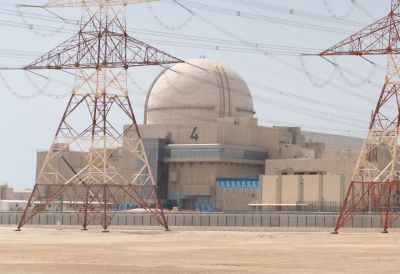
The Electricity Basic Plan is the highest-level statutory plan in the energy sector, established every two years to ensure the stability of the nation's mid- to long-term electricity supply and demand. It includes the basic direction and long-term outlook for electricity supply and demand over the next 15 years, power generation facility plans, and electricity demand management. The draft disclosed this time is a preliminary version prepared by the expert committee, and the government will finalize the official plan based on this.
The general committee predicted the increasing trend of electricity demand through a quantitative model reflecting economic growth, climate change impacts, industrial structure, and population change forecasts. It projected that the maximum electricity demand in 2038 will reach 128.9 GW, an increase of 30.6 GW compared to last year's peak demand (98.3 GW). Additionally, due to the expected surge in investment in the semiconductor industry from the establishment of semiconductor clusters, the spread of AI, and electrification demand mainly in data centers and the industrial sector, an additional 16.7 GW of electricity demand is expected by 2038. However, it is anticipated that 16.3 GW can be reduced through energy efficiency improvements.
Accordingly, the maximum electricity demand in 2038 is estimated at 129.3 GW, and considering an appropriate reserve margin (22%), the required capacity by 2038 is 157.8 GW. Reflecting the forecast for renewable energy facility deployment, the planned retirement of thermal power plants, and nuclear power plant construction plans such as Shin Hanul Units 3 and 4, the confirmed capacity in 2038 is estimated at 147.2 GW (effective capacity). This means an additional 10.6 GW of power generation facilities are needed.
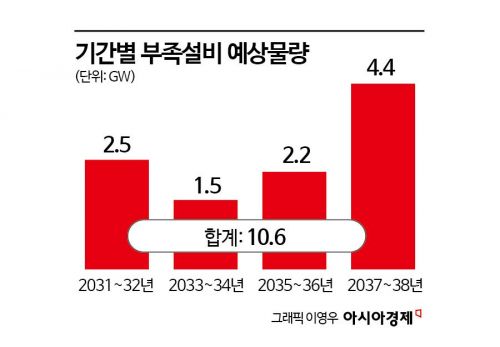
The general committee proposed a plan to the government to cover the shortfall of 10.6 GW with large nuclear power plants, small modular reactors (SMR), and combined heat and power using liquefied natural gas (LNG). Jeong Dong-wook, chairman of the 11th Electricity Basic Plan general committee, explained, "The 11th Electricity Basic Plan prioritizes the stability of power supply and focuses on composing a power mix that is economically and socially acceptable while accelerating the transition to carbon-free power sources to achieve the national greenhouse gas reduction target (NDC). Especially, considering the recently saturated power grid situation, efforts were made to derive renewable energy deployment forecasts using various policy measures."
The draft expects that new facilities will be needed starting from 2031, considering the confirmed capacity by year and the reserve margin by period, and derived the demand for new construction by period considering construction periods by power source and future technological conditions. By period, additional facilities of ▲2.5 GW in 2031?32 ▲1.5 GW in 2033?34 ▲2.2 GW in 2035?36 ▲4.4 GW in 2037?38 are required.
The general committee diagnosed that additional nuclear power plant construction is inevitable at this point to meet electricity demand after 2037. For large nuclear power plants, including site acquisition, the construction period is expected to be about 13 years and 11 months, so entry after 2037 is considered possible, and the facility plan was prepared accordingly. Construction of up to three units of APR1400, each with 1.4 GW capacity, is possible. However, it recommended that the government derive the optimal plan through consultation with project operators, comprehensively considering the construction scale, site acquisition, schedule, and costs.
For the 2.5 GW of new facilities needed in 2031?32, since the entry of carbon-free power sources is still uncertain, it was decided to cover the required capacity with combined heat and power using LNG. Of the 2.2 GW to be expanded in 2035?36, 0.7 GW will be allocated for the commercialization demonstration of the currently developing SMR, and the rest will be decided through the introduction of a carbon-free bidding market that allows competition among various carbon-free power sources such as hydrogen fuel cells, which the government was proposed to adopt.
An official from the Ministry of Trade, Industry and Energy said, "The draft proposed the introduction of a carbon-free competitive market to evaluate the economics of various carbon-free power sources in the market and promote technological competition," adding, "The government plans to explore a method to decide the optimal power source by introducing a carbon-free bidding market that allows competition among various carbon-free power sources, starting with LNG and hydrogen fuel cells."
The government expects that if power generation facilities are expanded according to this draft of the Electricity Basic Plan, the enhanced NDC target can be achieved thanks to renewable and hydrogen power generation. The official said, "By 2038, new nuclear power plants will enter, hydrogen power generation will expand further, and renewable power generation such as solar and wind will increase significantly, raising the share of carbon-free energy (CFE) to 70%, entering the full-fledged carbon-free energy era, compared to less than 40% last year."
The Ministry of Trade, Industry and Energy plans to prepare the government plan through consultations with related ministries such as strategic environmental and climate change impact assessments and the Carbon Neutral Green Growth Committee, based on the draft prepared by the expert committee. Then, after holding public hearings and reporting to the National Assembly standing committees, the 11th Electricity Basic Plan will be finalized through deliberation by the Electricity Policy Deliberation Committee.
© The Asia Business Daily(www.asiae.co.kr). All rights reserved.

![Clutching a Stolen Dior Bag, Saying "I Hate Being Poor but Real"... The Grotesque Con of a "Human Knockoff" [Slate]](https://cwcontent.asiae.co.kr/asiaresize/183/2026021902243444107_1771435474.jpg)
















