UNIST Professors Discover Pathway for Pancreatic Cancer Cell Death via Intracellular Membrane Oxidation
Pyroptosis Activation Induces Strong Immune Response... Published in Nature Communications
The research team led by Professors Kwon Taehyuk and Min Dooyoung from the Department of Chemistry at UNIST (President Lee Yonghoon) has discovered a new cancer treatment method that kills cancer cells by utilizing reactive oxygen species generated from water splitting.
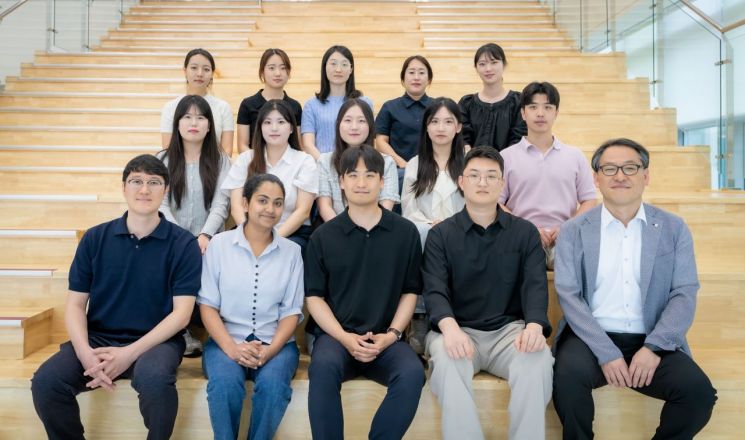 From the front row left: Professor Min Duyeong, co-first author W. C. Bhashini Wijesinghe, first author Lee Chaehun, co-first author Park Mingyu, Professor Kwon Taehyuk.
This method involves a photosensitizer that generates reactive oxygen species, which oxidizes membrane proteins inside cancer cells, leading to their destruction.
The team found that when the membrane of a cancer cell is oxidized, pyroptosis occurs. Pyroptosis is a process in which immune-related factors are released outside the cell, sending strong immune signals that induce effective cancer cell death. This is different from apoptosis, the typical method of cell death.
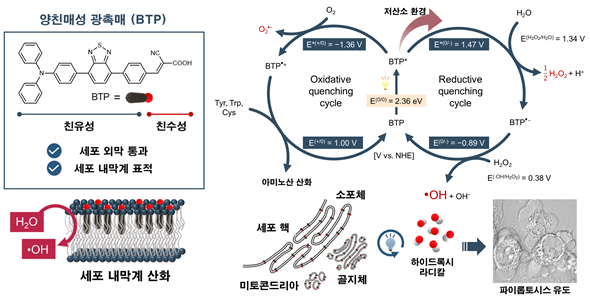
Professor Min Dooyoung emphasized that oxidation of membrane proteins leads to protein damage. When the photosensitizer inside the cell is exposed to light, membrane proteins are oxidized and damaged by reactive oxygen species. As a result, the endoplasmic reticulum, which attempts to repair this damage, becomes overloaded, ultimately triggering pyroptosis.
Lee Chaeheon, the first author of the study, said, "This research has discovered a new pathway in which pyroptosis can occur when intracellular oxidative stress accumulates independently of pathogens. These results will aid in the study of various immune-related diseases and immunotherapy for solid tumors in hypoxic environments."
Park Mingyu, co-first author and integrated master's and doctoral student, added, "We have proposed a new cancer treatment strategy that can create synergy with immunotherapy. It has proven effective even in hypoxic environments where cancer treatment is difficult, overcoming the limitations of existing drugs."
This study revealed how an electron donor-acceptor type photosensitizer can generate a potent reactive oxygen species, the hydroxyl radical, even in hypoxic environments. The photosensitizer-based anticancer drug overcomes drug resistance and activates the immune system, inducing pyroptosis to destroy cancer cells.
Professor Kwon Taehyuk explained, "This research is important for overcoming hypoxic environments to eliminate tumors and for strengthening immune responses against cancer cells, thereby preventing recurrence and metastasis. It also provides an academically new direction, as immune-activating cell death can be selectively induced at desired times and locations, and has high potential for application in cancer therapy."
Based on this research, UNIST startup company O2Medi is conducting preclinical experiments, including verifying the effective elimination of tumors in pancreatic cancer animal models.
This study was published online in the May 13 issue of Nature Communications, and was supported by O2Medi, the National Research Foundation of Korea, TIPS, the National Cancer Center, and Ulsan National Institute of Science and Technology.
© The Asia Business Daily(www.asiae.co.kr). All rights reserved.
![Clutching a Stolen Dior Bag, Saying "I Hate Being Poor but Real"... The Grotesque Con of a "Human Knockoff" [Slate]](https://cwcontent.asiae.co.kr/asiaresize/183/2026021902243444107_1771435474.jpg)

















