First Apple Tax Lawsuit... "No Evidence of High Commission Fees"
Commission Fees Reduced in EU, US, and Korea... Highest Level in China
The Shanghai court ruled against the plaintiff in an antitrust lawsuit filed by a Chinese consumer demanding the cessation of Apple's App Store commission fees and mandatory use of in-app Apple Pay.
According to local media including China’s Daily Economic News on the 30th, the Shanghai Intellectual Property Court dismissed all claims of the plaintiff in the first-instance judgment related to the 'Apple tax' antitrust lawsuit filed by a consumer the previous day.
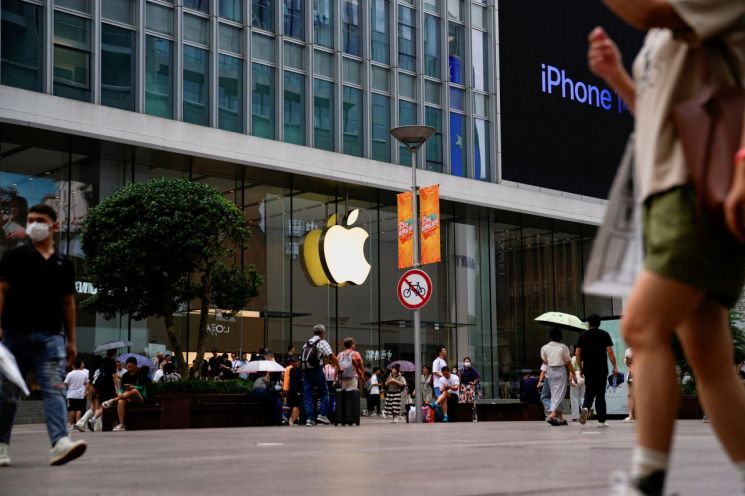
The Apple tax refers to the 15-30% commission Apple charges on all digital content consumption within the App Store. Because of this, users of Apple devices such as the iPhone had to purchase the same apps at higher prices than on Android app stores. According to market intelligence platform Sensor Tower, Apple earned approximately $22.34 billion (about 30.8224 trillion KRW) globally from the Apple tax in 2013, with revenue of 40 billion yuan from China alone.
This has caused dissatisfaction and criticism among many developers and users. Apple has been prosecuted or investigated over this issue for years in the European Union (EU), the United States, Japan, South Korea, and other regions. In March, the EU Commission announced a fine of 1.84 billion euros against Apple. EU regulators explained that Apple illegally blocked app developers from providing users with information about alternative and cheaper music subscription services outside the App Store. In response, Apple announced a new commission policy, lowering fees from 15-30% to 10-17%. In the United States, the commission was adjusted from the previous 15-30% to 12-27%.
In September 2021, South Korea officially implemented an amendment to the Telecommunications Business Act that prohibits mobile software market operators from forcing software developers to use their own payment systems and allows the government to impose restrictions on application markets for this reason. Since then, Apple’s commission rate in South Korea has been lowered to 26%.
The plaintiff filed the lawsuit in January 2021 against Apple and Apple Computer Trading Shanghai, demanding an immediate stop to the abuse of market dominance. The plaintiff also claimed compensation for economic losses of 100,000 yuan, including a price difference of 219 yuan (about 41,600 KRW) for four apps purchased on the Apple App Store compared to the Android app store.
The court stated, "Due to the vast operating system of the App Store platform, it is difficult to ascertain the specific costs Apple incurs in operating the platform," and added, "Considering operating costs, there is no evidence that the commission is significantly higher compared to similar operators."
Wang Qingfei, the plaintiff’s attorney, said, "We will appeal this case to the Supreme People’s Court," emphasizing, "In the future, domestic antitrust enforcement agencies should actively investigate and enforce measures to reduce the Apple tax."
Daily Economic News pointed out that the Apple tax imposed on Chinese companies remains at 15-30%, the highest level in the world. The media explained, "Apple’s total revenue for fiscal year 2023 is $383.3 billion, of which the services business accounts for $85.2 billion, or 22% of total revenue," adding, "While the gross profit margin for iPhone, iPad, and other hardware is 36.5%, the gross profit margin for services is 70.8%, nearly twice that of hardware."
© The Asia Business Daily(www.asiae.co.kr). All rights reserved.

















