Yasuo Attends Jeju Forum World Leaders Session
Defense Costs Doubled... Japan Breaks 'Security Taboo'
"1% of GDP Is Too Little When Seen by Japanese People"
Regarding Japan's defense policy shift, which is regarded as a de facto rearmament led by a former Japanese prime minister, he justified it with the logic that "the US-Japan alliance plays a role in maintaining the global order." On the decision to double defense spending, he appeared to avoid criticism by saying, "Although it is expressed as doubling, it is merely raising it from 1% to 2% of the Gross Domestic Product (GDP)."
Former Japanese Prime Minister Yasuo Fukuda expressed this stance on the 30th at the 'World Leaders Session' of the Jeju Forum held at the Jeju International Convention Center in Seogwipo, Jeju. The session was chaired by former Minister of Foreign Affairs and Trade Yum Young-hwan and included participants such as former UN Secretary-General Ban Ki-moon, former Prime Minister Yasuo Fukuda, Rebecca Fatima Santa Maria, Secretary-General of the Asia-Pacific Economic Cooperation (APEC), and Kao Kim Hourn, Secretary-General of the Association of Southeast Asian Nations (ASEAN).
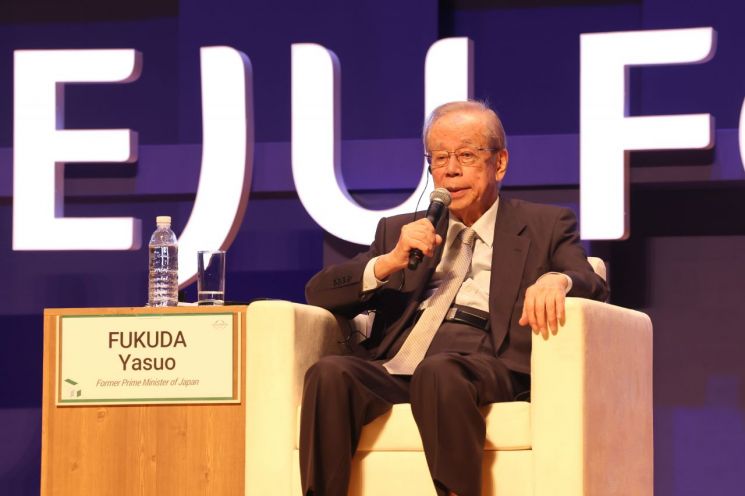 On the 30th, former Japanese Prime Minister Yasuo Fukuda is speaking at the "World Leaders Session" of the Jeju Forum held at the Jeju International Convention Center in Seogwipo City, Jeju.
 [Image source=Yonhap News]
Japan revised its National Security Strategy in 2022, abandoning the principle of maintaining defense spending within "1% of GDP" since 1976, and raised the limit to 2%. Last year, it allocated a record defense budget of 7.9496 trillion yen (approximately 71 trillion won), and announced plans to increase defense spending to 43 trillion yen by 2027, aiming to become the world's third-largest military power. Japan is gradually breaking the "security taboo" rooted in its history as a former aggressor nation.
Former Minister Yum Young-hwan pointed out that Japan has decided to acquire "preemptive strike capabilities" amid these changes in defense posture and asked how the Japanese people view these changes.
Former Prime Minister Yasuo Fukuda responded, "From abroad, it may inevitably appear that Japan can now launch preemptive attacks against enemy countries," but added, "Japan's fundamental thinking, as stated in our constitution, is the renunciation of war. Japan does not want to wage war." He continued, "However, I want to say that we must consider situations where (war or attack) becomes unavoidable, and make judgments considering the desperate moments that affect the survival of humanity." This implies that Japan's strengthening of its defense posture focuses more on self-defense rather than offense.
Fukuda said, "Even if defense spending is doubled, it means raising it from 1% to 2% of GDP, which is still only 2%," and noted that "there was criticism among the Japanese people that 1% of GDP was too low." He also emphasized that the target increase matches the NATO defense spending target of 2% of GDP.
However, he added, "Prime Minister Fumio Kishida has not yet detailed these plans in Japan," and said, "Budget execution will be postponed until next year, but I think a final decision will be made after carefully assessing changes in the international situation." He cautioned against overinterpretation, stating, "As a member of the public, I hold the position that 'nothing has been decided yet.'"
 On the 30th, panelists are discussing at the 'World Leaders Session' of the Jeju Forum held at the Jeju International Convention Center in Seogwipo City, Jeju. [Image source=Yonhap News]
Instead, he repeatedly emphasized the "crucial significance" of the US-Japan alliance, indirectly legitimizing Japan's increase in defense spending. He argued, "The US-Japan alliance must make various judgments amid difficult security situations such as Russia's invasion of Ukraine and North Korea's nuclear and missile development," and added, "The relationship between the United States and Japan holds not only security but also economic security significance, and it also plays an important role in uniting the entire world."
He further stated, "If the US-Japan alliance fails to function properly, chaos will begin worldwide," and added, "I do not know what the United States is thinking ahead of its presidential election, but I hope the US will also strive to ensure that the US-Japan relationship can play an important role in maintaining the global order."
© The Asia Business Daily(www.asiae.co.kr). All rights reserved.
![Clutching a Stolen Dior Bag, Saying "I Hate Being Poor but Real"... The Grotesque Con of a "Human Knockoff" [Slate]](https://cwcontent.asiae.co.kr/asiaresize/183/2026021902243444107_1771435474.jpg)

















