President Yoon and President Muhammad Joint Declaration
Condemning North Korean Provocations and Emphasizing Denuclearization Importance
North Korea Launches Missile That Day... Security Situation Meeting Held
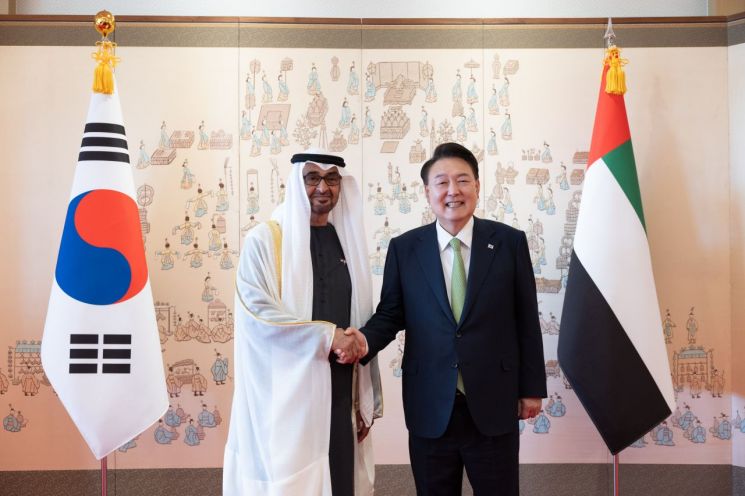 President Yoon Suk-yeol is shaking hands and taking a commemorative photo with Mohammed bin Zayed Al Nahyan, President of the United Arab Emirates (UAE), who visited South Korea as a state guest on the 29th at the Yongsan Presidential Office Building in Seoul.
 [Image source=Yonhap News]
President Yoon Suk-yeol and President Mohammed bin Zayed Al Nahyan of the United Arab Emirates (UAE) strongly condemned North Korea's ballistic missile launches, including its satellite launches, and demanded that North Korea return to the Treaty on the Non-Proliferation of Nuclear Weapons (NPT).
The Presidential Office disclosed the 'Joint Declaration' between President Yoon and President Mohammed containing these details on the 30th. Earlier, President Mohammed made a state visit to Korea from the 28th to 29th, held a summit with President Yoon, and agreed to deepen and advance the 'Special Strategic Partnership' between the two countries.
The joint declaration also included the two leaders' strong condemnation of North Korea's continuous provocations, including recent so-called 'satellite' launches and ballistic missile launches, which undermine the security of neighboring countries and the stability and security of the region and beyond.
In the joint declaration, both countries expressed deep concern over North Korea's heightened nuclear activities and demanded that North Korea respect and comply with international law and return to the Treaty on the Non-Proliferation of Nuclear Weapons. They also emphasized the importance of denuclearization of the Korean Peninsula through peaceful dialogue.
The two leaders urged North Korea to resume talks with relevant parties for peace and security on the Korean Peninsula, prioritize diplomatic solutions, and dismantle its nuclear weapons in a complete, verifiable, and irreversible manner.
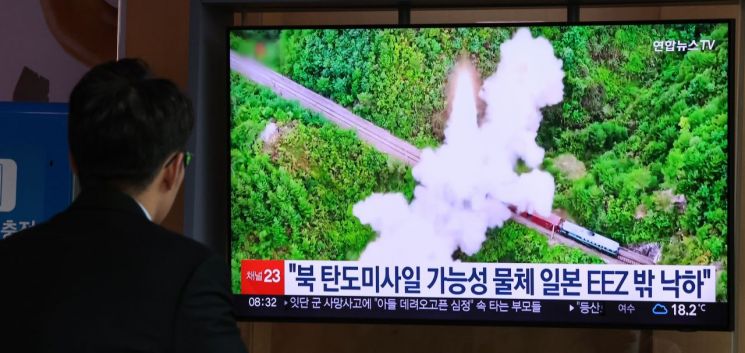 On the morning of the 30th, citizens are watching related news in the Seoul Station waiting room as North Korea launches a large number of short-range ballistic missiles into the East Sea. [Image source=Yonhap News]
Since the night of the 28th, North Korea has continued various provocations, including sending balloons carrying filth toward South Korea and launching a large number of short-range ballistic missiles (SRBMs) into the East Sea on the same day.
According to the Joint Chiefs of Staff, at around 6:14 a.m. that day, the South Korean military detected about 10 suspected SRBM projectiles launched by North Korea from the Pyongyang Sunan area toward the East Sea. The missiles flew approximately 350 km before landing in the East Sea. This distance covers major cities such as Seoul and Daejeon, as well as key air force bases from Pyongyang.
The Presidential Office held a security situation briefing chaired by In Seong-hwan, the Second Deputy Director of the National Security Office, that morning to discuss North Korea's military provocations. The meeting was convened immediately after detecting North Korea's missile launches and reviewed military readiness and response measures.
North Korea has also recently been releasing a large number of 'filth balloons' toward South Korea. So far, about 150 have been found nationwide in Gangwon, Gyeonggi, Gyeongsang, Jeolla, and Chungcheong provinces. The United Nations Command has determined North Korea's filth balloon releases to be a violation of the Armistice Agreement and has launched an official investigation.
© The Asia Business Daily(www.asiae.co.kr). All rights reserved.


















