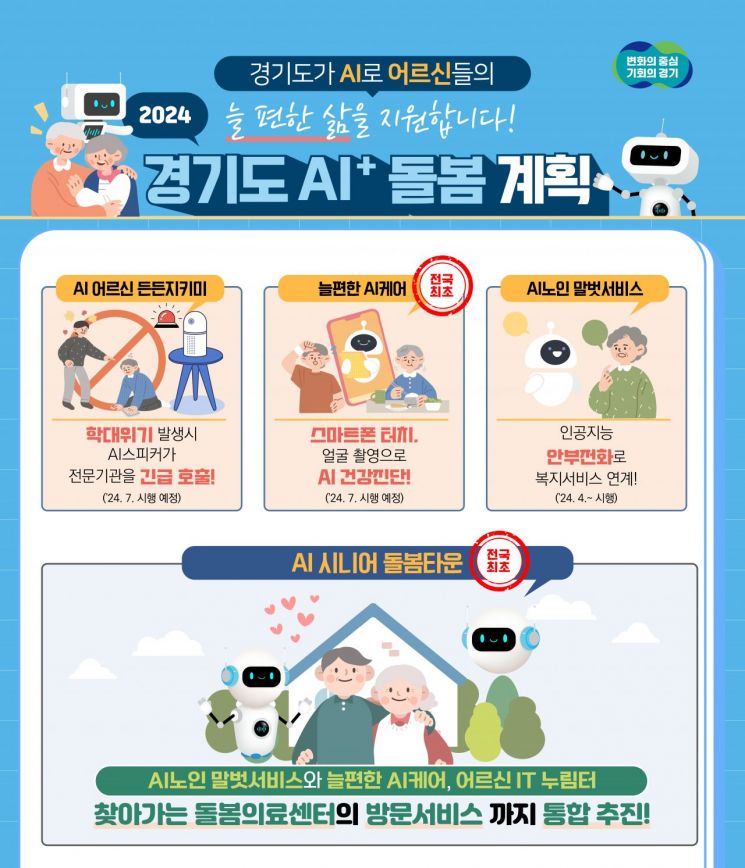
Gyeonggi Province is introducing artificial intelligence (AI) into its elderly care policies. The core of this initiative is to establish a preventive care system where AI regularly checks on the elderly, manages their health, and supports their emotional well-being. Gyeonggi Province will also pilot an AI Care Town that focuses intensively on such care services.
On the 30th, Gyeonggi Province announced the ‘Gyeonggi Senior AI+Care’ promotion plan, stating that the policy direction for elderly care in the province will shift from face-to-face post-management to an AI-based non-face-to-face preventive management system.
First, Gyeonggi Province plans to designate specific areas as ‘AI Senior Care Towns’ to provide integrated support including AI care services for the elderly, visiting medical services, and digital education.
The Care Town will offer AI companionship services to all elderly residents, conduct health assessments through AI, and introduce the pilot project of the Neulpyeonhan AI Care. Additionally, the Visiting Care Medical Center operated by Gyeonggi Provincial Medical Center will provide home visits to the elderly, along with ICT education and experiential spaces.
Gyeonggi Province expects that sustainable integrated care using AI and strengthening the digital capabilities of the elderly will help prevent welfare blind spots. The first Care Town site will be selected by June.
The ‘Neulpyeonhan AI Care’ project will also be fully launched in the second half of this year. This project is an AI-based ‘smartphone utilization care service’ that monitors the elderly’s well-being and health status through movement detection and biometric recognition via an app installed on their mobile phones. It is the first nationwide service to provide integrated AI care using only a smartphone, without separate care robots or smartwatches.
Starting in July, Gyeonggi Province will conduct a pilot project of Neulpyeonhan AI Care targeting 1,000 elderly residents aged 65 and older within the province.
Neulpyeonhan AI Care checks cardiovascular health by having users touch their finger on the phone camera for 15 seconds to measure blood flow. An AI algorithm generates health reports, and users periodically perform self-assessments for dementia risk, with results sent to care managers for monitoring.
Gyeonggi Province explained that while the existing welfare system focuses on face-to-face check-ins and periodic health management benefits only vulnerable groups, Neulpyeonhan AI Care is a service that any elderly person in need of care can enjoy regardless of income or age.
The province is also promoting the ‘AI Elderly Reliable Guardian’ project. This AI care service for abused elderly people uses AI speakers installed in advance to detect voice signals in crisis situations and automatically call 112 or specialized elderly protection agencies.
Additionally, through conversations with the elderly, the AI speaker alerts the monitoring center to keywords related to depression or loneliness. Gyeonggi Province plans to identify high-risk groups through monitoring and provide professional psychological counseling via the Gyeonggi Senior Comprehensive Center.
After selecting recipients for AI speaker installation by June, Gyeonggi Province will launch the AI Elderly Reliable Guardian project in July.
The ‘AI Senior Companionship Service’ will also be implemented. This service aims to prevent welfare blind spots by having AI make approximately 3-minute check-in calls once a week at a set time to elderly residents aged 65 and older in the province who require well-being confirmation.
If the call is not answered three or more times, a staff member from the Gyeonggi Social Service Agency will attempt to contact the person on the same day. If that call is also unanswered, the local township or neighborhood office will verify and conduct a direct visit. Furthermore, if the AI call detects emotional or economic difficulties such as “life is hard” or “feeling lonely,” or any signs of crisis, phone counseling is provided, and if welfare service linkage is needed, the call is connected to the Gyeonggi Emergency Welfare Hotline for specialized counseling.
Heo Seung-beom, Director of Welfare at Gyeonggi Province, said, “By 2028, Gyeonggi Province will enter a super-aged society where the elderly population accounts for 20%. The province will actively utilize AI technology and improve existing systems to create a sustainable care system that more residents can feel and benefit from.”
© The Asia Business Daily(www.asiae.co.kr). All rights reserved.
![Clutching a Stolen Dior Bag, Saying "I Hate Being Poor but Real"... The Grotesque Con of a "Human Knockoff" [Slate]](https://cwcontent.asiae.co.kr/asiaresize/183/2026021902243444107_1771435474.jpg)
















