Yoon Does Not Wear Sesongi Mulmangcho, Declaring 'Will to Resolve'
Kishida Shows Will by Wearing 'Blue Ribbon'
"Must Wear Badge and Strive to Solve Issues at Summit"
Families of abductees, detainees, and Korean War prisoners of war (POWs), along with North Korean human rights organizations, have urged President Yoon Suk-yeol to wear the 'Sesongi Mulmangcho' badge during summit diplomacy. Although this symbol was created by the government in March this year, President Yoon neither wore the badge nor mentioned the abductee issue at the recent Korea-Japan-China summit, drawing criticism.
The Association of Families of Korean War Abductees, the Federation of Families of Postwar Abductees, and the Korean War POW Families Association held a press conference on the 29th in front of the Presidential Office in Yongsan-gu, Seoul, stating, "We want to believe in the government's commitment to do its best to bring all abductees, detainees, and Korean War POWs back to their families." They also released a letter addressed to President Yoon. The conference was joined by Kim Jeong-sam, the brother of missionary Kim Jeong-uk who is detained in North Korea, as well as human rights organizations such as the North Korean Human Rights Citizens Alliance (NKHR), the Transitional Justice Working Group (TJWG), and Mulmangcho.
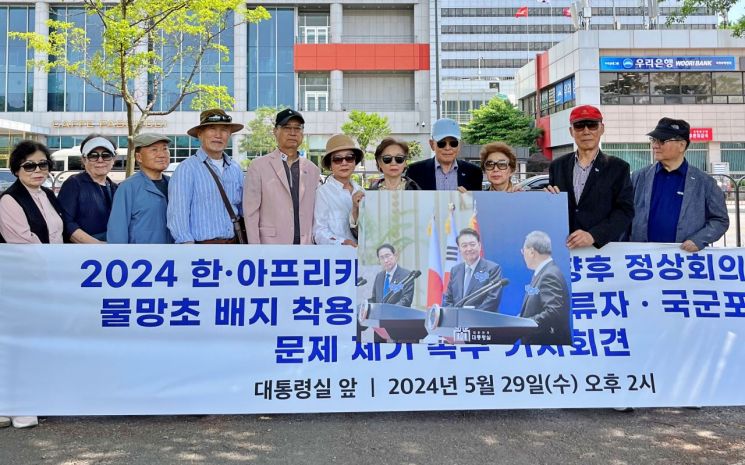 Families of abductees and North Korean human rights organizations are urging President Yoon Suk-yeol to wear the "Three Forget-Me-Nots" badge, symbolizing the commitment to resolving the issues of abductees, detainees, and prisoners of war.
Earlier, President Yoon did not wear the 'Sesongi Mulmangcho' badge at the Korea-Japan-China summit held in Seoul on the 26th and 27th. The badge was produced by the government in March this year to pray for the repatriation of abductees, detainees, and Korean War POWs. It borrows the meaning of the forget-me-not flower, which symbolizes "Please do not forget me." President Yoon himself introduced the badge at a Cabinet meeting, saying, "It embodies the will to bring all abductees, detainees, and Korean War POWs back to their families and the embrace of the Republic of Korea." In contrast, Japanese Prime Minister Fumio Kishida wore a 'Blue Ribbon' symbolizing his commitment to resolving the issue of Japanese abductees, creating a stark contrast. This led to criticism that the government's expression of will might be merely for show.
According to a comprehensive report by Asia Economy, opinions among related ministries were divided over the 'badge wearing.' The Ministry of Unification proposed that the president should wear the badge during summit schedules, but it is reported that the Presidential Office opposed this.
A senior official from the Presidential Office told this publication, "Prime Minister Kishida always wears it on overseas schedules, but if we wear it once and it becomes established, there would be a burden to wear it every time. Since there was no such principle in our diplomacy, it felt awkward to suddenly start wearing it."
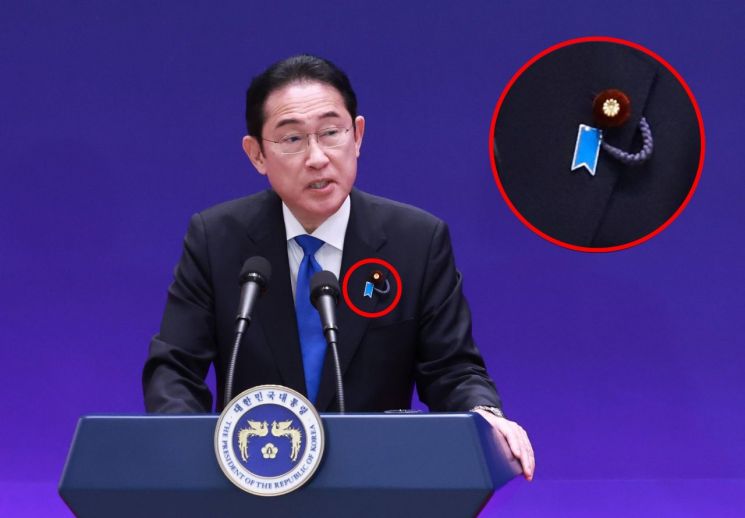 Japanese Prime Minister Fumio Kishida is speaking at the joint press conference of the 9th Korea-Japan-China Summit held at the Blue House State Guest House on the 27th. Prime Minister Kishida is wearing a 'Blue Ribbon' badge on his lapel.
Park Seon-young, director of Mulmangcho, pointed out, "President Yoon wore the badge only once at a Cabinet meeting and has never worn it since. Not wearing a symbol that means not forgetting the issue implies that the abductee, detainee, and Korean War POW issues are not on his mind." She emphasized, "A head of state can convey a lot of meaning and resonate worldwide even with the color of a tie."
Son Myeong-hwa, representative of the Korean War POW Families Association, said, "We had high expectations because the Yoon Suk-yeol administration created a badge to show they would not forget abductees, detainees, and Korean War POWs, but we are very disappointed," adding, "If the government made the badge directly, it should effectively show its meaning to the public."
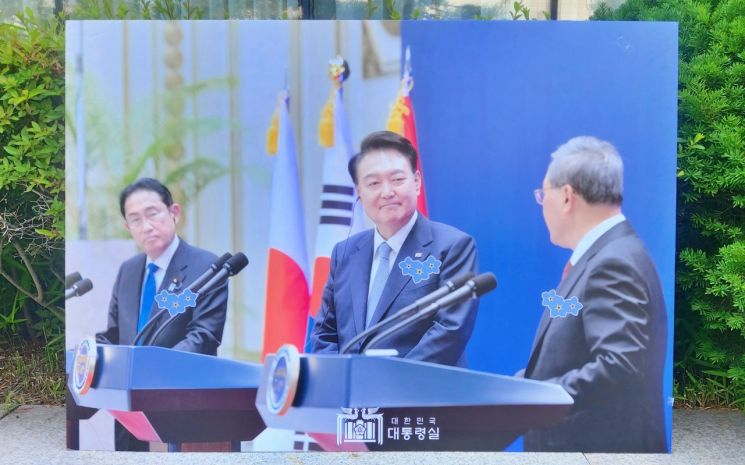 Families of abductees and North Korean human rights organizations urged President Yoon Seok-yeol to wear a "Sesongi Mulmangcho" badge symbolizing the will to resolve the issues of abductees, detainees, and prisoners of war, and performed a demonstration attaching the badge to a photo of President Yoon.
The organizations that held the press conference repeatedly urged that from the upcoming 2024 Korea-Africa summit on May 4-5 and future summits, President Yoon should wear the Sesongi Mulmangcho badge and discuss solutions to the abductee, detainee, and Korean War POW issues. They also performed a brief act by holding photos taken at the Korea-Japan-China summit and attaching badge-shaped decorations to the chests of the three leaders.
Families of abductees stated, "After the badge was introduced at the March Cabinet meeting, we did not see President Yoon wearing the Sesongi Mulmangcho badge at the summits in Romania on April 23, Angola on April 30, and Cambodia on May 16," pointing out that "Japanese prime ministers, including Prime Minister Kishida, have made it routine to wear the 'Blue Ribbon' badge symbolizing the resolution of the Japanese abductee issue at summits."
They especially recalled the joint statement at the Korea-U.S.-Japan summit held at Camp David in August last year, which reaffirmed "the shared will for the immediate resolution of the abductee, detainee, and unrepatriated Korean War POW issues," and emphasized again, "We ask President Yoon, who for the first time invited families of Korean War POWs and wartime and postwar abductees to his inauguration in May 2022, to show his commitment to resolving these issues with the international community."
© The Asia Business Daily(www.asiae.co.kr). All rights reserved.
![Clutching a Stolen Dior Bag, Saying "I Hate Being Poor but Real"... The Grotesque Con of a "Human Knockoff" [Slate]](https://cwcontent.asiae.co.kr/asiaresize/183/2026021902243444107_1771435474.jpg)


















