The government decided on the 28th to recommend the presidential veto of the Korean Beef Industry Act and the Agricultural and Fisheries Chamber Act, which were passed by the National Assembly plenary session.
Song Miryeong, Minister of Agriculture, Food and Rural Affairs, stated on the 29th, "As the Minister of Agriculture, Food and Rural Affairs, I express regret that the Chamber Act and the Korean Beef Act were unilaterally processed without sufficient consultation with the government and agricultural and fishery organizations," adding, "We proposed a request for reconsideration of the two bills, and the government decided today at the Cabinet meeting chaired by the Prime Minister to recommend the President to request reconsideration from the National Assembly."
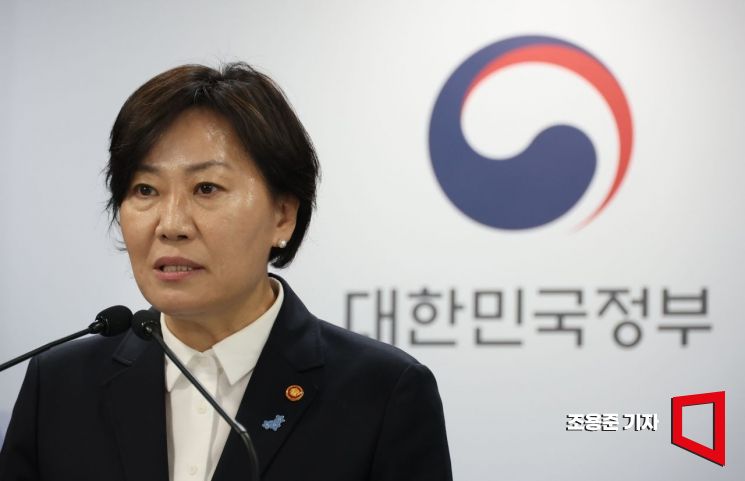 Song Mi-ryeong, Minister of Agriculture, Food and Rural Affairs, is expressing her position on the Cabinet meeting's resolution regarding the request for reconsideration of the amendments to the Agricultural and Fishery Chamber Act and the Korean Native Cattle Act at the Government Seoul Office in Jongno-gu, Seoul, on the 29th. Photo by Jo Yong-jun jun21@
At the previous day’s plenary session of the National Assembly, the Agricultural and Fisheries Chamber Act, which establishes and supports agricultural and fisheries chambers, and the Korean Beef Industry Act, which supports the Korean beef industry, were passed.
Minister Song said, "The government has opposed the Chamber Act because it overlaps in function with existing agricultural and fishery organizations and causes unnecessary conflicts, and opposed the Korean Beef Act due to issues such as fairness among livestock species and legislative inefficiency. However, the opposition party continued to forcibly pass the two bills unilaterally in the National Assembly’s Agriculture, Food, Rural Affairs, Oceans and Fisheries Committee, and even after the opposition party’s sole resolution to submit the bills to the plenary session, the bills passed without amendments despite the government’s many concerns."
Minister Song pointed out that the Korean Beef Act was enacted solely to foster the Korean beef industry, and at the time of enactment, it risks undermining the Livestock Act system, which is the basic law for the development of the entire livestock industry without bias toward specific livestock species including Korean beef, and the institutional foundation for balanced livestock policy promotion. She also criticized that enacting the Korean Beef Act separately would not only make balanced support for other livestock species such as pigs, chickens, eggs, and ducks difficult, but also harm fairness among livestock species, and lead to competition among livestock farms for limited resources, ultimately not benefiting the entire livestock farming community.
Minister Song emphasized, "If the proliferation of livestock industry support laws for each livestock species leads to administrative and legislative inefficiency, it will be difficult to respond promptly to urgent issues requiring institutional improvement, as each individual law must be amended separately, causing difficulties for livestock farmers and others."
She pointed out that the Chamber Act requires reconsideration as it is expected to cause unnecessary conflicts within the agricultural and fishery sectors due to forced legislative promotion. Minister Song said, "It overlaps in roles and functions with existing agricultural and fishery organizations, as well as the Nonghyup and Suhyup, causing inefficiencies such as redundant layers. The opposition from the agricultural and fishery sectors, which should be the operators of the Chamber Act, is very strong, and if the law is enacted amid significant disagreement and opposition from agricultural and fishery organizations, it will be difficult to properly enforce the law and social conflicts and confusion are expected to be very severe."
Minister Song stated, "The government will continuously cooperate centered on existing major agricultural and fishery federations instead of establishing separate organizations like chambers to enhance the economic and social status of agricultural and fishery workers and guarantee their policy participation, and will prepare more systematic and efficient communication methods. Also, reflecting the purpose of the Livestock Act, we will immediately pursue amendments to the Livestock Act right after the opening of the 22nd National Assembly to promote the development of the entire livestock industry and ensure that all livestock farmers benefit evenly."
© The Asia Business Daily(www.asiae.co.kr). All rights reserved.
![Clutching a Stolen Dior Bag, Saying "I Hate Being Poor but Real"... The Grotesque Con of a "Human Knockoff" [Slate]](https://cwcontent.asiae.co.kr/asiaresize/183/2026021902243444107_1771435474.jpg)
















