Democratic Party 'Abolition', Government 'Rational Improvement'... Financial Sector 'Cause of Loan Interest Rate Increase'
Differences in Views on Early Repayment Fee Reform Direction... Consumer Confusion Concerns

As the Democratic Party of Korea and financial authorities are pushing for a reform of prepayment penalties as part of livelihood financial policies, there remains a gap in perspectives between the Democratic Party, which is advocating for abolition, the financial authorities aiming for improvements at the level of actual costs, and frontline financial institutions.
According to the financial sector on the 30th, the financial authorities plan to complete the revision process of the 'Supervisory Regulations on the Protection of Financial Consumers' by June to improve the prepayment penalty system, and sequentially finalize revisions to the model regulations and the maintenance of comparison and disclosure systems in line with the implementation schedule. The current Financial Consumer Protection Act generally prohibits the imposition of prepayment penalties but allows exceptions for loans repaid within three years from the loan date.
The prepayment penalties for mortgage loans at the five major commercial banks are currently the same: 1.4% for fixed-rate loans and 1.2% for variable-rate loans. Despite differences in funding risk depending on the product, the fee difference between variable-rate and fixed-rate loans is minimal, and most banks charge the same fee for mobile subscriptions as for branch subscriptions.
Accordingly, the financial authorities plan to amend the Financial Consumer Protection Act to allow prepayment penalties to be charged only within actual costs, such as losses due to funding disruptions and administrative costs related to loans. If additional items beyond the listed costs are added, it will be considered an unfair business practice subject to fines. Furthermore, guidelines will be prepared to ensure that necessary measures following the revision of supervisory regulations are implemented smoothly, and disclosure of prepayment penalty calculation standards and imposition/exemption status will also be promoted.
Meanwhile, the Democratic Party plans to push for legislation to abolish or exempt prepayment penalties in the 22nd National Assembly, which convened on the same day. The Democratic Party intends to propose a bill in the second half of the year to exempt prepayment penalties on household loans starting with policy mortgages and policy financial institutions, excluding unnecessary additional interest rate items. Later, the goal is to expand this to include credit loans and jeonse loans.
If the Democratic Party's bill to abolish prepayment penalties proceeds as planned, the possibility of legal amendment is very high. Internet-only banks such as KakaoBank, K Bank, and Toss Bank exempt prepayment penalties on mobile-only loans, and some banks also offer discounts on prepayment penalties for mobile credit loan products, giving the bill legitimacy. Moreover, since the opposition bloc holds 192 seats, legal amendments can be made without agreement from the ruling party.
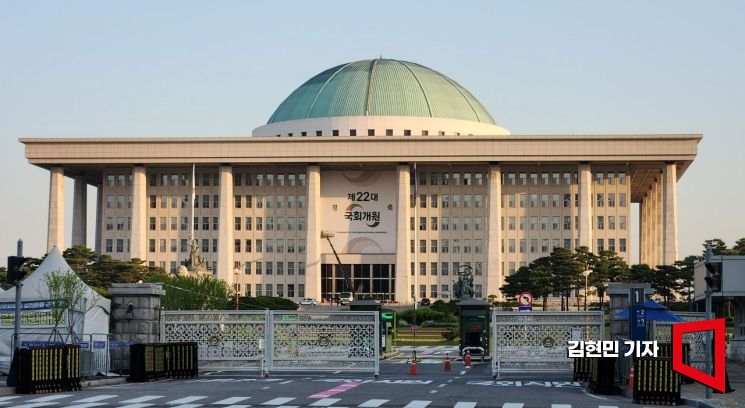 On the 29th, the last day of the 21st National Assembly's term, a banner congratulating the opening of the 22nd National Assembly is hung at the main building of the National Assembly. Photo by Kim Hyun-min kimhyun81@
'Prepayment Penalty Reform' Differences in Perspectives Among Opposition, Government, and Financial Sector
As the opposition and government movements to reform prepayment penalties become more visible, concerns are emerging within the financial sector.
Kwon Heung-jin, a research fellow at the Korea Institute of Finance, recently cited the U.S. case, analyzing that policies excessively restricting prepayment penalties on mortgage loans could lead to higher loan interest rates and reduced loan accessibility. Theoretically, borrowers can lower loan interest rates in exchange for bearing prepayment penalties. Since prepayment penalties can work beneficially for both financial companies and consumers, a multifaceted review is necessary.
Based on research cases, Kwon explained, "Analysis of U.S. subprime mortgage data shows that financial companies adjust loan interest rates and prepayment penalties simultaneously considering prepayment risk, resulting in a negative correlation between prepayment penalties and loan interest rates," adding, "Research also indicates that prepayment penalties can lower loan interest rates for medium- and low-credit borrowers and improve loan accessibility, thereby enhancing welfare."
He argued that the direction of discussions by the opposition and government on prepayment penalties should focus on expanding the diversity of fee structures. Kwon stated, "Policies that excessively lower prepayment penalty levels may hinder efficient contract formation between financial companies and borrowers, potentially harming consumer welfare," and "If fee levels are overly restricted, side effects such as increased loan interest rates may occur."
Kim Ju-hyun, chairman of the Financial Services Commission, expressed a critical view of the opposition's move to abolish prepayment penalties. While rationalizing excessive and unreasonable fees incurred when financial institutions execute loans is necessary, abolishing them could ultimately lead to burdens on other stakeholders, including financial consumers.
On the 28th, after the first anniversary meeting of the debt refinancing service, Chairman Kim told reporters, "When money is borrowed, the lender plans fund management accordingly, and if the initial agreement is broken, adjustments may be necessary depending on the customer," adding, "(The financial authorities) have been making efforts to reduce the burden related to prepayment penalties, but if abolished, someone will have to bear the resulting costs."
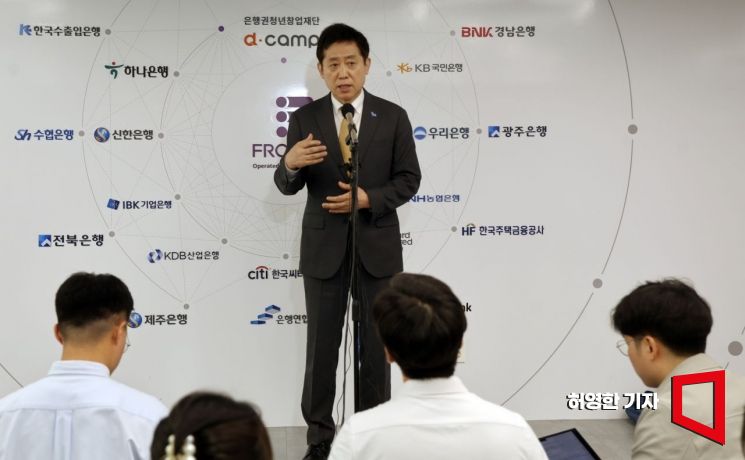 After the 'Loan Refinancing Service Users and Practitioners Meeting' held on the 29th at Front1 in Mapo, Seoul, hosted by the Financial Services Commission, he is giving a back briefing (background explanation) to reporters and answering questions. Photo by Heo Younghan younghan@
"Mortgage Prepayment Penalties Are a Significant Burden for Customers... Positive from a Social Responsibility Perspective"
Although concerns about abolishing prepayment penalties are voiced mainly by the government and financial sector, some see it ultimately as a positive direction for both consumers and banks. Internet-only banks such as KakaoBank and Toss Bank exempt prepayment penalties, including various fees. This is argued to be meaningful in terms of enhancing product competitiveness and strengthening social responsibility.
A financial sector official explained, "Since mortgage loans are large in scale, the fees alone are a very large amount, which acts as a significant burden on consumers and also a major obstacle to refinancing," adding, "Even if prepayment penalties are exempted at commercial banks, competitiveness will not weaken, and rather, it will be more meaningful in terms of strengthening social responsibility."
© The Asia Business Daily(www.asiae.co.kr). All rights reserved.
![Clutching a Stolen Dior Bag, Saying "I Hate Being Poor but Real"... The Grotesque Con of a "Human Knockoff" [Slate]](https://cwcontent.asiae.co.kr/asiaresize/183/2026021902243444107_1771435474.jpg)


















