People Power Party Seats Decrease from 113 to 108
Veto Power Becomes Ineffective with Only 8 Defections
Jo Hae-jin: "Demanding a United Front Means Failing Together"
There is a prospect that the vertical party-government relationship may somewhat improve in the 22nd National Assembly following the rejection of the 'Chae Sang-byeong Special Prosecutor Act.' Since the bill, reintroduced through the presidential veto power, could pass if only 8 votes defect, the Presidential Office has no choice but to pay more attention to the ruling party.
The 'Chae Sang-byeong Special Prosecutor Act,' which was reintroduced to the plenary session of the National Assembly the day before due to the president's veto, was initially expected to see more than 5 dissenting votes. However, it was ultimately rejected with 179 votes in favor, 111 against, and 4 invalid votes. Out of 294 members present, the special prosecutor law would have passed if 196 votes in favor were secured, but the People Power Party minimized defections and successfully defended the bill.
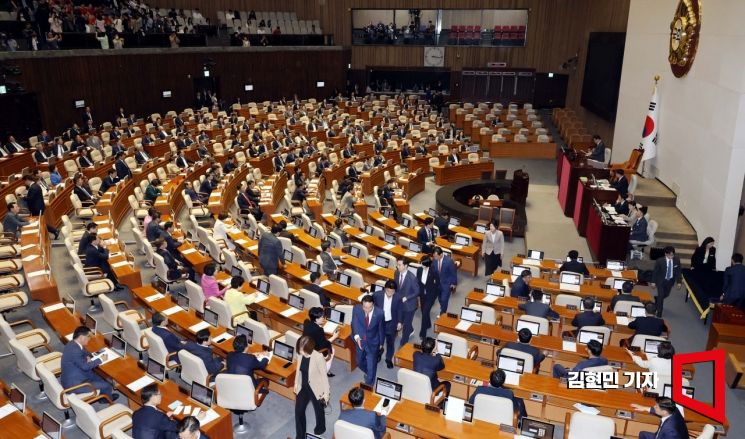 Speaker of the National Assembly Kim Jin-pyo is announcing the voting results of the "Special Prosecutor Act on Allegations of Investigation Interference in the Death Case of Marine Sergeant Chaesang-byeong," which was submitted for reconsideration but rejected at the plenary session held at the National Assembly on the 28th. Photo by Kim Hyun-min kimhyun81@
As the opposition parties, including the Democratic Party, have announced plans to re-push the 'Chae Sang-byeong Special Prosecutor Act' in the 22nd National Assembly, the special prosecutor and veto power political situation is expected to continue. However, the number of People Power Party members will decrease to 108 in the next National Assembly. When the veto is exercised, if a majority of the total members are present and two-thirds of those present vote in favor, the bill passes. Arithmetically, if only 8 members defect, the bill vetoed by the president can still be approved. For this reason, the Presidential Office cannot help but be cautious.
Kim Jong-in, former senior advisor of the Reform New Party (and former emergency committee chairman of the People Power Party), appeared on CBS Radio that day and said, "I think President Yoon Seok-yeol's approach to managing ruling party members has changed even before the opening of the National Assembly." He added, "He invites even first-term lawmakers to dinners, makes requests, and instructs them to negotiate with the opposition assuming the president’s veto power. Since there are only 108 seats, he seems to be thoroughly thinking that he must control this to protect himself."
Voices are emerging that the Presidential Office must change, even for the next election. People Power Party lawmaker Cho Hae-jin said on SBS Radio that day, "The party considers strategies to win elections. Ultimately, it is about attracting public sentiment, and if the party stands on the side of public sentiment and tries to represent it, it should not be blocked." He continued, "We must allow autonomy so that the party can represent public sentiment, even if it means giving harsh criticism to the president or government, and even if it is burdensome." Cho warned, "If you say things like 'Don’t say that,' 'Speak with one voice,' 'Act in unison,' 'Form a single front,' or 'The Presidential Office in Yongsan will raise the flag, so just follow,' then we will all fail together."
© The Asia Business Daily(www.asiae.co.kr). All rights reserved.

















