Labor Shortage Expected to Materialize Within an Average of 9 Years
Seven out of ten companies believe that a rapid decline in birth rates and aging population trends could soon lead to an economic crisis, including labor shortages and the collapse of the domestic market base.
On the 29th, the Korea Economic Association announced this through a 'Corporate Awareness Survey on Low Birth Rates and Population Aging,' conducted by Mono Research targeting HR and labor managers of the top 1,000 companies by sales.
Concerns over labor supply and sales decline due to low birth rates and aging population
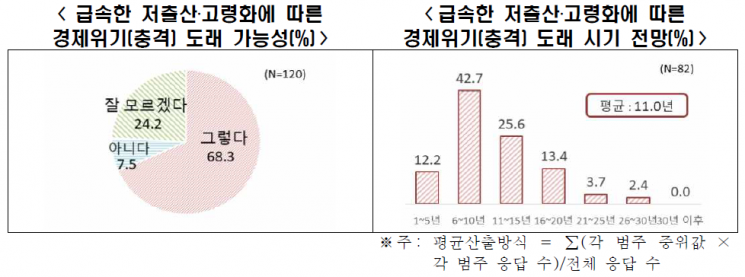
68.3% of responding companies predicted that if the current pace of low birth rates and aging continues, an economic crisis will occur. On average, they forecast that the crisis could arrive in 11 years. Specifically, the responses were ▲6?10 years (42.7%) ▲11?15 years (25.6%) ▲16?20 years (13.4%) ▲1?5 years (12.2%) in order of frequency.
Regarding the most concerning impact of low birth rates and aging on companies, half of the respondents (45.8%) cited difficulties in smooth labor supply. There were also concerns about sales decline due to reduced market demand (19.2%) and decreased labor productivity due to an aging workforce (17.5%).
Opinions also emerged that labor shortages caused by low birth rates and aging will begin to significantly affect industrial sites within an average of 9 years. By period, responses were ▲5?10 years (44.2%) ▲10?15 years (24.2%) ▲3?5 years (9.2%) in order.
To address labor shortage issues, 35.0% of respondents emphasized that the government should create an environment for utilizing older workers, such as reforming wage systems. Following this, 'expanding re-education for older workers and increasing employment opportunities for the elderly (29.2%)' and 'flexible working hours and easing childcare burdens to increase women's labor market participation (24.2%)' were also highlighted.
Securing replacement labor is difficult... Lack of corporate awareness and will
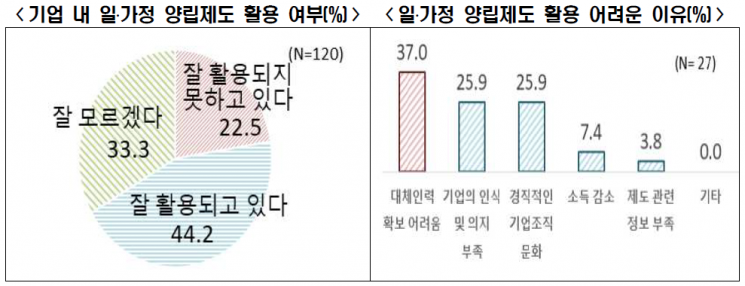
Despite legal systems for work-family balance such as parental leave and reduced working hours during childcare periods, some responses indicated that it is not easy to utilize these in practice. 22.5% of responding companies stated that these systems are not well utilized internally.
The most cited reason was difficulty in securing replacement labor (37.0%). 'Lack of corporate awareness and will (25.9%)' and 'rigid corporate culture (25.9%)' were also pointed out as main underlying factors.
Responding companies mentioned that the most effective incentive to increase the utilization rate of work-family balance systems is 'support for replacement labor wages (41.7%).' 'Tax incentives such as corporate tax reductions (35.8%)' and 'expansion of support and policy funds for small and medium enterprises (18.3%)' were also mentioned.
As policies the government should promote for work-family balance, 'activation of parental leave usage (40.0%)' was suggested. 'Expansion of flexible work systems such as staggered commuting and telecommuting (23.3%)', 'improvement of long working hour practices (14.2%)', and 'expansion of childcare services such as public daycare centers (8.3%)' were also mentioned.
"Government and National Assembly must establish institutional support"
The Korea Economic Association suggested that to fundamentally resolve low birth rates and aging, policies that reduce childcare burdens, such as expanding work-family balance systems, should be strengthened. They also explained that creating a business-friendly environment through flexible working hours and tax burden relief to generate quality jobs is important.
They proposed focusing policy support to help improve corporate productivity to prevent a decline in potential growth rates caused by a decrease in the working-age population and aging. This includes the need for efficiency improvements in production and logistics systems through artificial intelligence (AI).
Lee Sang-ho, head of the Economic and Industrial Division at the Korea Economic Association, said, "Amid the rapid trends of low birth rates and aging, the importance of an environment where work and family life can coexist is increasing, but companies face many difficulties in utilizing related systems." He added, "The government and National Assembly must establish institutional support such as wage subsidies for replacement labor and tax benefits to ensure that work-family balance support systems take root in industrial sites."
© The Asia Business Daily(www.asiae.co.kr). All rights reserved.
![Clutching a Stolen Dior Bag, Saying "I Hate Being Poor but Real"... The Grotesque Con of a "Human Knockoff" [Slate]](https://cwcontent.asiae.co.kr/asiaresize/183/2026021902243444107_1771435474.jpg)

















