Contributed to Citizen Convenience but Issues like Overwork of Voting Staff... "As Early Voting Importance Increases, Efficient Management is Needed"
About 10 years after the introduction of the early voting system, suggestions have emerged that improvements are necessary as the pros and cons of the system have become clear. While voter convenience has improved, measures are needed to address the side effects of increased burdens on election management tasks and costs.
According to the 'Current Status and Effects of the Early Voting System' published by the National Assembly Legislative Research Office on the 29th, the proportion of early voters relative to the total voters showed an increasing trend up to the recently held 22nd National Assembly election. In the 22nd general election, it was 46.7%, and in the 20th presidential election, 47.9%, both exceeding 45%, increasing from 40.3% in the previous 21st general election and 33.7% in the 19th presidential election.
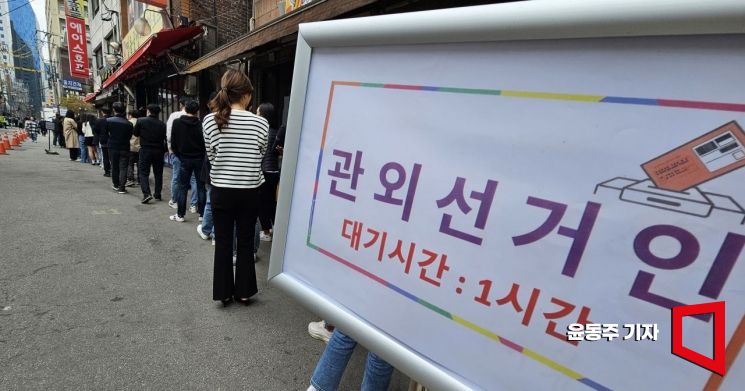 On the first day of early voting for the 22nd general election, voters are lining up to cast their early votes at the Euljiro-dong Community Center in Jung-gu, Seoul, which is recording an unprecedented turnout rate on the 5th. Photo by Dongju Yoon doso7@
In light of this trend, the general assessment is that one of the purposes of introducing the early voting system, 'enhancing convenience,' has been fulfilled. The early voting system, first introduced in the first half of 2013 during the by-elections and re-elections, was implemented to increase voter turnout by improving voting convenience. Kim (29), who voted early in last month's general election, said, "With the introduction of early voting, election day is something I look forward to like Christmas," adding, "It's nice to be able to vote as if going out for a stroll without having to find out where my designated polling station is, and then use my time more freely on the actual election day."
However, evaluations are mixed on whether the early voting system has actually contributed to increasing voter turnout. Looking at voter turnout immediately after the introduction of the early voting system, turnout generally increased except for local elections. But in recent presidential and general elections, despite the significant increase in the proportion of early voters relative to total turnout, the overall turnout did not differ much from previous elections. Researchers stated, "It is difficult to discuss the impact of the early voting system solely based on turnout rates, as the political, economic, and social backgrounds of each election differ."
Issues related to manpower and costs caused by the introduction of the early voting system also remain. Although more than 10 years have passed since the system began, there are still no effective measures for manpower utilization and expansion, according to field responses. In last month's general election, a public official in Namwon died after working on early voting duties. It is known that this official worked from around 3 a.m. throughout the weekend when early voting took place until about 7 p.m. when the polling station was closed. The labor union and bereaved family urged, saying that overwork from election duties was the cause of death and called for "improving the election system that forces sacrifices from public officials, including early voting that lasts 14 hours over the weekend."
Researchers emphasized the need for efforts to address problems such as the excessive workload of election staff as the proportion of early voting increases. The Ministry of the Interior and Safety has taken measures by revising public official work regulations this year to grant 1 to 2 days off to vote counting staff. However, there are opinions that practical solutions are needed, such as guaranteeing breaks during work hours exceeding 10 hours or reducing voting hours. Legislative researcher Song Jin-mi said, "In the long term, it is necessary to continuously seek ways to enhance the reliability of the early voting system and manage elections more efficiently."
© The Asia Business Daily(www.asiae.co.kr). All rights reserved.

















