Low Effectiveness of Policies to Revive So-Bu-Jang Ecosystem
Opposition's Landslide Victory in April 10 General Election... Speed of 22nd National Assembly Uncertain
"Regulatory Easing Should Consider International Standards Over Political Gains"
As the industrial promotion bills proposed in the 21st National Assembly were effectively discarded without being processed, companies are expressing concerns that investment uncertainty will increase, research and development (R&D) timing will be delayed, and management risks will grow. In particular, material, parts, and equipment companies receiving policy support for investment are increasingly anxious due to the uncertainty surrounding tax credit support. There are reactions suggesting that until the law is passed, companies might have to focus on cost reduction and workforce restructuring rather than R&D investment.
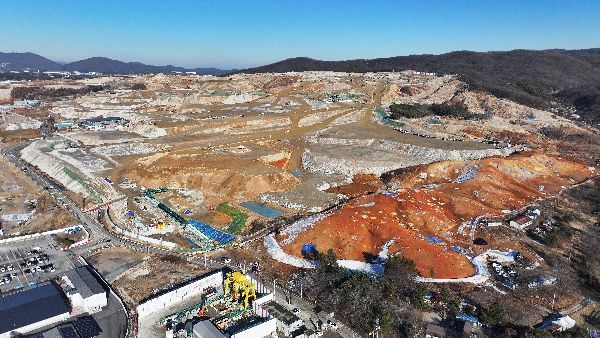 On the afternoon of January 15, construction was underway at the Yongin Semiconductor Cluster site in Wonsam-myeon, Cheoin-gu, Yongin-si, Gyeonggi-do. [Photo by Yonhap News]
Especially for small and medium-sized enterprises (SMEs) and mid-sized companies, there is a strong sense of crisis that neglecting R&D development could lead to falling behind in technological competitiveness and eventually losing out in orders from large corporations (demand companies). If this happens, not only will the effectiveness of the government's material, parts, and equipment ecosystem development policy decline, but the number of companies reducing domestic investment and employment will also increase.
A representative of a semiconductor equipment company said, "For material, parts, and equipment companies, maintaining the status quo is not a positive outcome. Continuous investment in technology development is necessary to survive, but the industrial promotion bill keeps being stalled in the National Assembly, increasing management uncertainty." A senior official from another semiconductor and display materials company stated, "For SMEs and mid-sized companies with limited overseas investment capacity, the passage of the bill is a matter of survival."
Given that trade risks may expand after the U.S. presidential election this November, there are voices insisting that the industrial promotion bill, which increases tax support such as the K-Chips Act and eases regulations, should have been passed in this National Assembly session. Even if direct cash subsidies are not provided, at least the existing tax benefits should have been guaranteed by the political sphere.
An industry insider said, "In the 22nd session, the same bill will have to go through the proposal and review process again," adding, "The timing is later than the advanced industry support policies of competing countries."
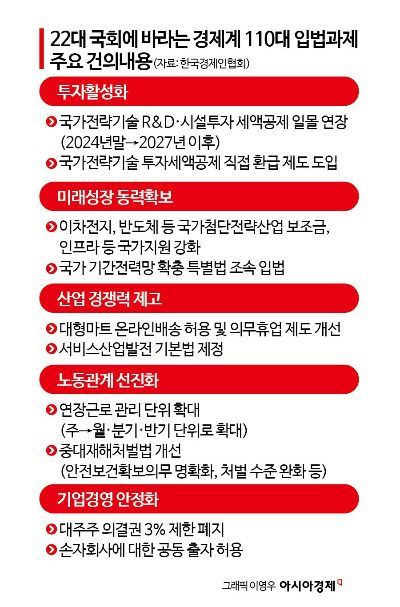
The focus now is on how quickly the bill will be processed in the 22nd National Assembly. The Korea Economic Association recently delivered '110 Legislative Tasks Desired by the Business Community for the 22nd National Assembly' to the People Power Party and the Democratic Party of Korea, requesting their cooperation. This includes ▲ introduction of a direct refund system for tax credits on national strategic technology investments ▲ prompt legislation of a special law to expand the national strategic network ▲ expansion of extended working hours units ▲ improvement of the Serious Accidents Punishment Act, among others.
However, the industry places more weight on the low possibility of rapid passage. Since the opposition won a landslide victory in the April 10 general election, there is a greater likelihood that the processing of industrial regulation relief bills promoted by the government will be delayed. The Democratic Party is drawing a line on business demands such as expanding extended working hours units and easing the Serious Accidents Punishment Act.
An official from an economic organization said, "I want to ask for bipartisan consideration of regulatory easing based on whether it aligns with global standards rather than political gains or losses. For example, in the case of the Serious Accidents Punishment Act, there is no clear evidence that punishing CEOs actually reduces industrial accidents, and considering that similar regulations are rare overseas, discussions on amendments can certainly be held."
A senior official from the Korea Economic Association said, "It is regrettable that the industrial promotion-related laws were not passed during the 21st session, but the fundamental problem is the continuous emergence of a wealthy elite privilege frame and factional logic during the bill processing." He added, "The political sphere and government have an obligation to support companies so they do not miss the optimal timing for facility and R&D investments. If financial support like subsidies for advanced industries is burdensome, it is urgent to induce corporate investment by quickly easing regulations that can be relaxed through political compromise without costing money (budget)."
© The Asia Business Daily(www.asiae.co.kr). All rights reserved.
![Clutching a Stolen Dior Bag, Saying "I Hate Being Poor but Real"... The Grotesque Con of a "Human Knockoff" [Slate]](https://cwcontent.asiae.co.kr/asiaresize/183/2026021902243444107_1771435474.jpg)

















