Gwangju Mayor Kang Gijeong's 38th Monday Dialogue... Discussing AI Business Policy Directions
Dialogue Among Various Sectors on 'What Gwangju, the AI Representative City, Needs?'
A forum was held to discuss the present and future of the artificial intelligence (AI) project, a strategic initiative of Gwangju Metropolitan City.
The event served as a communication platform where AI-related companies, students, and others shared their challenges and wishes, which they were previously unaware of due to lack of interaction, and learned about various support policies related to Gwangju’s AI projects.
On the 28th, according to Gwangju Metropolitan City, Mayor Kang Gi-jung held the 38th Monday Dialogue the previous afternoon at the ‘AI Academy AI Cafe’ in Dong-gu.
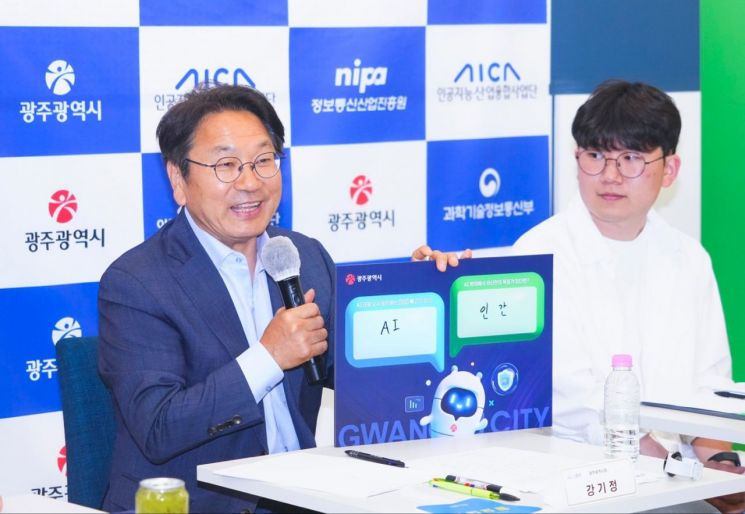
As Gwangju is actively promoting the second phase of its AI project, the event was organized to listen to vivid voices from the field and to set the direction of the project.
Representatives of companies, employees, and students involved in Gwangju’s AI projects participated. In particular, startup companies in Gwangju, companies that relocated their headquarters from Seoul to Gwangju, and employees who found jobs in Gwangju and Daejeon after graduating from the Gwangju AI Academy openly discussed what Gwangju, as a representative AI city, needs and their personal goals.
First, AI companies pointed out the need for exchanges among AI-related companies and team leader-level developers in Gwangju.
Jeon Gwang-myeong, CEO of Intflow Co., Ltd., said, “When I started a business in Gwangju 5 to 6 years ago, it felt like a barren land for the AI industry, but now I truly feel that the infrastructure has greatly improved.” He added, “However, a common problem for all AI companies is the lack of a solid customer base that can ensure steady sales and continuous growth.”
He continued, “There is a need to activate and promote systems like the demonstration support project promoted by Gwangju City, which allows companies to try and purchase AI solutions.”
Ham Min-hyeok, CEO of Zendata, said, “Since relocating our headquarters from Seoul to Gwangju, we have created various opportunities, but there is a shortage of team leader-level developers who can grow and lead together.” He emphasized, “From the second half of this year, inviting Seoul companies with the latest trends to exchange technologies could partially solve this issue. Also, I hope there will be more opportunities for service development companies and solution sales companies to interact.”
An employee who found jobs in Gwangju and Daejeon after graduating from the 4th class of the Gwangju AI Academy cited ‘exchange and transportation’ as necessities for Gwangju, the representative AI city.
Park Seung-joo said, “Due to the lack of jobs and support for web and app developers, I got a job in Daejeon,” and added, “Through today’s dialogue, I realized that there are many jobs for web and app developers in Gwangju as well.”
Voices calling for the activation of the international airport for overseas client meetings were also strong. Important client meetings need to be held in person rather than online, but there are difficulties because there are no direct flights to Gwangju and Jeonnam.
Company representatives said in unison, “It takes 2 hours to fly from Korea to Japan, but 4 hours from Incheon to Gwangju,” and “Although we meet at a midpoint, it is inconvenient when meeting overseas clients.”
Shin Beom-sik, a researcher at AI Campus Co., Ltd. in Gwangju, stated the goal of advancing AI education; Jeong Chang-hyun, a student at Chosun University, called for diversifying opportunities such as AI-related competitions; and Lee Ji-woong, a 5th class trainee at the AI Academy, said that just as the Kia Tigers and the Biennale are landmarks in sports and arts, the National AI Data Center should become a new landmark in the AI era.
Mayor Kang Gi-jung of Gwangju said, “Having the National AI Data Center in Gwangju is a great strength and opportunity for the city, but the AI industry in Gwangju cannot be grown by the data center alone.” He added, “Today’s Monday Dialogue holds answers about the present and future. We will further develop what we are doing well and supplement what is lacking to make Gwangju a truly representative AI city.”
Attendees of the dialogue included Mayor Kang Gi-jung, Jeon Gwang-myeong, CEO of Intflow Co., Ltd., Ham Min-hyeok, CEO of Zendata, Shin Beom-sik, a researcher at AI Campus Co., Ltd. and a 4th class graduate of the AI Academy, Park Seung-joo, junior at Ncube Co., Ltd., Lee Ji-woong, a 5th class trainee at the AI Academy, Jeong Chang-hyun, a student at Chosun University, Park Soo-gi, a Gwangju city council member, Lee Eun-kyung, head of the AI Convergence Talent Development Project at Honam University, and Kim Yong-seung, head of Gwangju’s AI Industry Office.
‘Monday Dialogue’ is a communication channel where Mayor Kang Gi-jung meets and interacts directly with citizens. They discuss major city issues and jointly deliberate on policy directions and problem-solving measures.
Meanwhile, Gwangju City has been investing 429.5 billion KRW from 2020 to 2024 to develop an AI cluster in the Advanced 3 District. Through this, it is implementing infrastructure construction such as the National AI Data Center, supporting startup companies, and conducting workforce development projects.
From 2025 to 2029, the second phase of the project will be promoted. The plan is to create an AI industrial ecosystem where Gwangju’s AI companies can develop and demonstrate technologies through global cooperation, making it a demonstration city with a high startup success rate.
© The Asia Business Daily(www.asiae.co.kr). All rights reserved.
![Clutching a Stolen Dior Bag, Saying "I Hate Being Poor but Real"... The Grotesque Con of a "Human Knockoff" [Slate]](https://cwcontent.asiae.co.kr/asiaresize/183/2026021902243444107_1771435474.jpg)
















