179 Votes in Favor, 111 Against, 4 Invalid
Far Below the 196 Votes Needed for Reapproval
Attention on 5 People in the People Power Party Expected to Vote in Favor
Possibility of Defections Within the Opposition Including the Democratic Party
The Chae Sang-byeong Special Prosecutor Act was finally rejected and discarded after a re-vote in the National Assembly on the 28th. Although the voting results closely matched the number of seats held by the ruling and opposition parties, various interpretations have emerged since five members of the ruling party had already expressed support. These interpretations range from the possibility that some members of the People Power Party, who initially intended to vote in favor, changed their minds, to the possibility of defections within the opposition camp. If the members who publicly expressed support against the party line did not change their minds, it can be seen that a majority of defections occurred within the opposition, which is expected to cause repercussions.
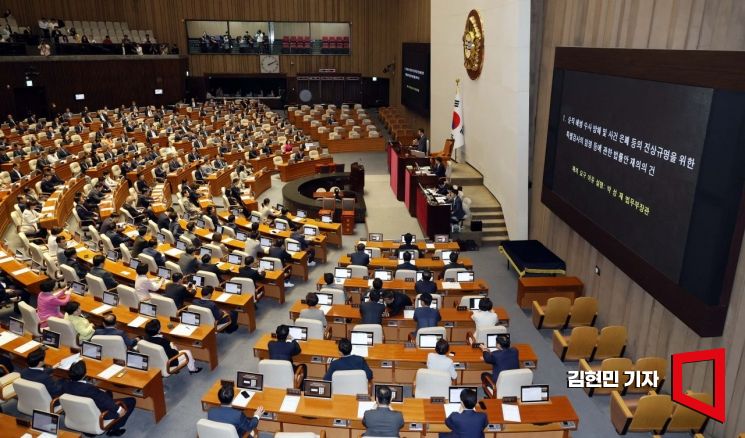 On the 28th, a plenary session was held at the National Assembly to vote on the reconsideration agenda, including the 'Special Prosecutor Act on the Investigation Pressure Allegations in the Death Case of Marine Sergeant Chaesangbyeong.' Photo by Kim Hyunmin kimhyun81@
On the 28th, the Chae Sang-byeong Special Prosecutor Act was rejected in the plenary session of the National Assembly with 179 votes in favor, 111 against, and 4 invalid votes out of a total of 294 votes cast. This bill, which President Yoon Seok-yeol requested to be reconsidered (vetoed), required more than two-thirds of the members present in the National Assembly to pass, but it fell short of the 196 votes needed for approval.
What draws attention is that the voting result was an 'ambiguous outcome' different from public expectations.
Looking at the current number of seats, there are 295 members excluding the detained independent lawmaker Yoon Kwan-seok. Among them, the ruling coalition holds 115 seats (People Power Party 113 seats, Liberty Unification Party 1 seat, Independent 1 seat), and the opposition coalition holds 180 seats (Democratic Party 155 seats, Justice Party 6 seats, New Future Party 5 seats, Reform New Party 4 seats, Progressive Party 1 seat, New Progressive Union 1 seat, National Innovation Party 1 seat, Independents 7 seats). On the day of the plenary session, Lee Soo-jin, who left the Democratic Party (Seoul Dongjak-gu Eul), was absent. On the surface, it appears that all 294 members were present and that both the ruling and opposition camps' votes were consolidated.
What is noteworthy is that before the vote, five members of the People Power Party publicly expressed their intention to support the Chae Sang-byeong Special Prosecutor Act. While individual members' choices may vary, there are two main possibilities: either the People Power Party members who initially intended to vote in favor switched to invalid or opposing votes, or there were defections within the opposition camp.
Did the 'Eagle Five' of the People Power Party break their convictions?
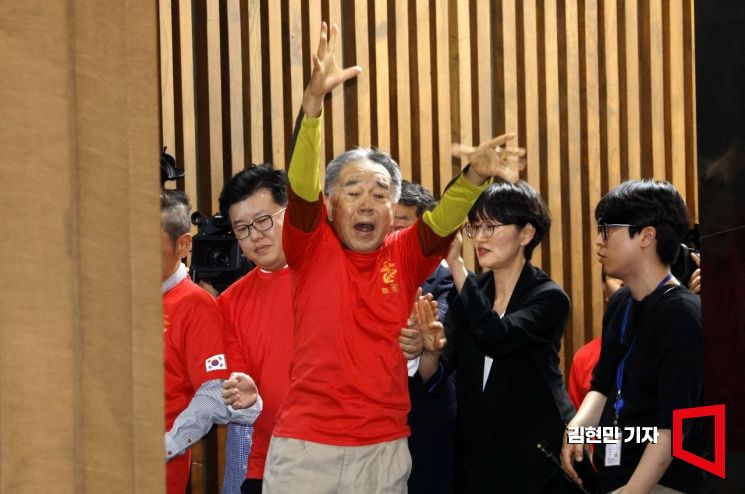 Members of the Marine Corps Reserve Regiment are leaving the plenary session hall after the "Special Prosecutor Act on Allegations of Investigation Interference in the Death Case of Marine Corporal Chaesangbyeong," which was resubmitted as a reconsideration agenda item at the National Assembly plenary session held on the 28th, was rejected. Photo by Hyunmin Kim kimhyun81@
Within the People Power Party, five lawmakers (Kim Geun-tae, Kim Woong, Ahn Cheol-soo, Yoo Ui-dong, Choi Jae-hyung) publicly declared their intention to vote in favor of the Chae Sang-byeong Special Prosecutor Act. First, it is possible that they changed their stance and voted invalid or against the bill. The ruling party leadership might have persuaded these five principled lawmakers to cast invalid votes instead of supporting the bill. Regarding this, Choo Kyung-ho, the floor leader of the People Power Party, said in a meeting with reporters immediately after the vote, "We did not discuss specific voting behavior."
However, the People Power Party lawmakers who had expressed support immediately after the vote told reporters, "Our thoughts have not changed," and "We voted according to our convictions." This suggests that they likely voted in favor as initially promised. It seems unlikely that those who publicly expressed their convictions despite internal criticism would reverse their stance at the voting booth. The remaining possibility is that the opposition camp was shaken.
Did the opposition fail to enforce party discipline?
If we assume that the five People Power Party members voted in favor, the side that failed to enforce party discipline would be the opposition. Adding the People Power Party members' votes to the opposition votes (179 votes excluding Lee Soo-jin) would total 184 votes in favor. However, the number of votes in favor was only 179. If the pro-vote People Power Party members voted as declared, it suggests that at least five members of the opposition defected.
In this case, defections could have occurred not only within the Democratic Party but also among the New Future Party, Reform New Party, Justice Party, and others. Moreover, if the number of defectors within the People Power Party exceeds five, it would imply that more than five members of the opposition camp also chose differently.
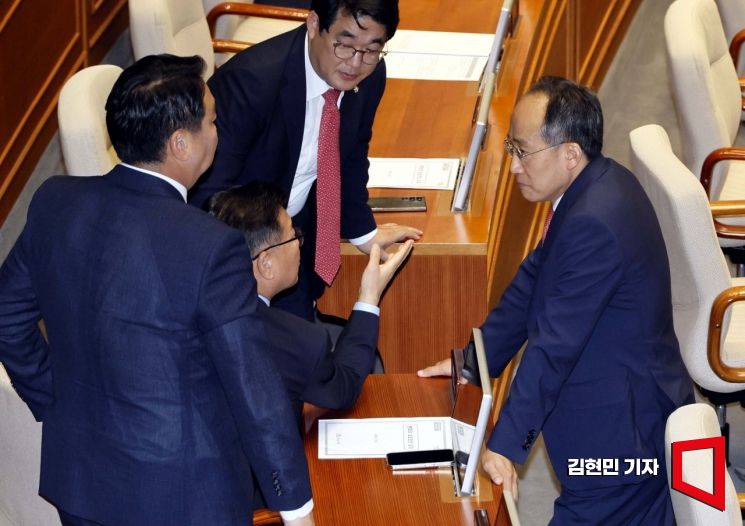 On the 28th, Choo Kyung-ho, floor leader of the People Power Party, is talking with lawmakers ahead of the vote on the "Special Prosecutor Act on Allegations of Investigation Interference in the Death Case of Marine Corporal Chaesangbyeong," which was submitted as a reconsideration agenda at the National Assembly plenary session. Photo by Kim Hyun-min kimhyun81@
So far, no one within the opposition has publicly expressed opposition to the Chae Sang-byeong Special Prosecutor Act. However, there remains the possibility that some supported pushing for a special prosecutor if the investigation results from the High-ranking Officials' Crime Investigation Office and others were deemed insufficient. Additionally, considering the intense struggles during the nomination process for the general election, it is possible that lawmakers who were excluded from nominations staged a hidden rebellion.
As a result of this vote, Choo Kyung-ho, the floor leader of the People Power Party, can claim success in enforcing party discipline. Conversely, the opposition faces the challenge of consolidating votes within both the Democratic Party and the broader opposition camp in the 22nd National Assembly due to their failure to enforce party discipline.
© The Asia Business Daily(www.asiae.co.kr). All rights reserved.
![Clutching a Stolen Dior Bag, Saying "I Hate Being Poor but Real"... The Grotesque Con of a "Human Knockoff" [Slate]](https://cwcontent.asiae.co.kr/asiaresize/183/2026021902243444107_1771435474.jpg)


















