Major ICT Bills of the 21st National Assembly Automatically Expired
Uncertain Chances of Passage in the 22nd National Assembly
ICT Industry "Only Increasing Confusion"
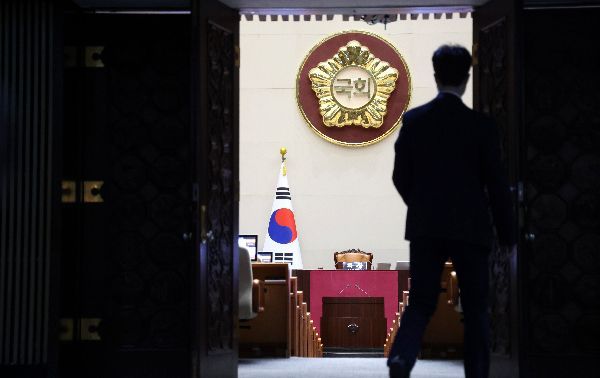 After the final plenary session of the 21st National Assembly was adjourned on the 28th, a National Assembly staff member is closing the door of the plenary hall. Photo by Kim Hyun-min kimhyun81@
As the 21st National Assembly concluded on the 29th, several bills aimed at fostering the artificial intelligence (AI) industry, including the AI Basic Act, and the so-called repeal bill of the Mobile Device Distribution Structure Improvement Act (commonly known as the Dantong Act) intended to reduce communication costs, were automatically discarded. With a series of information and communication technology (ICT) bills designed to create new industrial foundations or alter existing market competition environments being scrapped, the industry has criticized the situation for only increasing confusion.
The AI Basic Act (Act on the Promotion of the AI Industry and Establishment of a Trust-Based System) is a representative example. This bill, which was proposed in December 2022, had been pending in the National Assembly for nearly a year and a half before entering the process of being discarded. It included provisions for establishing a dedicated government organization necessary for AI industry promotion, supporting research and development (R&D), allowing priority approval for technology development, and implementing post-regulation.
In the industrial field, there are concerns that the failure to pass the AI Basic Act will cause the domestic AI industry to fall behind. This is because a mid- to long-term development plan is necessary to secure leadership in AI. From a regulatory perspective, leaving uncertainties could limit growth. An industry insider said, "To commercialize AI technology, a legal and administrative foundation is necessary. If regulations emerge later forcing services to shut down, companies will face a critical survival crossroads."
Even if discussions resume in the 22nd National Assembly, it is expected to take considerable time for the bill to pass. Among the seven lawmakers who originally proposed the bill, only Min Hyung-bae of the Democratic Party of Korea was elected to the 22nd National Assembly. Even if a new bill is proposed, it must go through bipartisan agreement and gather opinions from various sectors. Since opposition to priority approval and post-regulation was strong among civic groups when the AI Basic Act was pursued in the 21st National Assembly, similar controversies are likely to recur.
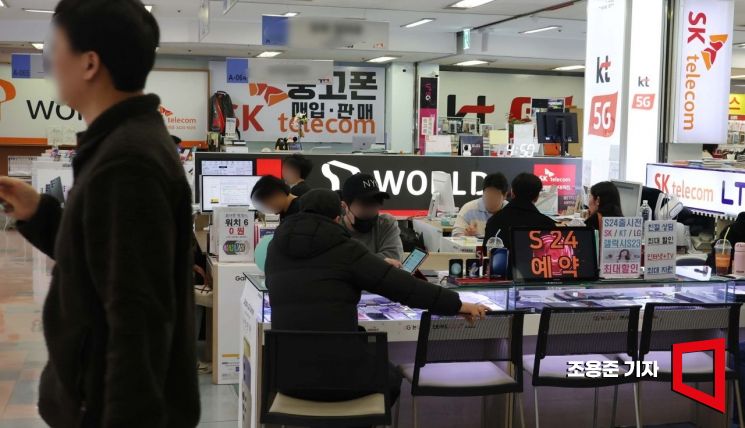 Mobile phone store related to the abolition of the Mobile Phone Special Price Protection Act. Photo by Jo Yongjun jun21@
Discussions on the Dantong Act (Act on the Improvement of the Distribution Structure of Mobile Communication Devices), which attracted attention due to its repeal after 10 years, have also returned to square one. The repeal bill aimed to remove the cap on additional subsidies to reduce consumers' burden when purchasing mobile phones. Although the government and ruling party actively pushed for it, the opposition party opposed the bill, making its passage in the 22nd National Assembly uncertain.
The industry is somewhat relieved. This is because if the Dantong Act is repealed, there is concern about the three major telecom companies entering a subsidy competition, which is burdensome. Contrary to expectations, telecom companies believe that since the mobile communication market is saturated, there is nothing to gain from a subsidy price war. They prefer to invest in new growth areas such as AI. The budget phone industry shares this view. With the emergence of a fourth telecom operator and the entry of financial institutions into the budget phone market, their position is already shrinking, and the repeal of the Dantong Act would further threaten their market share. They worry that if the three major telecom companies' marketing activities become freer, budget phone customers will defect. However, from the consumer perspective, there are criticisms that the repeal only increased confusion. It raised expectations for higher subsidies, leading consumers to postpone device replacement.
The gaming industry expresses regret over the scrapping of the amendment to the Game Industry Promotion Act. The amendment was proposed by Lee Sang-heon of the Democratic Party of Korea. It required overseas game companies that provide services in Korea but do not have a business office or address in Korea to designate a domestic agent. This was intended to establish means to sanction overseas game companies without offices in Korea if they fail to comply with rating classification procedures or neglect user protection measures.
Domestic game companies argue that the designation of domestic agents for overseas game companies should be promptly introduced as a law to resolve issues of reverse discrimination. Since March, the obligation to disclose information on probability-type items has been enforced, but overseas game companies remain outside the regulation. As the influence of overseas game companies grows, with Chinese games increasingly ranking high in domestic mobile game sales, there is a growing call to regulate them equally with domestic game companies.
© The Asia Business Daily(www.asiae.co.kr). All rights reserved.
![Clutching a Stolen Dior Bag, Saying "I Hate Being Poor but Real"... The Grotesque Con of a "Human Knockoff" [Slate]](https://cwcontent.asiae.co.kr/asiaresize/183/2026021902243444107_1771435474.jpg)

















