The government once again expressed its willingness to engage in dialogue with the medical community on the 28th.
Jeon Byeongwang, the Chief Officer of the Central Accident Response Headquarters (CARH) for the doctors' collective action, stated at the 48th CARH meeting held that day, "The government's position to engage in dialogue with the medical community regardless of the format or agenda remains unchanged," and urged, "We ask medical professionals to participate in discussions for the advancement of health care, including the referral system and regional medical expert committee meeting held today."
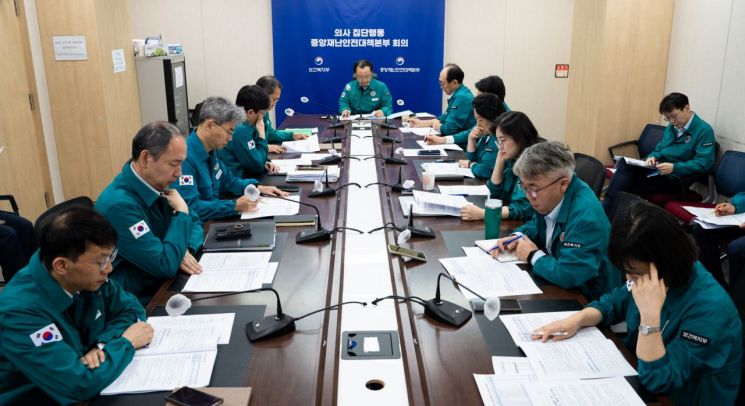
Jeon said, "Despite the emergency medical system continuing for over three months causing many inconveniences in medical use, we deeply thank the public who still support medical reform," and added, "We repeatedly express our respect and gratitude to the doctors, nurses, and frontline medical staff who fill the vacancies left by residents, quietly protect the medical field, and devote their utmost efforts to saving precious lives."
According to CARH, as of the 27th, the average number of inpatients at tertiary general hospitals was 22,704, a 6.1% decrease compared to the previous week's average. This is 68.5% of the level during the first week of February under normal conditions.
The total number of patients in all general hospitals, including tertiary general hospitals, was 88,061, a 3.7% decrease compared to the previous week, representing 91.7% of the normal level.
The number of patients admitted to intensive care units at tertiary general hospitals was 2,931, a 1.9% increase compared to the previous week, which is 88.4% of the normal level. The total number in all general hospitals was 7,255, a 2.7% increase compared to the previous week.
On the same day, among 408 emergency rooms nationwide, 391 operated without bed reductions, and 16 regional emergency medical centers displayed messages restricting treatment for some of the 27 severe emergency diseases.
Jeon said, "Based on the experience of operating the emergency medical system so far, the government is improving the division of responsibilities among emergency medical institutions so that regional emergency medical centers focus on severe cases, local emergency medical centers on moderate cases, and local emergency medical institutions on mild cases," and added, "We will continue to strengthen institutional and financial support for the emergency patient transfer and treatment cooperation system to normalize the medical referral system."
© The Asia Business Daily(www.asiae.co.kr). All rights reserved.

















