Yoon Does Not Wear Sesongi Mulmangcho Symbolizing 'Will to Resolve'
Kishida Shows Will by Wearing 'Blue Ribbon'
Presidential Office: "Once Worn, It's a Burden to Keep Wearing"
Human Rights Groups: "Clearly Neglecting Duty by Silencing Voices"
After four and a half years, the Korea-Japan-China summit was held, creating momentum for regional cooperation, but the issue of our abductees was not addressed. Criticism has arisen that President Yoon Suk-yeol missed the opportunity to show his will to resolve the issue in front of China, which has been closely aligned with North Korea, by not even wearing the 'Sesongi Mulmangcho' badge. On the other hand, Japanese Prime Minister Fumio Kishida was evaluated as showing the government's will to protect its citizens by wearing the 'Blue Ribbon.'
According to diplomatic sources on the 28th, President Yoon Suk-yeol did not wear the 'Sesongi Mulmangcho' badge at the Korea-Japan-China summit held in Seoul on the 26th and 27th. It was produced by the government in March this year to pray for the repatriation of abductees, detainees, and Korean War prisoners of war. The meaning was borrowed from the forget-me-not flower language, which means 'Please do not forget me.' At the time, President Yoon introduced it himself at a Cabinet meeting, saying, "All Cabinet members, including myself, wore a 'very special badge' on our chests," and "It contains the will to bring all abductees, detainees, and Korean War prisoners of war back to their families and the embrace of the Republic of Korea."
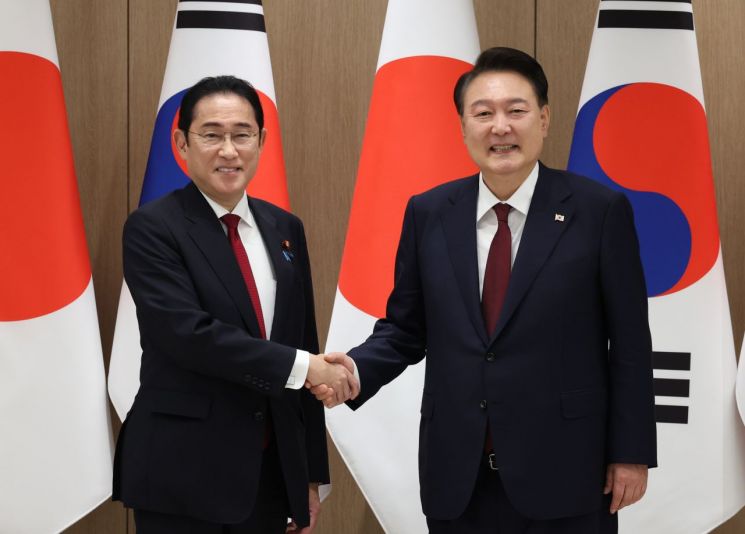 President Yoon Suk-yeol shakes hands with Japanese Prime Minister Fumio Kishida at the South Korea-Japan summit held at the Presidential Office in Yongsan, Seoul, on the 26th. [Image source=Yonhap News]
According to a compilation of Asia Economy's coverage, opinions were divided among related ministries regarding the 'badge wearing.' The Ministry of Unification proposed that the president should wear the badge during the summit schedule, but it is reported that the presidential office opposed it. A government official said, "There was an opinion that wearing the 'Sesongi Mulmangcho' badge at this summit would be meaningful, but I understand there was opposition from Yongsan," adding, "Even considering China, it was a low burden and a good opportunity to express the will to resolve the issue just by wearing the badge, so it is a regrettable point."
The Yoon Suk-yeol administration has raised 'value diplomacy' as its banner and started to raise its voice on universal values such as human rights in the international community. In North Korea policy, 'North Korean human rights' was the axis, and the government's interest in the abductees, detainees, and Korean War prisoners of war issue increased in this context. At the Korea-U.S.-Japan summit held at Camp David in August last year, the three countries' leaders confirmed a 'joint will to resolve the abductees, detainees, and Korean War prisoners of war issue.' Since then, the Ministry of Unification established an 'Abductees Task Force' directly under the minister and has continued cooperation with Japan, which faces the same issue.
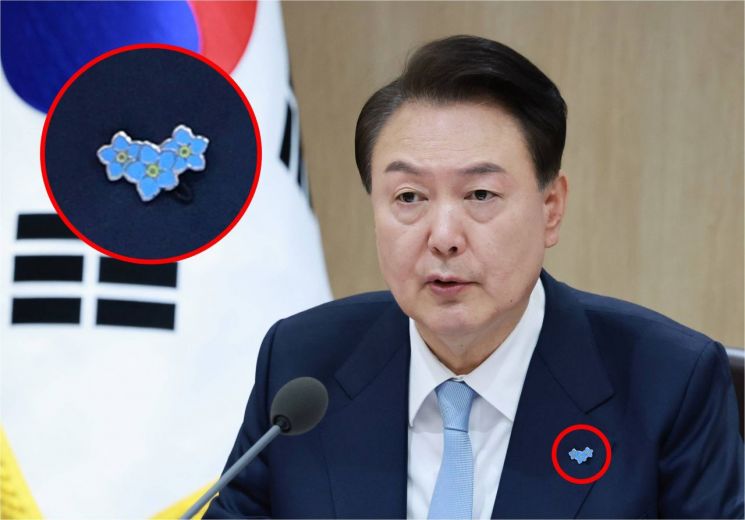 President Yoon Suk-yeol is speaking while wearing a Sesongi Forget-me-not badge at the Cabinet meeting held in March this year at the Yongsan Presidential Office building in Seoul.
Expectations grew that our abductees issue, like Japan's, would be explicitly mentioned in the joint declaration of this Korea-Japan-China summit. However, criticism has emerged that not only did President Yoon not wear the badge or mention the related issue, but the content also 'regressed.'
The joint declarations announced at the summits held in Tokyo, Japan, and Chengdu, China, in 2018 and 2019 respectively, included the issue of 'Japanese abductees by North Korea.' It explicitly stated that the leaders of Korea and China hoped to resolve the issue. However, there was no mention of our citizens. This time, the perpetrator North Korea was not specified, and it only stated that 'each side reaffirmed their stance on the abductees issue.'
A senior official from the presidential office said, "Prime Minister Kishida always wears it on overseas schedules, but if we wear it once and it becomes a mark, there is a burden to wear it every time," adding, "It was an unfamiliar principle in our diplomacy, so it was awkward to suddenly wear it." He added, "I agree with the intention, but since it is a South-North relationship (not North Korea and foreign relations like Japan), wouldn't it be awkward to wear it at every global diplomatic event?"
Shin Hee-seok, a legal analyst at the Transitional Justice Working Group (TJWG), pointed out, "Urging the repatriation of our citizens held by North Korea is a basic duty of the state." He continued, "Families of abductees, detainees, and Korean War prisoners of war also know that resolving the issue with North Korea is not easy," and criticized, "What tears their hearts apart is the government's dereliction of duty, which does not even show the minimum consistent diplomatic effort and determination to speak out."
'Blue Ribbon' Worn on the Chests of Japanese Politicians
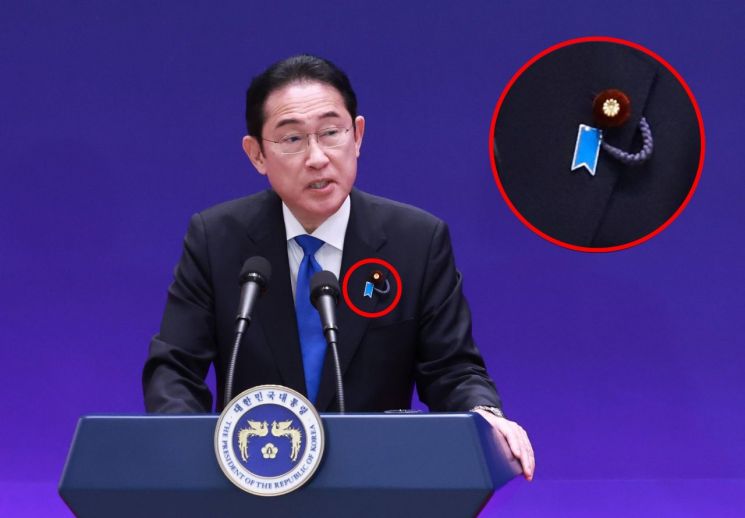 Japanese Prime Minister Fumio Kishida is speaking at the joint press conference of the 9th Korea-Japan-China Summit held at the Blue House State Guest House on the 27th. Prime Minister Kishida is wearing a 'Blue Ribbon' badge on his lapel.
Prime Minister Kishida appeared again wearing the 'Blue Ribbon' badge on his suit lapel. He also wore this badge when he visited the National Seoul Memorial Cemetery during his visit to Korea last year. This badge symbolizes the issue of 'Japanese abductees' by North Korea and was created by civic groups. The trigger was when Kim Jong-il, then Chairman of the National Defense Commission of North Korea, admitted the abduction of Japanese citizens to then Japanese Prime Minister Junichiro Koizumi in 2002. The blue color represents the abductees, their families, and the Japanese people looking at the blue sky and sea connecting Japan and North Korea, waiting for 'reunion.'
The issue of Japanese abductees came to light with the 'Megumi Yokota' case. In November 1977, Megumi, then 13 years old, disappeared on her way home from school. Twenty years later, in 1997, it was first revealed by defectors that she and many other Japanese were detained in North Korea. North Korea claimed she was hospitalized for mental illness in 1993 and committed suicide, but according to victim testimonies, she was still alive in 1994. The Japanese government has not ruled out the possibility of her survival and continues to urge repatriation, with the 'Blue Ribbon' being a representative symbol.
A source close to Japan said, "In Japan, this badge is called the 'Blue Ribbon,' and politicians wearing it means they are determined not to forget the abductees issue and urge the release of Japanese detainees in North Korea," adding, "Not only the prime minister but all cabinet ministers wear this badge at official events, and this principle was the same during the administrations of former Prime Ministers Yoshihide Suga and Shinzo Abe."
© The Asia Business Daily(www.asiae.co.kr). All rights reserved.
!["I'd Rather Live as a Glamorous Fake Than as a Poor Real Me"...A Grotesque Success Story Shaking the Korean Psyche [Slate]](https://cwcontent.asiae.co.kr/asiaresize/183/2026021902243444107_1771435474.jpg)


















