"Let's Create a Korea-Japan-China Civil Cooperation Platform"
"A Cooperative Body Like the EU" Emphasized Repeatedly
Market Expansion, Social and Economic Problem Solving
Choi Tae-won, chairman of SK Group and the Korea Chamber of Commerce and Industry, has officially proposed the establishment of a cooperation platform among South Korea, Japan, and China on a private sector level, drawing attention to his long-standing idea of uniting Northeast Asia into an "economic cooperation body."
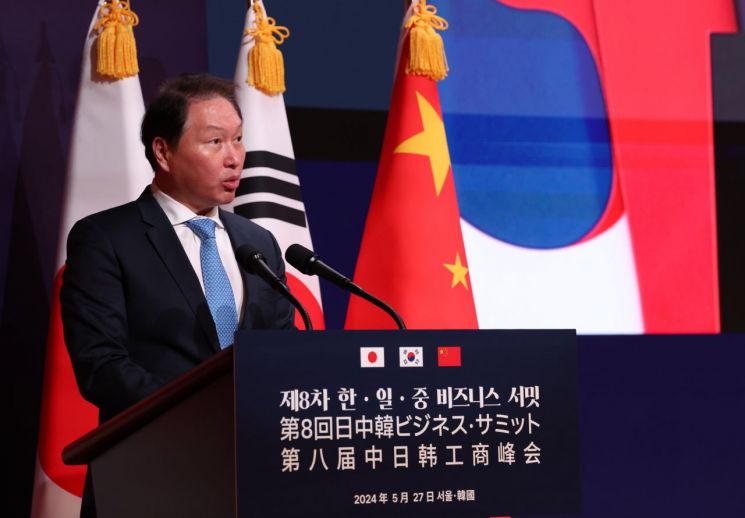 Choi Tae-won, Chairman of the Korea Chamber of Commerce and Industry, is reporting on the discussions of the economic organizations of the three countries at the 8th Korea-Japan-China Business Summit held on the 27th at the Korea Chamber of Commerce and Industry in Jung-gu, Seoul. [Image source=Yonhap News]
According to the business community on the 28th, Chairman Choi officially proposed the "formation of a trilateral cooperation platform at the private sector level" at the 8th Korea-Japan-China Business Summit held on the 27th at the Korea Chamber of Commerce and Industry in Jung-gu, Seoul. His platform proposal aims to foster cooperation across economic and social sectors on a private level.
His suggestion stood out at the event attended by the heads of major economic organizations from South Korea, Japan, and China because he has consistently advocated this idea since the end of the COVID-19 pandemic in May last year.
Chairman Choi has repeatedly emphasized that Northeast Asia should create a cooperative body similar to the European Union (EU), which integrates politics, society, and economy among major European countries. He views cooperation as a stepping stone toward integration. Through this integration, the overall economic scale would expand, and the market where companies operate would also broaden, enabling the three countries to jointly address social and economic issues they currently face. For example, South Korea’s low birth rate is causing a rapid decline in future population, which could lead to a significant reduction in consumers?the target of corporate business activities?in the market. If South Korea, Japan, and China integrate their economies, the number of consumers available for business operations would expand across the three countries. At a press conference earlier this month following his reappointment as chairman of the Korea Chamber of Commerce and Industry, Choi stressed, "If our society continues on the path it has taken in the past, we need to reconsider the question, ‘Is this Republic of Korea really okay?’" He implied that the current situation, where the three countries are each fending for themselves, cannot solve these problems.
Chairman Choi appears to be increasing engagement with Japan more than with China. It is reported that he believes Japan would be a slightly better partner for integration, as there is a sense of social and cultural affinity and economic parity that allows for envisioning integration on equal footing. However, there are many issues outside the economy that need to be resolved with Japan, such as differing views on history and the Dokdo territorial dispute. Recently, anti-Japanese sentiment has intensified following allegations of Japanese government intervention in the incident where Yahoo Japan demanded Naver sell its stake in Line.
In December last year, at the 2023 Trans-Pacific Dialogue held at the Choi Jong-hyun Academic Institute, Chairman Choi stated, "South Korea and Japan have benefited greatly from the World Trade Organization (WTO) system, but now those benefits are disappearing, and China, once a large market, has become a strong competitor." He emphasized, "In this situation, cooperation between South Korea and Japan can be the solution to overcome these challenges." On the 23rd, at the ‘Future of Asia’ forum hosted by Nihon Keizai Shimbun (Nikkei) in Tokyo, he said, "Cooperation between South Korea and Japan is not a choice but a necessity."
© The Asia Business Daily(www.asiae.co.kr). All rights reserved.

















