"Government Should Engage in Dialogue with Medical Community and Hold at Least Minimal Consultations"
"Some Non-Essential Medical Residents in Dermatology and Plastic Surgery Show Signs of Returning"
"Many Residents in Essential Medical Fields Like Internal Medicine and Emergency Medicine Have Completely Given Up Training"
It has been nearly 100 days since residents left hospitals in protest against the government's increase in medical school admissions, but they have not returned. Most of the residents who resigned are reportedly not considering returning, with the return of residents in essential medical specialties particularly uncertain. The resigned residents maintain that nothing has changed since February when they left, insisting on the need for a complete re-discussion.
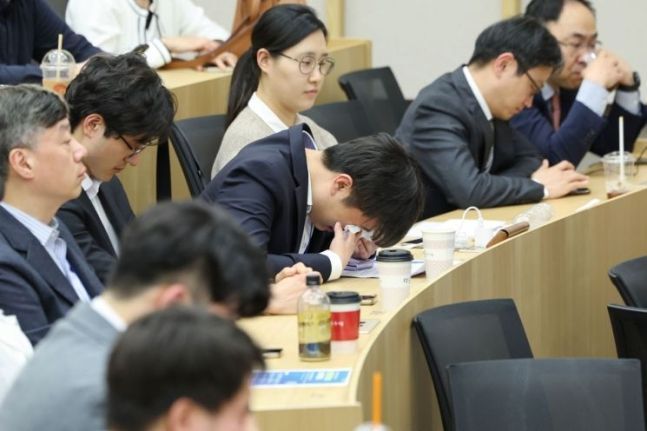 On the afternoon of April 30, Park Jae-il, the representative resident of Seoul National University Hospital, who attended the emergency symposium of the Seoul National University College of Medicine-Seoul National University Hospital Faculty Council Emergency Committee held at CheilJedang Hall of Seoul National University Hospital, is shedding tears after finishing his presentation on behalf of the residents.
 [Image source=Yonhap News]
As of the 30th, it marks the 100th day since residents at training hospitals nationwide left their posts on February 20th in protest against the government's increase in medical school admissions. However, fewer than one in ten residents have returned to the hospitals. According to the Ministry of Health and Welfare, as of the 23rd, only 839 out of 10,501 residents at 211 training hospitals were attending work (attendance rate of 8.0%). Among these, the attendance rate at 100 major training hospitals, where most residents are affiliated, is even lower at 6.8% (675 out of 9,991 residents).
The resigned residents continue to insist on a complete re-discussion and are not considering returning. Jung Geun-young, the resident representative at Bundang CHA Hospital, said, "I do not believe that the increase in medical school admissions, decided solely by government departments without consultation with the medical community, is final." He added, "Nothing has changed since we individually resigned in February, so there is no reason to return. Our position of demanding a complete re-discussion remains unchanged." He continued, "While some residents who are economically struggling due to long-term resignation, such as those working day labor jobs, may have no choice but to return, most insist that the government must engage in dialogue and at least conduct consultations with the medical community before they consider returning."
Resident A, who resigned, said, "If the government wants to have a dialogue, they need to show something, but they are proceeding with the medical school increase process while only verbally asking us to return. How can we go back under these circumstances?" He added, "We are not particularly concerned. Compared to before the approval by the Korean Association of Medical Colleges, residents have not been swayed or changed their stance."
Lee Byung-chul, a legal representative for the medical community from the law firm Chanjong, also said, "The biggest concern is that the residents will ultimately not return." He added, "When preparing for litigation and talking with residents, many expressed that they have no intention of returning. Even if the lawsuit had been accepted, many said they would not have returned."
However, it was also reported that a small number of residents in non-essential medical specialties are considering returning. Resident A explained, "Residents in essential medical specialties are firmly opposed to returning to the government, but some residents in dermatology and plastic surgery want to go back." Representative Jung also said, "The overall trend of not returning has not changed. However, since resignations were submitted based on individual decisions, returning is also a personal choice and I think there is no problem with that."
On the other hand, most residents in essential medical specialties appear to be firmly refusing to return. Representative Jung said, "When talking with various residents, many in core essential medical specialties such as internal medicine have given up their training entirely." He added, "If they quit permanently, it will inevitably cause a serious problem."
Kim In-byung, chairman of the Korean Society of Emergency Medicine and director of the Regional Emergency Medical Center at Myongji Hospital, also said, "I think less than half of the emergency medicine residents will return." He explained, "When talking with residents, first- and second-year residents have little intention of returning, and even among senior residents, some have decided not to return." He added, "With the current staffing situation, it is impossible to maintain the emergency room. The number of residents leaving must be matched by those entering, but it seems there will be no new residents even next year."
© The Asia Business Daily(www.asiae.co.kr). All rights reserved.
![Clutching a Stolen Dior Bag, Saying "I Hate Being Poor but Real"... The Grotesque Con of a "Human Knockoff" [Slate]](https://cwcontent.asiae.co.kr/asiaresize/183/2026021902243444107_1771435474.jpg)
















