"Significant Changes in Trilateral Relations Over the Past 4 Years"
"Yet Still Complementary... Cooperation Must Be Expanded"
As the Korea-Japan-China summit resumed after four years, Chinese state media evaluated that the meeting brought significant progress in trilateral and Korea-China bilateral relations. They also assessed that impactful outcomes such as the regular holding of summits and acceleration of Free Trade Agreement (FTA) negotiations were achieved.
On the 27th, the Chinese state media outlet Global Times commented on the Korea-Japan-China summit, stating that "cooperation has been revived." The Global Times reported, "Although there were external voices deliberately trying to lower expectations, the achievements and ripple effects from this meeting were very significant," emphasizing, "In addition to trilateral achievements, considerable progress was also made at the bilateral level."
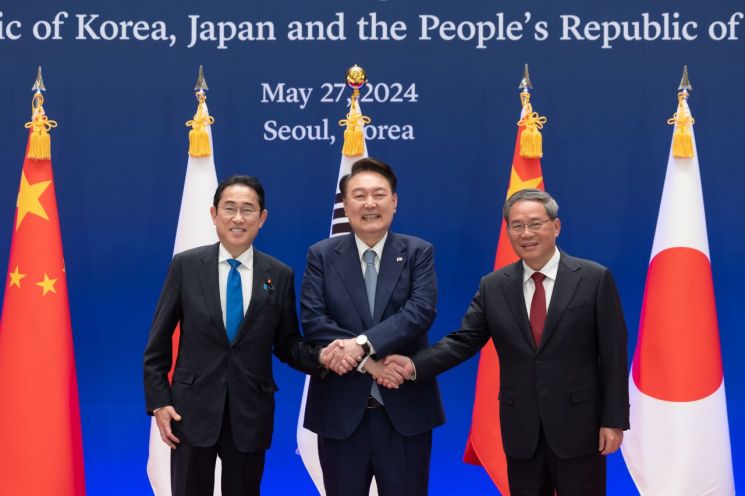
It further mentioned the acceleration of the second phase of Korea-China FTA negotiations and the establishment of a high-level consultative body for diplomatic and security dialogue, explaining, "These are all fruits borne within the framework of the summit," and "This meeting reflected the three countries' will to develop relations through practical cooperation." It also noted, "Some U.S. media frankly evaluated this summit by saying, 'U.S. allies must manage their own interests.'"
The Global Times stressed, "From a geopolitical perspective, especially as the U.S. strengthens efforts to rally alliances against China, this meeting plays a greater role in stabilizing bilateral and trilateral relations," and added, "From the viewpoint of safeguarding the common interests of the three countries and addressing shared challenges, this meeting demonstrated a strong foundation for cooperation and vast potential."
Moreover, it acknowledged, "It cannot be denied that there have been many changes among China, Japan, and Korea over the past four years," pointing out, "In economic terms, trade that was once complementary has become more competitive, and on a cognitive level, some follow the U.S. view of seeing China more as a competitor than a partner."
It further explained, "More important than the changes themselves is how these changes are perceived," citing China and Korea as examples: "As China's industrial competitiveness rises, competition between the two countries has intensified. However, it is also important to recognize that strong trade complementarities still exist in sectors such as electronics, new energy, and advanced manufacturing." The Global Times argued, "If the recent emerging industry FTA negotiations are upgraded with new regulations, industrial cooperation between the two countries will expand further, continuously generating benefits for Korea-China economic and trade cooperation."
It repeatedly emphasized that although Korea and Japan have established strong cooperative relations with the U.S., they remain "neighboring countries" that cannot be changed and are interdependent. The Global Times stressed, "China, Japan, and Korea are immovable neighboring countries that are interdependent in terms of regional peace and stability, economic development, and prosperity," adding, "Despite ongoing U.S.-led actions and noise such as 'decoupling' from China, building 'small yards with high fences,' and 'reducing dependence on China for economic security,' China remains the largest trading partner of both Japan and Korea."
© The Asia Business Daily(www.asiae.co.kr). All rights reserved.
![Clutching a Stolen Dior Bag, Saying "I Hate Being Poor but Real"... The Grotesque Con of a "Human Knockoff" [Slate]](https://cwcontent.asiae.co.kr/asiaresize/183/2026021902243444107_1771435474.jpg)











