Samsung Electronics Former Vice President An Seung-ho
Acquired 'Samsung Patent Secrets'
Conspired with Former Subordinate Insider
Before Filing Patent Infringement Lawsuit
Revealed in Korean Prosecutors' Investigation
In the patent infringement lawsuit filed by former Samsung Electronics Vice President Seungho Ahn, who was once Samsung's "patent chief," against his former employer Samsung Electronics in collaboration with the patent troll (NPE) known as "Stayton Tekiya," the Korean prosecution's discovery of call records on Ahn's mobile phone played a "smoking gun" role in Samsung's victory. The call records revealed that before filing the patent infringement lawsuit, Ahn colluded with an insider at Samsung Electronics to unlawfully obtain "Samsung's privileged confidential information," specifically internal documents related to the patent dispute with Tekiya. The U.S. court found that Ahn and Tekiya used this evidence in the patent infringement lawsuit against Samsung.
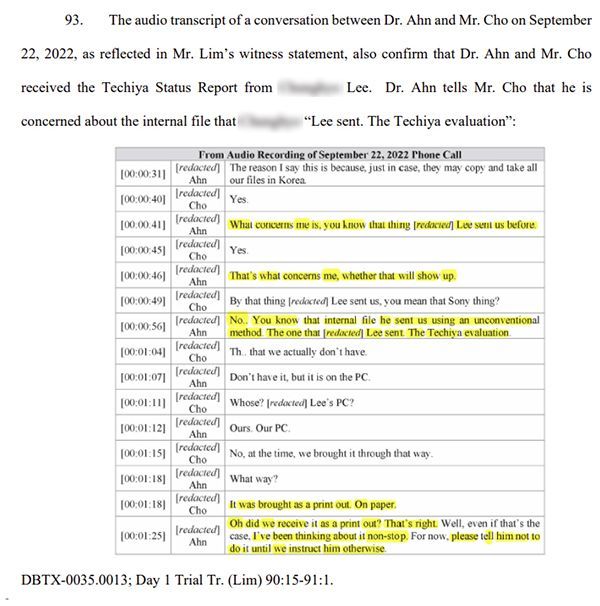 The phone conversation between former Vice President Ahn Seung-ho and former Samsung Electronics senior counsel Cho, as stated in the ruling of the U.S. Federal Eastern District Court of Texas. Samsung employee Lee admitted to leaking Samsung's confidential information to them. [Image source=Legal News]
How the Prosecution-Seized 'Seungho Ahn's Mobile Phone Call Records' Were Presented to the U.S. Court
On the 9th (local time), U.S. Federal Eastern District of Texas Judge Rodney Gilstrap ruled that former Vice President Ahn had illegally stolen Samsung's confidential information to file the patent lawsuit. Judge Gilstrap stated, "The 'Tekiya status report' stolen by Ahn contains Samsung's comprehensive strategy related to the Tekiya lawsuit and is one of the most critical documents determining the outcome of the case."
Ahn, who served as Samsung's first global IP (intellectual property) center head, oversaw Samsung's IP operations, including patent development and litigation supervision. After resigning from Samsung in 2019, he founded the patent management company Synergy IP and suddenly filed a patent infringement lawsuit against Samsung Electronics in November 2021. The claim was that Samsung Electronics had unlawfully used about ten patents held by Tekiya, including audio recording devices, in wireless earbuds such as the Galaxy Buds.
In response, Samsung Electronics filed a counterclaim in February 2022, accusing Synergy IP and Tekiya of misappropriating Samsung's trade secrets. Following Samsung's complaint, the Korean prosecution launched an investigation into Ahn and former senior official Jomo Cho, who was responsible for IP management at Samsung Electronics.
According to the judgment obtained by Legal Times, the Seoul Central District Prosecutors' Office began a full-scale investigation in the second half of last year by summoning Ahn and Cho for questioning. Forensically examining Ahn's mobile phone, the prosecution discovered that just before filing the patent infringement lawsuit, Ahn had a phone conversation with Cho in which they referenced documents containing Samsung Electronics' internal confidential information about Tekiya's patents. The person who leaked Samsung's confidential information to the two was an employee named Im, who was working at Samsung at the time.
According to the call transcripts secured by the prosecution, during a call with Cho on September 22, 2022, Ahn expressed concerns about the Tekiya-related files sent by Im, saying, "What gets caught is the stuff Im sent a long time ago," "The internal documents that Im strangely sent back then, the Tekiya evaluation," "(We don't have it, but) it should be on the PC," and "Oh, did you print it out and receive it?"
Samsung learned of the existence of this evidence while attending an investigation as a complainant in late November last year. The prosecution presented the call records between Ahn and Cho to Samsung during the investigation. Samsung submitted a motion to the court compelling Ahn and Cho to secure and submit the call records, documents, and other evidence held by the Korean prosecution to the U.S. court. After obtaining copies of witness statements from the prosecution, Samsung also submitted the Tekiya-related documents mentioned in those statements to the U.S. court. Samsung argued to the court that "the use of Samsung's privileged confidential information by Ahn and Cho irreversibly contaminated the case" and requested the dismissal of claims by Synergy IP and Tekiya.
Samsung also persuaded the U.S. court that the statements and evidence obtained by the Korean prosecution through investigation were ① trustworthy and ② public records. A lawyer with extensive experience attending Korean prosecution witness investigations testified in court, explaining that the witness investigations and prosecution-prepared statements are "standard procedures constituting Korea's investigative process."
The U.S. Court's Ruling...
The court accepted Samsung's arguments, ruling that the Korean prosecution's statements met the evidentiary requirements under the Federal Rules of Evidence. The court stated, "The transcripts and other evidence included in the prosecution's statements constitute 'factual findings' under the Federal Rules of Evidence," thereby recognizing the evidentiary value of the evidence obtained through the Korean prosecution's investigation. The court also acknowledged that "both Ahn and Cho, currently under prosecution in Korea, reside in Korea, not the U.S., and are refusing to testify regarding the investigation, so Samsung could not secure their trial attendance or testimony in the U.S. court," explaining why Samsung had to submit their call records and other evidence obtained through the Korean prosecution as evidence.
The court concluded that "Samsung clearly and convincingly proved the essential elements of the unclean hands defense" and ruled that the patents claimed by Tekiya were "unenforceable due to unclean hands" because they were obtained through wrongful conduct. The "unclean hands doctrine" means "the court's doors are closed to one tainted with inequity or bad faith."
The court criticized Ahn and Cho for violating their ethical duties as attorneys. It pointed out, "The evidence showing that Ahn and Cho attempted to use privileged confidential information in litigation demonstrates that the patent claims and public records were contaminated by Samsung's attorney-client privileged information, causing Samsung irreparable harm." The court ordered that the judgment be forwarded to the ethics committees of the California and New York State Bar Associations, where Ahn and Cho are licensed attorneys.
Both individuals, licensed U.S. attorneys, graduated from U.S. law schools with Samsung's support during their tenure at Samsung Electronics.
Hong Yoonji, Legal Times Reporter
※This article is based on content supplied by Law Times.
© The Asia Business Daily(www.asiae.co.kr). All rights reserved.
!["The Woman Who Threw Herself into the Water Clutching a Stolen Dior Bag"...A Grotesque Success Story That Shakes the Korean Psyche [Slate]](https://cwcontent.asiae.co.kr/asiaresize/183/2026021902243444107_1771435474.jpg)
















