60% of All Cases Closed... Truth Verification Decisions at 46.8%
The 2nd Truth and Reconciliation Commission for Past Affairs (Truth and Reconciliation Commission), which marked the 3rd anniversary of the start of its investigation, announced its achievements so far. However, it emphasized the need for institutionalization to enable effective compensation for victims and continued research on historical incidents that have not received sufficient attention.
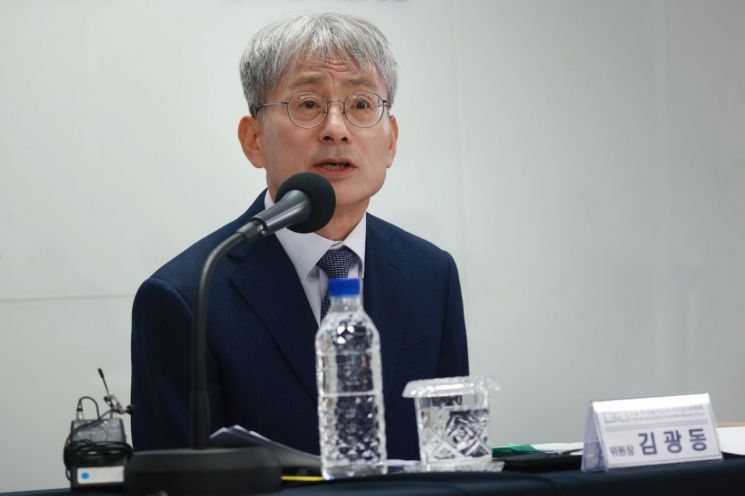 On the morning of the 27th, Chairman Kim Kwang-dong is speaking at the 3rd anniversary press conference of the Truth and Reconciliation Commission held at the Truth and Reconciliation Commission for Past Affairs in Jung-gu, Seoul.
 [Image source=Yonhap News]
At around 10:30 a.m. on the 27th, the Truth and Reconciliation Commission held a '3rd Anniversary Press Conference' at the Namsan Square Building in Jung-gu, Seoul. Chairman Kim Gwang-dong, Standing Commissioner Lee Ok-nam, and Standing Commissioner Lee Sang-hoon participated in the conference.
The 2nd Truth and Reconciliation Commission received 20,245 applications for past incidents from its launch date on December 10, 2020, until December 31 of last year. Including cases investigated ex officio, the total number of cases to be processed as of the 27th was 20,632, of which 12,143 cases (60%) were closed. This figure exceeds the case processing rate (57%) projected at the 2nd anniversary conference.
Among these, 5,670 cases (46.8%) were determined to have been truthfully clarified, while 5,880 cases (48.1%) were withdrawn, dismissed, or transferred. Of the total seven cases investigated ex officio by the Truth and Reconciliation Commission, one case was fully resolved.
Chairman Kim said, "Since the start of the investigation, a significant achievement has been that seven people were recognized as independence patriots by the Ministry of Patriots and Veterans Affairs through the truth verification of the anti-Japanese independence movement, and compensation or retrial decisions were made for the Samcheong education victim cases and the human rights violation cases of abducted and returned fishermen."
He added, "In the remaining year, we will accelerate case processing and open the path for restoring the honor of victims and providing relief through truth verification."
Among the tasks to be pursued during the remaining period, he cited the formation of a compensation review committee and the enactment of a comprehensive compensation and relief law. He also emphasized that the enactment of the Truth and Reconciliation Foundation Act is an essential task to ensure continuous research and reconciliation measures on historical incidents even after activities end in May next year. The Truth and Reconciliation Commission's activity period is three years from the start of the investigation, and the investigation period was extended by one year until May 26 next year.
Chairman Kim said, "Even if the truth has been verified, victims are in a situation where they must seek relief through individual lawsuits against the state," and added, "We are pushing for the enactment of a comprehensive compensation law because we judge it to be urgent for establishing the effectiveness and fairness of victim relief."
Additionally, the Truth and Reconciliation Commission plans to review unresolved cases such as human rights violations during overseas adoption processes during the remaining period. The first investigation results related to these cases are scheduled to be announced in the second half of this year.
Meanwhile, regarding the decision to withhold recognition of some victims' harm in the 'Civilian Casualty Incident by Jindo Military and Police,' the Truth and Reconciliation Commission stated, "(The Commission) has an obligation to distinguish whether the victims were civilians to be protected or individuals who participated in invading hostile forces," and added, "We are making every effort to examine this part."
The civilian casualty incident by Jindo military and police refers to an incident during the Korean War period from 1950 to 1951, in which residents of Jindo-gun, Jeollanam-do, were killed by the police on suspicion of collaborating with North Korean forces during their occupation. Among them, some victims were listed as 'assassination squad members' in the 'List of Those Killed and Their Family Status' prepared by the Jindo Police Station in 1969, which became an issue leading to the withholding of truth verification.
© The Asia Business Daily(www.asiae.co.kr). All rights reserved.

![Clutching a Stolen Dior Bag, Saying "I Hate Being Poor but Real"... The Grotesque Con of a "Human Knockoff" [Slate]](https://cwcontent.asiae.co.kr/asiaresize/183/2026021902243444107_1771435474.jpg)















